What Is Underwriting and Why Does It Take So Long?
August 21, 2026

August 21, 2026
One of the questions I hear from buyers most often after they've found a home is,
"We've already been pre-approved. Why is the lender asking for more paperwork?"
If you've ever felt that way, you're not alone.
Many buyers think a mortgage is fully approved once they receive a pre-approval letter.
Here's the thing.
A pre-approval is an important first step, but it isn't the final step.
Before your loan can close, it typically goes through a process called underwriting.
If you're buying a home in Paso Robles, Templeton, Atascadero, San Miguel, or anywhere in San Luis Obispo County, understanding underwriting can help you know what to expect and why your lender may request additional information along the way.
Over the past 13+ years, I've found that buyers worry much less about underwriting once they understand what the underwriter is actually doing. My goal is to explain the process in plain English so you can move through it with confidence instead of wondering what's happening behind the scenes.
Before we get started, I also recommend reading my article, "What Is a Mortgage Pre-Approval and Why Should I Get One?" A pre-approval helps you understand your budget before you start shopping, while underwriting is the process that helps move your loan from approval toward closing.
What Is Underwriting?
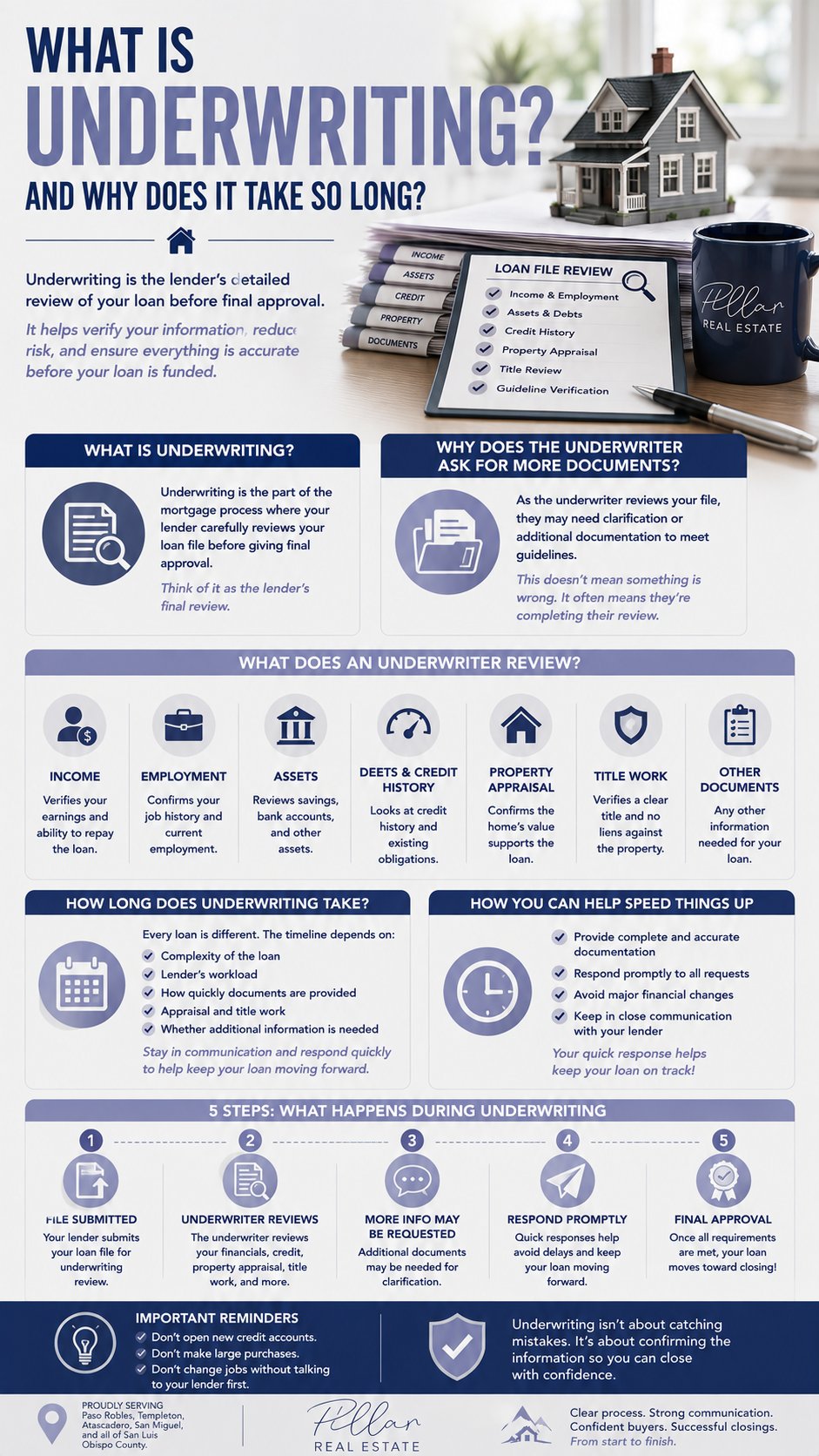
Underwriting is the part of the mortgage process where your lender carefully reviews your loan file before giving final approval.
Think of it as the lender's final review.
The underwriter looks at the information you've provided to confirm that your loan meets the lender's guidelines.
It's a detailed process that's designed to reduce risk and make sure everything is accurate before the loan is funded.
What Does an Underwriter Review?
Every loan is different, but an underwriter commonly reviews information such as:
The goal isn't to make the process difficult.
It's to verify the information that's already been provided.
Why Does the Underwriter Ask for More Documents?
This is probably the question I hear most often.
Many buyers feel like they've already submitted everything.
Then another request arrives.
In many cases, that's completely normal.
As the underwriter reviews your file, they may need clarification or additional documentation to satisfy a particular requirement.
That doesn't automatically mean something is wrong.
It often means they're completing their review.
Responding quickly to those requests is one of the best ways to help keep your loan moving forward.
How Long Does Underwriting Take?
Every transaction is different.
The timeline depends on several factors, including the complexity of the loan, the lender's workload, how quickly requested documents are provided, and whether additional information is needed.
Some files move through underwriting quickly.
Others take longer.
The important thing is to stay in communication with your lender and respond promptly if additional documentation is requested.
Can I Do Anything to Help the Process?
Yes.
One of the best things you can do is provide complete and accurate documentation as quickly as possible.
If your lender asks for an updated pay stub, bank statement, or explanation of a financial transaction, responding promptly can help prevent unnecessary delays.
It's also a good idea to avoid making major financial changes while your loan is being processed unless you've discussed them with your lender first.
What I'm Seeing
I've found that underwriting feels stressful mainly because buyers can't see what's happening behind the scenes.
It can feel like you're waiting without knowing why.
Once buyers understand that underwriting is simply a careful review designed to move the loan safely toward closing, the process becomes much less intimidating.
Instead of wondering why another document is needed, they understand it's often just one more step toward getting the keys to their new home.
From start to finish.
A Real-Life Example
I was working with buyers who had already been pre-approved and had their offer accepted.
Everything seemed to be moving along smoothly.
Then they received an email from their lender asking for updated bank statements and another recent pay stub.
Their first reaction was,
"Didn't we already send all of this?"
The answer was yes.
But underwriting is a detailed review, and sometimes the underwriter needs updated information or clarification before issuing final approval.
The buyers responded quickly, submitted the requested documents, and their loan continued moving toward closing without any issues.
By the end of the transaction, they told me the underwriting process wasn't nearly as stressful as they expected once they understood why those requests were being made.
That's a conversation I've had many times over the years.
The Biggest Mistake
The biggest mistake I see is assuming you're finished with paperwork after you're pre-approved.
Pre-approval gets the process started.
Underwriting helps get you to the finish line.
Another common mistake is making major financial changes while your loan is in underwriting.
For example, buyers sometimes:
If you're thinking about making a financial change during escrow, it's always a good idea to talk with your lender first.
A quick conversation today can prevent unnecessary complications later.
What This Process Should Feel Like
When your loan enters underwriting, I don't want you to feel like you're being tested.
I want you to understand what's happening.
By this point, you should know:
Once you understand the purpose of underwriting, those document requests usually feel much less overwhelming.
How This Connects to the Bigger Picture
Earlier, I wrote about "What Is a Mortgage Pre-Approval and Why Should I Get One?"
That article explains how pre-approval helps you understand your buying power before you start shopping for a home.
Underwriting comes later.
It's the detailed review that takes place after you've found a home and applied for your mortgage.
Together, these two steps help move your loan from preparation to final approval.
Next, we'll continue our financing series with another important topic:
What Is Debt-to-Income Ratio (DTI) and Why Does It Matter?
Steps: What Happens During Underwriting?
Step 1: Your Loan File Is Submitted
Once you're under contract and your lender has the required documentation, your loan file is submitted for underwriting.
Step 2: The Underwriter Reviews Your Information
The underwriter reviews your income, employment, assets, debts, credit history, appraisal, title work, and other information related to your loan.
Step 3: Additional Information May Be Requested
If clarification or updated documentation is needed, your lender will let you know.
This is a normal part of the process for many buyers.
Step 4: Respond Promptly
One of the best ways to help your loan move smoothly is to provide requested documents as quickly as possible.
Keeping in close communication with your lender can also help avoid unnecessary delays.
Step 5: Final Approval
Once the underwriting requirements have been satisfied, your loan can move toward final approval and closing.
So... What Is Underwriting?
Underwriting is the lender's detailed review of your loan before it's finalized.
It's designed to verify the information in your loan file and confirm that the loan meets the lender's guidelines.
Although it can feel like a lot of paperwork, underwriting is one of the final steps that helps move you toward becoming a homeowner.
The Best Loan Experiences Start With Good Communication
Over the past 13+ years, I've found that buyers are much more relaxed when they know what to expect.
Underwriting doesn't have to feel mysterious.
When you understand why documents are requested, respond promptly, and stay in communication with your lender, the process becomes much easier to navigate.
That's exactly how I want every buyer to feel.
Prepared.
Confident.
And ready for the next step.
From start to finish.
The Real Question to Ask
Instead of asking:
"Why do they keep asking for more paperwork?"
Ask:
"What information does my lender still need to move my loan toward final approval?"
That's the question that helps you work with your lender instead of feeling frustrated by the process.
Next Steps
If you're planning to buy a home in Paso Robles, Templeton, Atascadero, San Miguel, or anywhere in San Luis Obispo County, I'd be happy to help you understand every step of the financing process before you reach the closing table.
I also recommend reading my article, "What Is a Mortgage Pre-Approval and Why Should I Get One?" Understanding the difference between pre-approval and underwriting gives you a much clearer picture of how your loan progresses from your first conversation with a lender to closing.
When you're ready to begin your home search, visit:
👉 https://pillarrealestate.com/buying
My goal is to help you understand the process, answer your questions honestly, and help you make informed decisions from your first showing through closing.
From start to finish.
FAQ
What is underwriting?
Underwriting is the process where your lender reviews your loan application, financial information, and supporting documents before giving final approval for your mortgage.
Is underwriting the same as pre-approval?
No. A pre-approval is an early evaluation of your financial situation that helps you understand your buying power. Underwriting is a more detailed review that takes place after you've applied for a mortgage on a specific property.
Why does the underwriter ask for more documents?
It's common for an underwriter to request updated or additional documentation while reviewing your file. In many cases, they're simply verifying information or requesting clarification before issuing final approval.
How long does underwriting take?
Every loan is different. The timeline depends on factors such as the complexity of the loan, the lender's workload, the appraisal, and how quickly requested documents are provided.
Can I make major financial changes during underwriting?
It's usually best to talk with your lender before opening new credit accounts, financing a vehicle, changing jobs, or making large financial moves while your loan is in underwriting.
What can I do to help my loan move through underwriting?
Respond to document requests promptly, provide complete and accurate information, and stay in communication with your lender throughout the process.
Does underwriting mean there's a problem with my loan?
Not at all. Underwriting is a standard part of the mortgage process. Most buyers go through it, and requests for additional information are often a normal part of completing the lender's review.
Amber Johnson, Founder
Pillar Real Estate
805.835.3425
[email protected]
1345 Park St. Paso Robles, CA 93446
DRE# 01925434

Amber Johnson | October 25, 2026
Set buyer expectations with accurate positioning, thoughtful presentation and firsthand checks at different times of day.

Amber Johnson | October 24, 2026

Amber Johnson | October 21, 2026

Amber Johnson | October 21, 2026

Amber Johnson | October 21, 2026
Check privacy, shared-space rules and activity near the unit before deciding whether courtyard-facing condo living suits you.

Amber Johnson | October 20, 2026
Review the stove, venting, documentation and insurance questions before treating wood heat as a benefit of the purchase.

Amber Johnson | October 20, 2026
Test the routes to your actual errands, what you need to carry and your backup options before choosing a home around cycling.

Amber Johnson | October 20, 2026
Compare these two Morro Bay areas through the specific homes, daily routes and property features that matter to your household.

Amber Johnson | October 20, 2026
Check the property’s jurisdiction, current home-business rules and private restrictions before assuming clients can visit your home.
You’ve got questions and we can’t wait to answer them.

Amber Johnson, Founder
Pillar Real Estate
805.835.3425
DRE# 01925434
1345 Park Street
Paso Robles, CA 93446