What Happens If the Home Appraisal Comes in Low?
July 31, 2026

July 31, 2026
Your offer was accepted.
You made it through the inspection.
You're working through the loan process.
Then you hear something you probably weren't hoping to hear:
"The appraisal came in low."
For a first-time buyer, that can sound like the entire purchase is falling apart.
Did you offer too much?
Will the lender still make the loan?
Do you have to come up with more money?
Does the seller have to lower the price?
Are you going to lose the house?
Here's the thing.
A low appraisal doesn't automatically mean the purchase is over. It means the appraised value came in below the purchase price, and now you need to understand what that means for your financing, your contract, and your options.
There isn't one outcome every time.
The specific purchase agreement matters.
Your loan matters.
The numbers matter.
And how the buyer and seller choose to respond matters.
Amber is a real estate agent in Paso Robles, CA helping buyers throughout San Luis Obispo County understand the decisions that come up between an accepted offer and closing. Her approach is to slow the situation down, understand the facts, and help buyers evaluate their options without unnecessary pressure.
A low appraisal can feel like bad news at first. But before assuming the deal is in trouble, understand the actual numbers and what options may be available.
First, What Is a Home Appraisal?
When you're financing a home, your lender will generally require an appraisal as part of the loan process.
The appraiser develops an opinion of the property's value.
That process may include looking at the home itself, its characteristics, location, condition, and relevant comparable sales.
The appraisal serves a different purpose from your home inspection.
The inspection helps you learn more about the property's condition.
The appraisal is primarily connected to value and the lender's loan process.
Those are two separate things.
What Does a "Low Appraisal" Actually Mean?
Let's keep this simple.
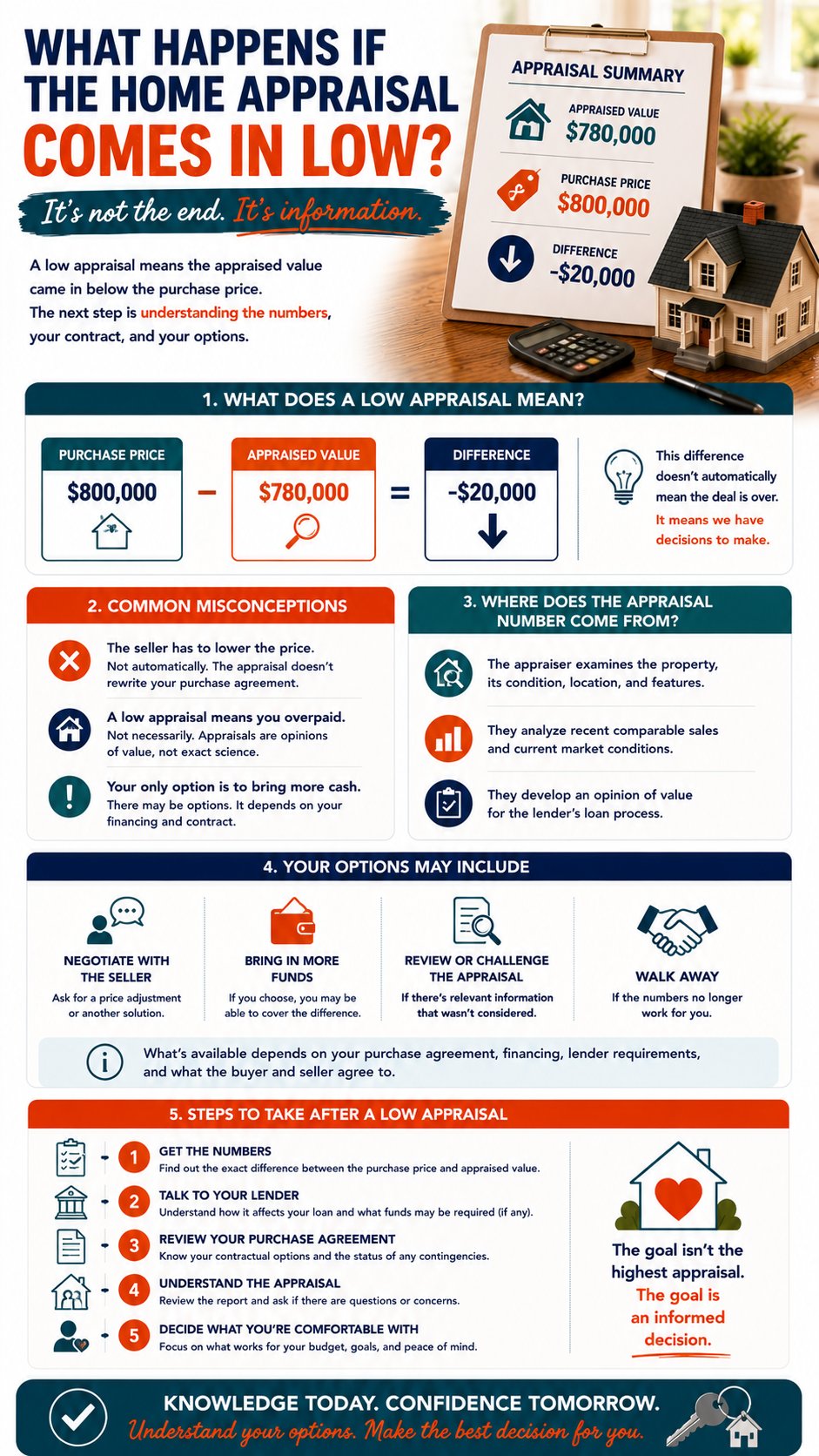
Imagine you agree to purchase a home for $800,000.
The appraisal comes back at $780,000.
That's a $20,000 difference between the purchase price and the appraised value.
That doesn't automatically mean you need to write a $20,000 check.
It also doesn't automatically mean the seller has to reduce the price by $20,000.
What happens next depends on your financing, the terms of your purchase agreement, and what the parties agree to do.
That's why the first step isn't panicking.
It's understanding the numbers.
The Biggest Misconception
One of the biggest misconceptions buyers have is:
"If the appraisal comes in low, the seller has to lower the price."
Don't assume that.
The appraisal doesn't automatically rewrite the purchase agreement.
The seller may be willing to discuss the price.
They may not.
There may be other possible solutions depending on the contract and financing.
Your first conversation should be with your real estate agent and lender so you understand exactly how the appraisal affects your particular purchase.
Does a Low Appraisal Mean I Overpaid?
Not necessarily.
An appraisal is an opinion of value developed for a specific purpose.
Your purchase price is the amount you and the seller agreed upon.
Those numbers can be different.
That's especially important to understand when you're buying in communities like Paso Robles, Templeton, and Atascadero.
Properties aren't always identical.
Lot size can vary.
Condition can vary.
Updates can vary.
Views, acreage, location, outbuildings, and other property characteristics can vary.
Sometimes finding truly comparable properties can be more straightforward than others.
So don't immediately translate:
"The appraisal came in below the purchase price"
into:
"I made a terrible offer."
Those aren't necessarily the same statement.
Talk to Your Lender About the Actual Impact
This is important because buyers often hear the appraisal number and immediately start doing their own math.
Before deciding what you can or can't afford to do, talk with your lender.
Ask how the appraised value affects your specific loan.
What changes?
What doesn't?
Does it affect the loan amount?
Does it affect the cash you would need?
Are there financing considerations you need to understand?
Get the actual numbers for your situation.
Don't make a major decision based on an assumption.
When an appraisal comes in below the purchase price, start with the actual numbers. Your lender can explain how the appraisal affects your specific financing.
Could the Seller Lower the Price?
Potentially.
A buyer and seller may discuss the difference depending on the terms of the transaction.
Maybe the seller is willing to adjust the purchase price.
Maybe the parties find another solution.
Maybe they don't reach an agreement.
There isn't one outcome I can promise you before seeing the actual contract, appraisal, financing, and circumstances.
This is where negotiation may come back into the transaction.
And just like we discussed with inspections, it helps to know your priorities before that conversation begins.
Could the Buyer Bring in More Money?
Depending on the financing and circumstances, a buyer may consider bringing additional funds into the transaction.
But don't jump immediately to:
"I guess I'll just pay the difference."
First understand exactly what would be required.
Then ask whether you're financially comfortable doing it.
Buying the home still needs to make sense for you.
Getting this far into the transaction doesn't mean you should automatically agree to anything just because you don't want to lose the house.
What About Challenging the Appraisal?
If there appears to be relevant information that wasn't considered or there are potential factual issues, there may be a process for asking the lender about an appraisal reconsideration or review.
That doesn't mean the value will change.
And it isn't simply:
"We don't like the number, so please make it higher."
There needs to be a legitimate basis for providing additional information or raising a concern.
Your lender can explain what process, if any, is available for your loan.
Again, information first.
Reaction second.
Your Purchase Agreement Matters
This is one of the reasons I don't like giving buyers blanket answers about low appraisals.
Your contractual protections and obligations depend on the agreement you actually signed and the status of any applicable contingencies.
Don't rely on what happened when your friend bought a house.
Don't rely on a social media video telling you what every buyer can do.
Review your actual transaction.
That's what matters.
What I'm Seeing Right Now
Working with buyers throughout Paso Robles, Templeton, Atascadero, and San Luis Obispo County, I've found that the phrase "low appraisal" often creates more fear than the situation deserves before we've even looked at the numbers.
Buyers immediately imagine the worst outcome.
Instead, I want to know:
What was the purchase price?
What was the appraised value?
What does the lender say?
What does the purchase agreement provide?
What options are actually available?
And what is the buyer comfortable doing?
Once we answer those questions, we have something useful to work with.
A low appraisal can create another decision in the transaction.
But another decision doesn't automatically mean the purchase is falling apart.
A Real-Life Example
I worked with buyers who found a home they really wanted.
The location worked.
The house checked their important boxes.
We looked at the comparable sales before writing the offer, discussed the market, and they felt comfortable with the price they offered.
The seller accepted.
Inspections went well.
Everything was moving forward.
Then the appraisal came back below the purchase price.
Their first reaction was immediate.
"Did we overpay?"
Then came the next question.
"Does this mean we're going to lose the house?"
Before jumping to either conclusion, we looked at the actual situation.
What was the difference between the purchase price and appraised value?
How did that affect their specific financing?
What did their purchase agreement say?
What options were available?
And most importantly, what were they comfortable doing?
Once we broke the situation into those pieces, it became much less overwhelming.
The low appraisal hadn't made the decision for them.
It had simply created another decision that needed to be worked through.
The Biggest Mistake
The biggest mistake is assuming a low appraisal automatically tells you what happens next.
It doesn't necessarily mean the seller has to lower the price.
It doesn't automatically mean you need to bring in the entire difference.
And it doesn't automatically mean you should walk away.
Start with your actual transaction.
Talk with your lender.
Review the purchase agreement with your real estate agent.
Understand the numbers.
Then decide what makes sense.
What This Process Should Feel Like
Working through a low appraisal should feel like solving a specific problem.
At first, you may hear:
"The appraisal came in low."
That sounds big.
But once you start asking questions, the situation becomes more specific.
How low?
How does it affect the loan?
What contractual options are available?
Is the seller willing to discuss it?
What is the buyer financially comfortable doing?
Those are questions you can actually work through.
You may not get the outcome you originally hoped for.
But you'll have better information for making the decision.
How This Connects to the Bigger Picture
We've just finished talking about inspections and what happens when you learn new information about the physical condition of the home.
An appraisal introduces a different kind of information.
This time, the conversation is about value and financing.
Both can create stress.
But the approach is similar.
Understand what you've learned before deciding what it means.
Related: Should I Ask the Seller to Fix Everything on the Home Inspection?
A low appraisal doesn't automatically determine what happens to the purchase. The next step is understanding the numbers, the contract, and the options available to you.
Steps: What to Do If the Home Appraisal Comes in Low
Step 1: Find Out the Exact Difference
Start with the numbers.
What is the purchase price?
What is the appraised value?
What's the difference between them?
Don't react to the phrase "low appraisal" without understanding how large the difference actually is.
Step 2: Talk With Your Lender
Ask your lender how the appraised value affects your specific financing.
Does anything change with the loan?
Would your required funds change?
Are there other financing considerations?
Get the actual numbers before deciding what you're willing or able to do.
Step 3: Review Your Purchase Agreement
Talk with your real estate agent about the terms of your specific contract and the status of any applicable contingencies.
Your options depend on the agreement you're actually in.
Step 4: Review the Appraisal
Look at the appraisal itself.
If there appears to be relevant information that wasn't considered or a potential factual issue, discuss that with your real estate agent and lender.
Your lender can explain whether there is an appropriate review or reconsideration process.
Step 5: Understand the Seller's Position
Depending on the circumstances, there may be another conversation with the seller.
The seller may agree to an adjustment.
They may propose something different.
They may not agree to a change.
Don't assume their answer before the conversation happens.
Step 6: Decide What You're Comfortable With
This part matters.
Even if there is a way to keep the transaction together, you still need to decide whether that solution makes sense for you.
Don't let the fact that you've already invested time and energy into the purchase make the decision for you.
Look at where you are today.
Then decide.
So... What Happens If the Home Appraisal Comes in Low?
You gather information.
That's the first thing.
Find out the actual difference between the purchase price and appraised value.
Talk with your lender about how it affects your financing.
Review your purchase agreement.
Understand whether there are legitimate questions about the appraisal itself.
Then look at the options available in your specific transaction.
There may be a negotiation.
There may be different ways the numbers could work.
Or you may reach a point where you have to decide whether you're comfortable moving forward.
A low appraisal creates a problem to solve.
It doesn't automatically tell you the answer.
Don't Let How Far You've Come Make the Decision
This is important.
By the time the appraisal comes back, you've probably invested a lot into the home.
Not just money.
Time.
Energy.
Inspections.
Paperwork.
Planning.
Maybe you've already started imagining where your furniture will go.
That can make it tempting to say:
"We've come this far. We have to make it work."
Be careful with that thinking.
The goal isn't simply to reach closing at any cost.
The goal is still to buy a home that makes sense for your finances and your goals.
If the appraisal changes the numbers, look at the new numbers.
Then make the decision based on where you are now.
The Real Question to Ask
Instead of asking:
"Does a low appraisal mean I'm going to lose the house?"
Ask:
"How does this appraisal affect my specific purchase, and what options do I actually have?"
That's the question that moves the conversation forward.
Next Steps
If an appraisal comes in below the purchase price on a home in Paso Robles, Templeton, Atascadero, or anywhere in San Luis Obispo County, don't assume the worst.
Start with the numbers.
Talk with your lender.
Review your purchase agreement.
Understand the appraisal.
Then evaluate the options available in your specific transaction.
The next article will answer a question first-time buyers ask all the time:
What's the difference between an appraisal and a home inspection?
From start to finish.
FAQ
What happens if a home appraises for less than the purchase price?
The next steps depend on your financing, purchase agreement, applicable contingencies, and what the buyer and seller decide to do. Start by asking your lender how the appraised value affects your specific loan.
Does the seller have to lower the price after a low appraisal?
Not automatically. A low appraisal doesn't by itself require the seller to change the agreed purchase price. What happens next depends on the contract and any negotiation between the parties.
Do I have to pay the entire appraisal difference in cash?
Don't assume that. Talk with your lender about exactly how the appraisal affects your financing and required funds before deciding what options may make sense.
Can a home appraisal be challenged?
There may be a process through the lender for reviewing or reconsidering an appraisal when there is relevant additional information or a potential factual issue. Your lender can explain what process is available for your loan.
Does a low appraisal mean I offered too much for the house?
Not necessarily. An appraisal is an opinion of value developed for the lender's process, while the purchase price is the amount the buyer and seller agreed upon. If the numbers differ, review the appraisal, financing, comparable sales, and your specific situation before drawing a conclusion.
Amber Johnson, Founder
Pillar Real Estate
805.835.3425
[email protected]
1345 Park St. Paso Robles, CA 93446
DRE# 01925434

Amber Johnson | September 21, 2026
How traffic patterns, privacy, parking, lot shape, and buyer preferences can influence marketing and value.

Amber Johnson | September 21, 2026
The price, credits, repairs, timing, and other terms Paso Robles sellers may need to evaluate this season.

Amber Johnson | September 21, 2026
When an open house can support a launch, when private showings may matter more, and how to judge the results.
Amber Johnson | September 20, 2026
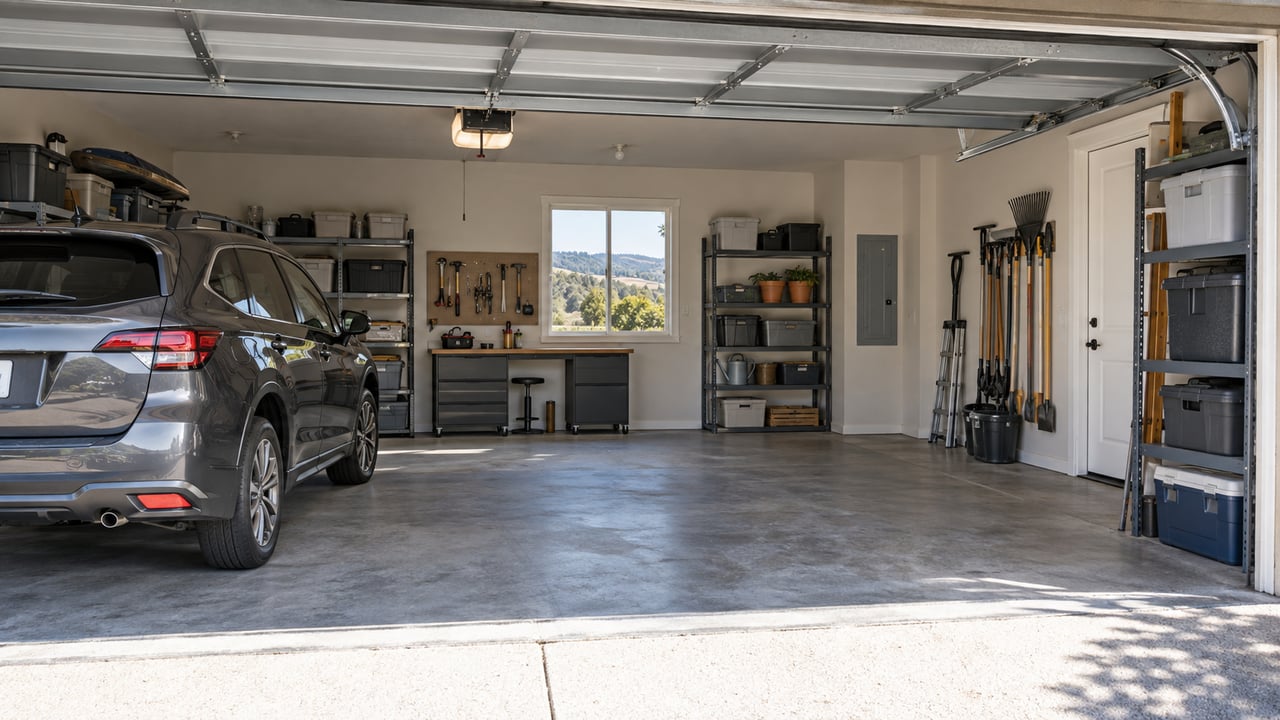
How garage organization, storage, access, and visible maintenance can influence a buyer’s overall impression.

Amber Johnson | September 20, 2026
Why seller absence usually gives buyers more freedom to look, talk, and form an honest impression.
Amber Johnson | September 20, 2026
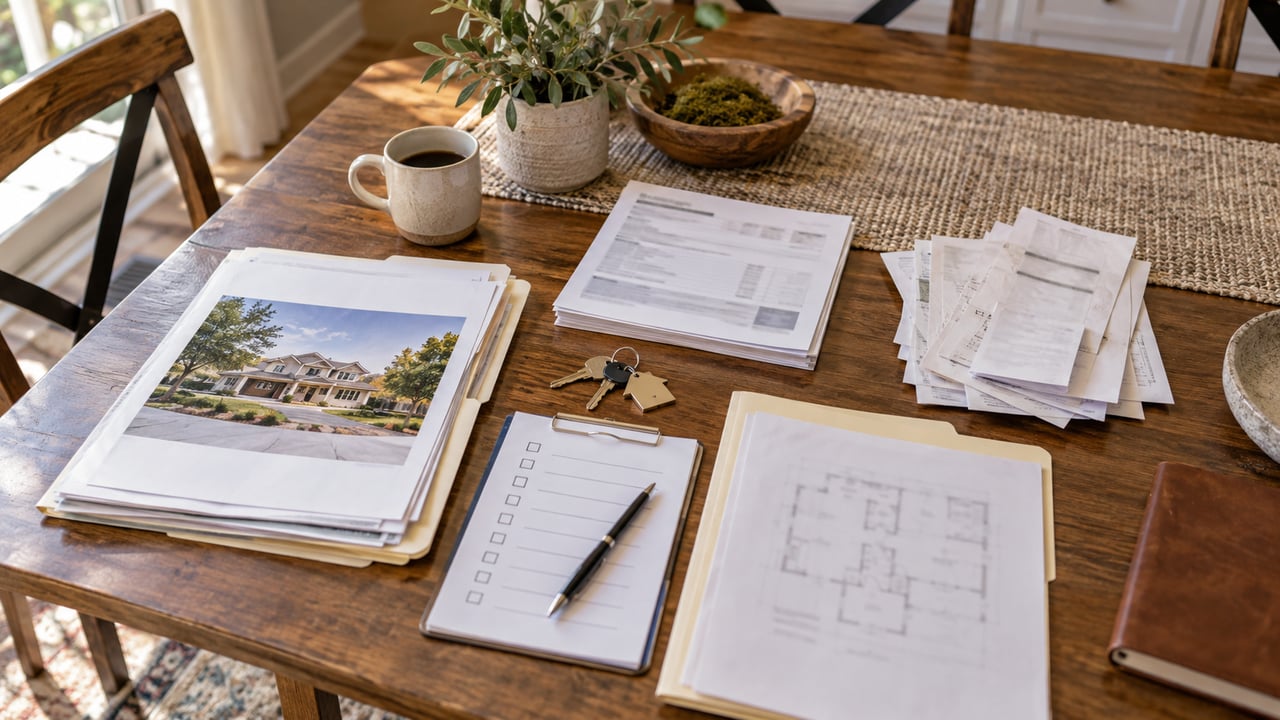
The records that help confirm ownership, payoff information, property history, and a smoother listing process.

Amber Johnson | September 18, 2026

Amber Johnson | September 18, 2026

Amber Johnson | September 18, 2026
How wells, septic systems, acreage, access, and the buyer pool shape a rural-property sale.
You’ve got questions and we can’t wait to answer them.

Amber Johnson, Founder
Pillar Real Estate
805.835.3425
DRE# 01925434
1345 Park Street
Paso Robles, CA 93446