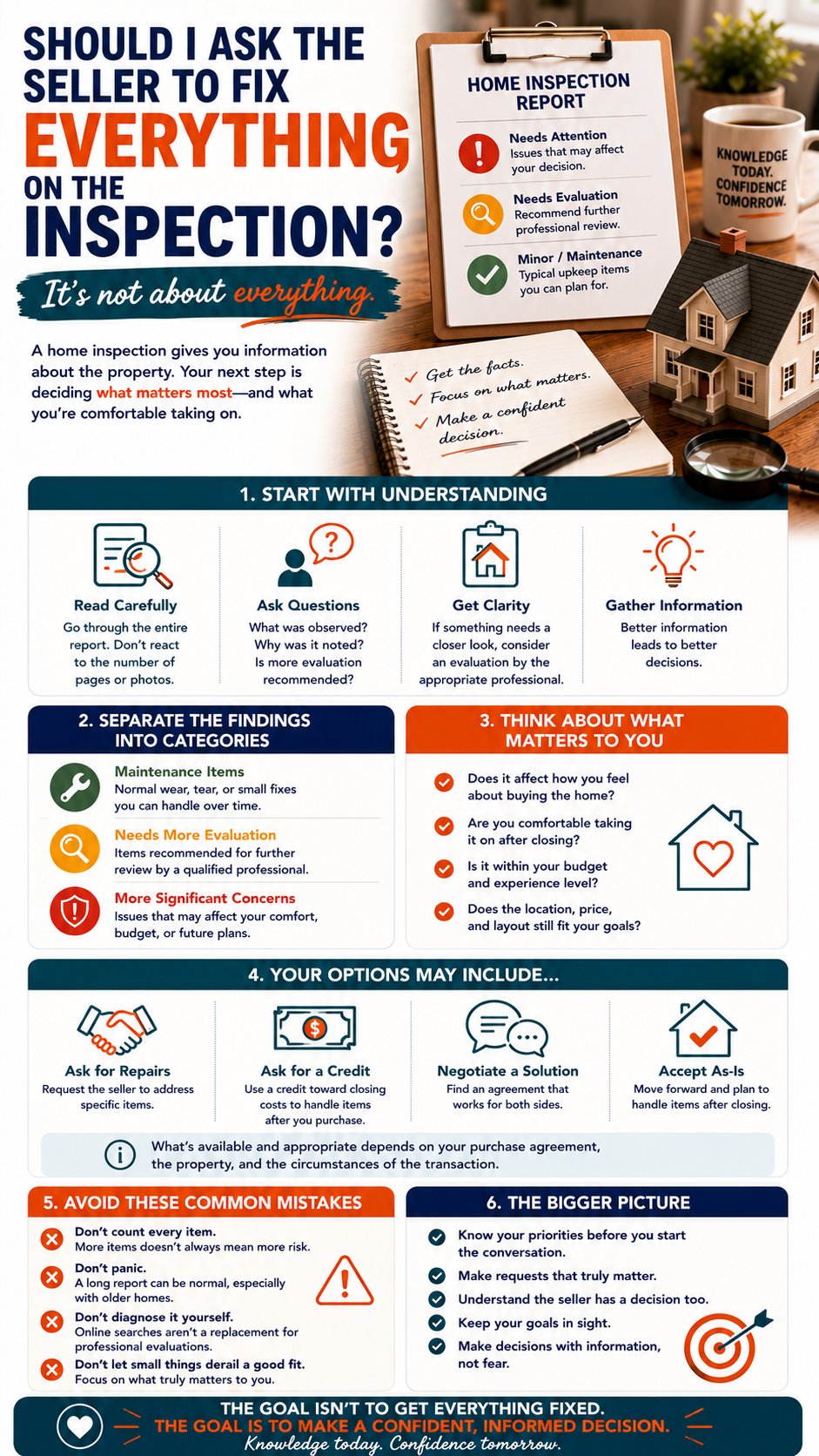
Should I Ask the Seller to Fix Everything on the Home Inspection?
July 30, 2026

July 30, 2026
You get the inspection report.
It's 60 pages long.
There are photos.
Recommendations.
Maintenance items.
A few things you definitely want to know more about.
And maybe dozens of smaller observations.
Your first reaction might be:
"Should we ask the seller to fix all of this?"
It's an understandable question.
You're spending a lot of money on a home.
Why wouldn't you want everything addressed before you move in?
Here's the thing.
A home inspection report isn't automatically a list of repairs the seller should make.
The report gives you information about the property.
What you do with that information is a separate decision.
Some findings may deserve more attention.
Some may be worth discussing with the seller.
Some may be normal homeownership and maintenance items you're comfortable handling yourself.
The goal isn't necessarily to get every item fixed.
The goal is to understand what matters most and make thoughtful decisions based on the home, your priorities, your purchase agreement, and the situation.
Amber is a real estate agent in Paso Robles, CA helping buyers throughout San Luis Obispo County navigate inspections and the decisions that follow. Her approach is practical and focused on helping buyers understand their options without creating unnecessary pressure.
An inspection report gives you information about the home. The next step is deciding which findings actually matter to you.
Start by Understanding the Findings
Before talking about what you want the seller to address, make sure you understand what the inspector found.
This sounds obvious.
But it's easy to skip.
You see something highlighted in the report and immediately think:
"We need them to fix that."
First ask:
What exactly did the inspector observe?
Is additional evaluation recommended?
Do we know the extent of the issue?
Is this something relatively straightforward?
Or do we need more information before deciding what to do?
Sometimes the best next step isn't making a request.
It's getting clarity.
The Biggest Misconception
One of the biggest misconceptions first-time buyers have is:
"The seller has to fix everything the inspector finds."
That's not generally how I want buyers thinking about the inspection process.
Your inspection report may contain a wide range of observations.
Some could involve significant concerns.
Others could be routine maintenance.
Some may simply be things you'll want to improve after you own the home.
What happens next depends on the purchase agreement, the specific findings, the property, and the circumstances of the transaction.
That's why every inspection conversation is different.
Focus on What Actually Matters
Imagine your inspection report contains dozens of items.
Do they all matter equally?
Probably not.
Maybe there's a loose door handle.
A damaged window screen.
Old caulking.
A dripping faucet.
And then there's an issue where the inspector recommends evaluation by a qualified professional.
Those shouldn't necessarily receive the same amount of your attention.
I encourage buyers to focus first on the findings that could meaningfully affect their decision to own the property.
What deserves more information?
What are you genuinely concerned about?
What are you comfortable handling later?
That's a much more useful conversation than simply working from page one to page sixty and asking for everything.
Think About the Difference Between Repairs and Maintenance
Homes require maintenance.
That's part of ownership.
Things wear.
Caulking deteriorates.
Filters need changing.
Fixtures eventually need attention.
Not every maintenance item means something has gone terribly wrong with the house.
That doesn't mean you should ignore the report.
It means you should understand what you're looking at.
If you're comfortable taking care of a particular item after closing, it may not need to become the center of your negotiation.
Your priorities matter.
What About Bigger Concerns?
This is where the conversation changes.
If an inspection identifies something that may be more significant, don't guess.
Get more information when appropriate.
If the inspector recommends evaluation by a specialist, consider having the appropriate qualified professional look at it within the time allowed by your purchase agreement.
You may discover the concern is relatively straightforward.
Or you may learn that it's more involved than you initially thought.
Either way, better information helps you make a better decision.
Before deciding what to ask a seller to address, make sure you understand the issue. Additional information can completely change the conversation.
Should I Ask for a Repair or Something Else?
This is another question buyers often have.
Depending on the transaction, buyers may wonder whether they should request that something be repaired or explore another approach permitted by their agreement.
There isn't one answer that works for every property.
If a seller agrees to perform a repair, you'll want to understand what is being agreed to and how it will be handled.
In other situations, a buyer may prefer a different negotiated solution rather than having the seller coordinate work.
What's available and appropriate depends on the purchase agreement, the parties, the lender when applicable, and the specific circumstances.
This is where your real estate agent can help you understand the contractual options available to you, while qualified professionals can help you understand the actual condition or repair itself.
Remember That the Seller Has a Decision Too
This part can get lost.
A buyer can make a request.
That doesn't automatically mean the seller will agree to it.
The seller may agree.
They may agree to part of it.
They may propose something different.
Or they may decline a request.
What happens depends on the contract and negotiation.
That's why I think it's important to know your priorities before you start the conversation.
If everything on your list is treated as equally important, it can become harder to communicate what actually matters to you.
Know the difference between:
"This would be nice."
and
"This significantly affects how I feel about buying the home."
That's useful information.
Don't Lose the House Over Something You Don't Actually Care About
This is where perspective matters.
You spent weeks finding the home.
The location works.
The payment works.
The layout fits your life.
You can picture yourself living there.
Then the inspection finds several relatively small items.
Ask yourself whether those things truly change how you feel about owning the property.
Sometimes buyers become so focused on getting every possible item addressed that the inspection becomes a contest.
That's not the goal.
The goal is making an informed decision about the property and protecting the things that genuinely matter to you.
What I'm Seeing Right Now
Working with buyers throughout Paso Robles, Templeton, Atascadero, and San Luis Obispo County, I've found that inspection conversations become much easier when buyers prioritize.
Instead of asking:
"What can we get?"
we focus on:
"What matters?"
That's a very different mindset.
Maybe there are one or two findings that deserve additional information.
Maybe there's something significant the buyer wants to discuss with the seller.
Maybe there are ten smaller items the buyer is completely comfortable handling after closing.
Every property is different.
Every buyer is different.
And every negotiation is different.
The goal isn't to "win" the inspection.
It's to understand the home and make decisions that still make sense for you.
A Real-Life Example
I worked with buyers who received an inspection report with a long list of findings.
Their first reaction was understandable.
"Should we just ask the seller to fix all of it?"
So we went through the report together.
Once we started talking about each item, something became clear.
They didn't actually care about everything on the list.
There were a few maintenance items they were completely comfortable handling after closing.
There were cosmetic things they already planned to change.
Then there were a couple of findings they genuinely wanted more information about.
Those became the priority.
Instead of treating the inspection report like one giant repair request, we focused on what actually affected their decision.
That made the conversation much simpler.
They weren't trying to get everything they possibly could from the seller.
They were trying to understand the home and make a thoughtful decision about what they were willing to take on.
That's the difference.
The Biggest Mistake
The biggest mistake is turning the inspection into a negotiation just for the sake of negotiating.
It's easy to look at a report and think:
"We should ask for this because it's on the list."
But ask yourself:
"Do I actually care about this?"
If the seller said no, would it change your decision?
Would you still buy the house?
Are you comfortable handling it after closing?
Those questions can help you separate the important items from everything else.
What This Process Should Feel Like
The inspection negotiation should feel focused.
You understand the findings.
You've gathered additional information when appropriate.
You know which items matter most to you.
And you understand the options available under your purchase agreement.
That doesn't mean you'll get everything you request.
It means you're making intentional decisions instead of reacting to a long report.
The goal isn't to leave the inspection period feeling like you won.
The goal is to leave it understanding what you're buying and feeling comfortable with the decisions you've made.
How This Connects to the Bigger Picture
In the last two articles, we talked about what to expect during a home inspection and what happens when the inspection finds a lot of problems.
Now we're taking the next step.
You understand the report.
You've asked questions.
You've gotten additional information where appropriate.
Now you have to decide what, if anything, you want to discuss with the seller.
Related: What If the Home Inspection Finds a Lot of Problems?
The goal isn't to ask for everything. It's to understand what matters enough to affect your decision about the home.
Steps: How to Decide What to Ask the Seller to Address
Step 1: Understand the Finding
Don't make a request simply because something appears in the inspection report.
Understand what was observed.
Ask questions.
Get additional evaluation when appropriate.
Start with information.
Step 2: Separate Priorities From Preferences
Create two categories.
Things that genuinely affect how you feel about buying the home.
And things you'd simply prefer the seller to handle.
That distinction matters.
Step 3: Think About What You're Comfortable Taking On
Maybe you're comfortable replacing a fixture after closing.
Maybe you don't mind handling some routine maintenance.
Another issue may be outside your comfort level entirely.
Know where that line is for you.
Step 4: Understand Your Contractual Options
Talk with your real estate agent about the options available under your purchase agreement.
Every transaction is different.
Don't assume what happened in someone else's home purchase automatically applies to yours.
Step 5: Keep the Bigger Picture in Mind
Go back to why you wanted the home.
Does the location still work?
Does the payment still make sense?
Does the property still fit your goals?
Then ask whether the inspection findings actually change that picture.
So... Should You Ask the Seller to Fix Everything on the Home Inspection?
Usually, that's not the most useful way to approach the inspection.
Start by understanding the findings.
Then prioritize.
Some items may deserve additional evaluation.
Some may become part of a conversation with the seller.
Others may simply become part of your future home maintenance list.
The right approach depends on the property, your comfort level, your purchase agreement, and the circumstances of the transaction.
Don't focus on getting the longest list of repairs.
Focus on getting the information and clarity you need to decide whether the home still makes sense for you.
What If the Seller Says No?
This is where buyers can get nervous.
You make a request.
The seller doesn't agree to everything.
Now what?
First, understand exactly what the seller is and isn't agreeing to.
Then go back to your priorities.
If an item genuinely affects your willingness to own the home, that's important.
If it's something you'd prefer to have addressed but could comfortably handle yourself, that's different.
Your options will depend on your purchase agreement and the specific circumstances of the transaction.
This is why knowing what matters before making the request is so helpful.
You're not deciding based on disappointment.
You're deciding based on priorities.
The Real Question to Ask
Instead of asking:
"How much can I get the seller to fix?"
Ask:
"Which inspection findings matter enough to affect my decision about buying this home?"
That's a much better foundation for the conversation.
Next Steps
If you're buying a home in Paso Robles, Templeton, Atascadero, or anywhere in San Luis Obispo County and you've received your inspection report, start by understanding the findings before deciding what to request.
Separate the important concerns from routine maintenance.
Get additional information when appropriate.
Think about what you're comfortable taking on.
Then review the options available under your purchase agreement.
The goal isn't to turn every inspection item into a negotiation.
It's to make an informed decision about the home you're buying.
From start to finish.
FAQ
Should I ask the seller to fix everything on the inspection report?
Not automatically. An inspection report provides information about the property. Consider the significance of each finding, your own priorities, and the options available under your purchase agreement before deciding what to request.
What inspection items should I focus on?
Focus on findings that meaningfully affect your comfort with the property, along with items that may deserve additional professional evaluation. Your priorities will depend on the specific home and your situation.
Can I ask the seller to make repairs after the inspection?
Depending on your purchase agreement and circumstances, you may have options for making requests after inspections. Review your specific contractual options with your real estate agent.
What happens if the seller refuses my repair request?
What happens next depends on your purchase agreement, the seller's response, and your priorities. Review your options carefully before deciding how you want to proceed.
Is it better to ask for repairs or a credit?
There isn't one answer for every transaction. The appropriate approach can depend on the issue, your agreement, lender requirements, and the circumstances of the purchase. Discuss your contractual options with your real estate agent and obtain professional guidance about the condition itself when appropriate.
Amber Johnson, Founder
Pillar Real Estate
805.835.3425
[email protected]
1345 Park St. Paso Robles, CA 93446
DRE# 01925434

Amber Johnson | September 21, 2026
How traffic patterns, privacy, parking, lot shape, and buyer preferences can influence marketing and value.
Amber Johnson | September 21, 2026
The price, credits, repairs, timing, and other terms Paso Robles sellers may need to evaluate this season.

Amber Johnson | September 21, 2026
When an open house can support a launch, when private showings may matter more, and how to judge the results.
Amber Johnson | September 20, 2026
How garage organization, storage, access, and visible maintenance can influence a buyer’s overall impression.

Amber Johnson | September 20, 2026
Why seller absence usually gives buyers more freedom to look, talk, and form an honest impression.
Amber Johnson | September 20, 2026
The records that help confirm ownership, payoff information, property history, and a smoother listing process.

Amber Johnson | September 18, 2026

Amber Johnson | September 18, 2026

Amber Johnson | September 18, 2026
How wells, septic systems, acreage, access, and the buyer pool shape a rural-property sale.
You’ve got questions and we can’t wait to answer them.

Amber Johnson, Founder
Pillar Real Estate
805.835.3425
DRE# 01925434
1345 Park Street
Paso Robles, CA 93446