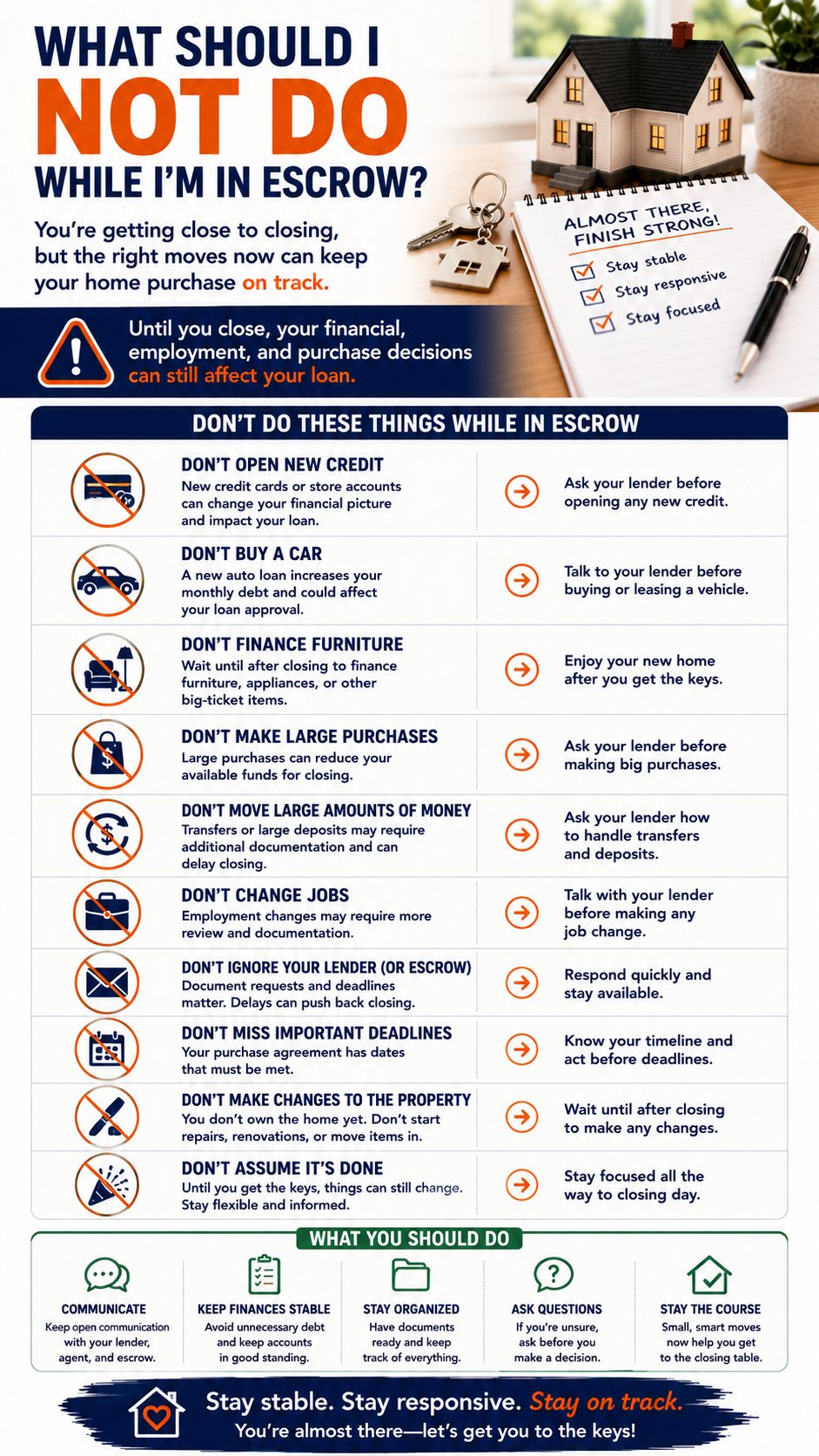
What Should I NOT Do While I’m in Escrow?
July 31, 2026

July 31, 2026
Your offer was accepted.
You made it through the inspection.
The appraisal is underway or already complete.
Your lender is working on the loan.
You're getting closer to closing.
This is usually when buyers start feeling like the hard part is behind them.
And in many ways, it is.
But there's something important to understand:
You're not finished yet.
The time between an accepted offer and closing isn't the best time to make big changes.
Not with your finances.
Not with your employment.
And not with the house you're buying.
One of the questions I hear from first-time buyers is:
"What should I NOT do while I'm in escrow?"
Here's the simple answer.
While you're in escrow, avoid making significant financial or employment changes without talking with your lender, don't ignore deadlines or document requests, and don't assume the transaction is finished until it actually closes.
You don't need to be nervous about every decision you make.
You just want to avoid creating unnecessary problems when you're this close to owning the home.
Amber is a real estate agent in Paso Robles, CA helping first-time buyers throughout San Luis Obispo County understand the home-buying process from accepted offer through closing. Her approach is practical and communication-focused, helping buyers know what needs their attention and what comes next.
Once you're in escrow, you're getting closer to owning the home. Staying responsive and avoiding unnecessary changes can help keep the transaction moving.
Don't Open New Credit Without Talking With Your Lender
Let's start with one of the biggest ones.
You're buying a house.
Naturally, you're thinking about everything you're going to need for it.
Furniture.
Appliances.
Maybe a new television.
Maybe you walk into a store and see:
"12 months, no interest."
Wait.
Before applying for financing or opening a new credit account, talk with your lender.
New credit can potentially affect your financial profile while your mortgage is still being completed.
Does that mean every credit inquiry automatically destroys a home loan?
No.
It means you shouldn't guess about how a financial decision could affect your specific financing.
Ask first.
Don't Buy a Car
At least not without having a conversation with your lender first.
This one deserves repeating because a new car payment can create a meaningful change in your monthly debt.
Imagine getting within two weeks of closing and deciding it's time for a new SUV.
You finance it.
Now your financial picture has changed.
Could that affect your loan?
Your lender needs to answer that based on your specific situation.
The better order is:
Talk with lender.
Understand the impact.
Then make the decision.
Not the other way around.
Don't Finance Your New Furniture Yet
I understand why buyers want to do this.
You've already mentally moved into the house.
You know exactly where the couch is going.
You've measured the dining room.
You've found the bedroom set.
And there's a sale ending Sunday.
The sale isn't more important than your home closing.
If buying the furniture involves new debt or credit, talk with your lender before doing it.
There will be another couch.
Get the keys first.
Don't Make Large Purchases Without Asking
New credit isn't the only consideration.
Large purchases can change your account balances or the funds you have available for closing.
Maybe you're paying cash for furniture.
Maybe you're planning an expensive vacation.
Maybe you want to purchase equipment for your business.
Before making a significant purchase while you're in escrow, ask your lender whether it creates any concern for your loan or closing funds.
You don't need to stop living.
You just want to avoid surprises.
Don't Move Large Amounts of Money Around Without Asking
This one catches buyers off guard.
You have money in savings.
Money in checking.
Maybe another investment or financial account.
You decide to consolidate everything before closing.
That might seem perfectly logical.
But depending on your financing, significant transfers or deposits may create additional documentation requests.
Your lender may need to verify or document certain funds.
Before moving substantial amounts of money, ask your lender how they'd like you to handle it.
A quick conversation can save a lot of paperwork.
Keeping your financial situation predictable during escrow can make things easier. Ask your lender before making significant purchases, opening credit, or moving large amounts of money.
Don't Change Jobs Without Talking With Your Lender
Sometimes a job opportunity shows up at exactly the wrong time.
You're in escrow.
Then another company offers you more money.
Your first thought might be:
"I'm earning more. How could that possibly hurt my loan?"
Maybe it won't.
But your lender still needs to know.
A job change can involve more than salary.
Your compensation structure may change.
You could move from salary to commission.
You might become self-employed.
There could be a gap between employers.
Different documentation may be required.
If you're considering changing jobs during escrow, talk with your lender before making the change when possible.
Let them evaluate your actual situation.
Don't Quit Your Job
This probably sounds obvious.
But buying a home can sometimes happen at the same time as other major life changes.
If you're planning to leave your job, don't assume it won't matter because you've already been pre-approved.
Employment can still be relevant to your financing before closing.
Talk with your lender.
Don't Ignore Your Lender
Your lender sends an email.
They need an updated bank statement.
You think:
"I'll get to that this weekend."
Then Friday becomes Monday.
Monday becomes Wednesday.
Meanwhile, your closing date hasn't moved.
When your lender asks for something, respond as quickly as reasonably possible.
If you don't understand the request, ask.
If you can't provide it immediately, communicate.
Silence doesn't help anyone.
Don't Ignore Escrow Documents Either
Your lender isn't the only person who may need something.
Escrow may send documents.
Your real estate agent may need signatures or decisions.
Insurance may need to be arranged.
There may be other transaction-related items that require your attention.
Check your email.
Check your voicemail.
Stay available.
You don't have to spend all day watching your inbox.
But disappearing for several days during escrow can make an already time-sensitive process more difficult.
Don't Miss Important Contract Deadlines
Once you're under contract, dates matter.
Your purchase agreement contains deadlines and terms that apply to your transaction.
Don't assume someone else will handle every decision automatically.
Your real estate agent should help you understand the timeline and what needs your attention.
When a deadline is approaching, understand what it means.
Ask questions if you're unsure.
And don't wait until the last minute to start thinking about an important decision.
Don't Assume the Inspection Means the House Is Perfect
You completed your inspection.
Great.
That doesn't mean someone guaranteed that nothing will ever go wrong with the house.
Inspections provide information about observable conditions within the scope of the inspection.
Homes still require maintenance.
Systems age.
Things can change.
And some areas or conditions may require specialized evaluation.
Use the inspection for what it's intended to do.
Learn more about the property.
Don't turn it into a guarantee that you'll never have a repair.
Don't Start Making Changes to the Property
This is important.
You don't own the house yet.
Don't start acting like you do.
Don't schedule contractors to begin work.
Don't move belongings into the property without proper authorization.
Don't start painting.
Don't remove anything.
Don't make alterations.
You may be excited.
You may be only days away from closing.
But until ownership has actually transferred, treat the property accordingly.
Don't Cancel or Change Things Prematurely
Buyers sometimes become so confident that closing will happen exactly as planned that they begin making irreversible decisions too early.
Maybe you're coordinating your current housing.
Utilities.
Moving arrangements.
Deliveries.
Travel.
Other commitments.
Some preparation is obviously necessary.
But be careful about treating an estimated closing timeline as though nothing could possibly change.
Real estate transactions have moving pieces.
Stay flexible until you're actually closed.
Don't Stop Asking Questions
This is one of the biggest mistakes buyers make near the end.
They've asked so many questions already that they start feeling like they should understand everything.
You don't have to.
If something doesn't make sense, ask.
If a number looks different, ask.
If you don't understand a document, ask the appropriate professional.
If your lender requests something unusual, ask what they need.
Being close to closing isn't the time to become embarrassed about asking questions.
It's the time to make sure you understand what you're doing.
What I'm Seeing Right Now
Working with buyers throughout Paso Robles, Templeton, Atascadero, and San Luis Obispo County, I've noticed something interesting.
Buyers are often extremely careful at the beginning.
They're watching their credit.
Saving money.
Talking with the lender.
Planning every step.
Then their offer gets accepted.
Inspections happen.
The appraisal gets done.
And they start relaxing.
That's understandable.
But I want buyers to keep that same discipline until the transaction is actually complete.
Keep your finances boring.
Stay responsive.
Don't create unnecessary changes.
Ask before making significant financial decisions.
And remember:
Almost closed isn't the same as closed.
You're getting close.
Let's get you all the way there.
A Real-Life Example
I worked with buyers who were getting very close to closing.
The inspection was behind them.
The appraisal was complete.
Their lender was finishing the loan.
They were excited and already thinking about everything they wanted to buy for the house.
Then one of them mentioned they were planning to open a store credit card that weekend to purchase furniture.
They weren't doing anything unusual.
They were simply preparing for their new home.
But the timing mattered.
Instead of applying for the card, they contacted their lender first.
That's exactly what I want buyers to do.
You don't need to understand every mortgage guideline yourself.
You just need to know when to ask before making a change.
During escrow, a quick conversation with your lender before opening credit, making a large purchase, changing jobs, or moving money can prevent unnecessary complications later.
The Biggest Mistake
The biggest mistake is acting like the transaction is finished before it actually is.
You're close.
Maybe really close.
But you're still in escrow.
Your lender may still need documents.
There may still be contractual deadlines.
Escrow may still need information.
Your financial situation may still matter to the loan.
And you don't own the property yet.
Keep doing what got you this far.
Stay responsive.
Keep your finances stable.
Ask questions.
And don't make significant changes without checking with the appropriate professional first.
What This Process Should Feel Like
The final stretch of escrow shouldn't feel scary.
It should feel organized.
You should know what needs your attention.
You should understand the next important deadline.
You should know who to contact when you have a question.
And you should be able to continue living your normal life without constantly worrying that you're going to accidentally ruin the transaction.
The goal isn't to make you afraid to spend $20 at the grocery store.
It's to avoid major, unnecessary changes while your purchase is still being completed.
How This Connects to the Bigger Picture
In the last article, we talked specifically about what could affect your loan before closing.
This article expands that conversation beyond financing.
While you're in escrow, you're managing several things at once.
Your loan.
Your purchase agreement.
Escrow.
Insurance.
The property.
Your closing timeline.
The simplest approach is to stay engaged until everything is complete.
Related: What Could Go Wrong With My Loan Before Closing?
You're almost there. Staying organized and avoiding unnecessary changes during escrow can help you get through the final stretch.
Steps: What to Do While You're in Escrow
Step 1: Keep Your Finances Stable
Avoid unnecessary new debt or credit.
Keep paying your existing bills.
Before making a significant financial move, talk with your lender.
Step 2: Stay Responsive
Watch for communication from your lender, real estate agent, escrow, insurance provider, and other professionals involved in the transaction.
If someone needs something, respond promptly.
Step 3: Know Your Important Dates
Understand the timeline in your purchase agreement.
You don't need to memorize everything.
But you should know what's coming next and whether there's anything you need to do.
Step 4: Ask Before Making Big Changes
New job?
New car?
Large purchase?
Moving money?
Opening credit?
Ask your lender before making the change when possible.
Step 5: Remember You Don't Own the Home Yet
Don't make changes to the property or treat it like it's already yours.
Wait until ownership has actually transferred.
Step 6: Keep Asking Questions
If you don't understand something, ask.
Don't assume you're supposed to know every part of the transaction just because you're getting close to closing.
So... What Should You NOT Do While You're in Escrow?
Don't make unnecessary financial changes.
Don't open new credit without talking with your lender.
Don't finance a car or furniture without asking first.
Don't move substantial amounts of money around without discussing it with your lender.
Don't change jobs without communicating.
Don't ignore requests for documents.
Don't miss important deadlines.
Don't start making changes to a house you don't own yet.
And don't assume the transaction is finished before it actually closes.
Most of this comes down to one simple idea:
Don't create unnecessary surprises.
You've already done a lot of work to get here.
Keep things steady for a little longer.
What If I Already Did Something on This List?
Don't panic.
Maybe you already opened a credit card.
Maybe you made a large purchase.
Maybe money moved between accounts.
Maybe your employment situation changed.
The worst thing you can do is hide it and hope nobody notices.
Talk with your lender if the issue involves your finances or financing.
Explain what happened.
Let them determine whether it affects your loan and what information they need.
If the issue involves your purchase agreement or another part of the transaction, talk with your real estate agent about the situation.
A mistake doesn't automatically tell you what the outcome will be.
Get information first.
Keep the Final Stretch Boring
This may be the least exciting advice you'll receive while buying a home.
But it's useful.
Keep things boring.
Don't buy the car.
Don't finance the couch.
Don't suddenly move all your money around.
Don't disappear on vacation without telling anyone how to reach you.
Don't make major changes because you're convinced closing is guaranteed.
Keep doing what you've been doing.
There will be plenty of time to celebrate after the home is actually yours.
The Real Question to Ask
Instead of asking:
"Can I do this while I'm in escrow?"
Ask:
"Could this affect my loan, purchase, or closing, and who should I talk with before I do it?"
That question can save you a lot of unnecessary stress.
Next Steps
If you're currently in escrow on a home in Paso Robles, Templeton, Atascadero, or anywhere in San Luis Obispo County, focus on keeping things simple.
Stay responsive.
Keep your finances stable.
Know your important deadlines.
Ask before making significant financial or employment changes.
And don't treat the home like it's yours until the transaction is actually complete.
You're getting close.
The next part of this buyer journey is understanding what happens as your loan and transaction move toward final approval and closing.
From start to finish.
FAQ
Can I use my credit card while I'm in escrow?
Normal spending isn't necessarily the same as taking on significant new debt, but your specific financial situation matters. If you're planning a large purchase or significant increase in credit balances, talk with your lender first.
Can I buy furniture while I'm in escrow?
If you're considering financing furniture or making a significant purchase before closing, ask your lender first. Waiting until after closing may help you avoid creating unnecessary questions during the loan process.
Can I change jobs while I'm in escrow?
Employment changes may affect your financing or require additional documentation. Talk with your lender before changing jobs when possible so you understand how the change could affect your specific loan.
Can I move money between bank accounts during escrow?
Before making significant transfers, talk with your lender. Depending on your financing, they may need documentation related to certain funds or transactions.
What happens if I make a financial mistake before closing?
Tell your lender as soon as possible. Don't assume the transaction is ruined, and don't hide the change. Explain what happened and let your lender determine whether it affects your financing and what needs to happen next.
Amber Johnson, Founder
Pillar Real Estate
805.835.3425
[email protected]
1345 Park St. Paso Robles, CA 93446
DRE# 01925434

Amber Johnson | September 21, 2026
How traffic patterns, privacy, parking, lot shape, and buyer preferences can influence marketing and value.

Amber Johnson | September 21, 2026
The price, credits, repairs, timing, and other terms Paso Robles sellers may need to evaluate this season.

Amber Johnson | September 21, 2026
When an open house can support a launch, when private showings may matter more, and how to judge the results.
Amber Johnson | September 20, 2026
How garage organization, storage, access, and visible maintenance can influence a buyer’s overall impression.

Amber Johnson | September 20, 2026
Why seller absence usually gives buyers more freedom to look, talk, and form an honest impression.
Amber Johnson | September 20, 2026
The records that help confirm ownership, payoff information, property history, and a smoother listing process.

Amber Johnson | September 18, 2026

Amber Johnson | September 18, 2026

Amber Johnson | September 18, 2026
How wells, septic systems, acreage, access, and the buyer pool shape a rural-property sale.
You’ve got questions and we can’t wait to answer them.

Amber Johnson, Founder
Pillar Real Estate
805.835.3425
DRE# 01925434
1345 Park Street
Paso Robles, CA 93446