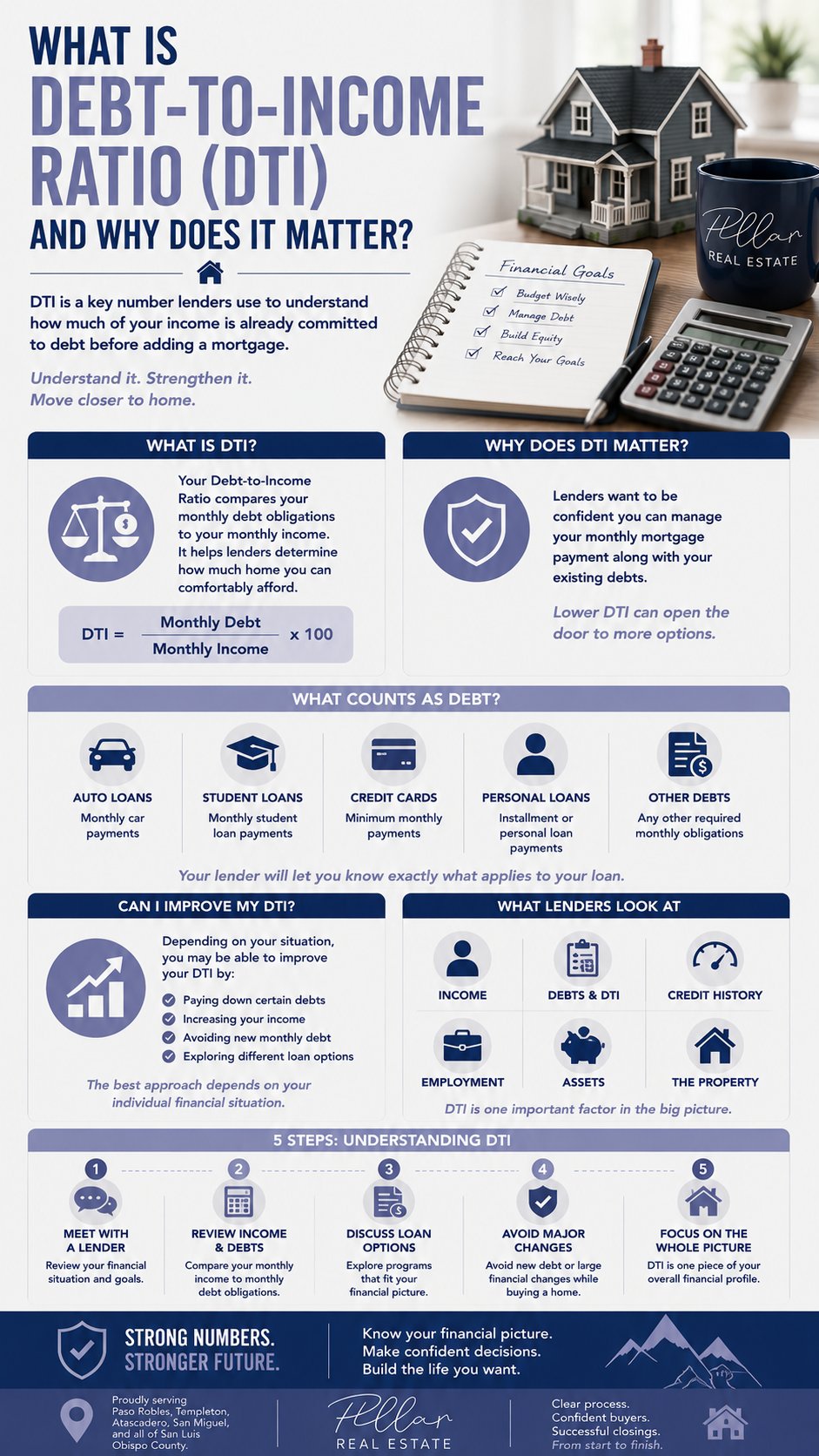
What Is Debt-to-Income Ratio (DTI) and Why Does It Matter?
August 21, 2026

August 21, 2026
One of the questions I hear from buyers after they've spoken with a lender is,
"They mentioned my debt-to-income ratio. What does that actually mean?"
It's a great question.
Most buyers spend a lot of time thinking about their credit score.
But your Debt-to-Income Ratio, often called DTI, is another important part of qualifying for a mortgage.
If you're buying a home in Paso Robles, Templeton, Atascadero, San Miguel, or anywhere in San Luis Obispo County, understanding your DTI can help you better understand how lenders evaluate your loan application.
Over the past 13+ years, I've found that buyers feel much more confident once they understand that lenders aren't just looking at how much money they earn. They're also looking at how much of that income is already committed to monthly debt. My goal is to explain DTI in a simple way so you'll know why it matters before you begin shopping for a home.
Before we get started, I also recommend reading my article, "What Is Underwriting and Why Does It Take So Long?" Underwriting is where your lender reviews your financial information in detail, and your debt-to-income ratio is one of the factors considered during that process.
What Is Debt-to-Income Ratio?
Your Debt-to-Income Ratio is a comparison between your monthly income and your monthly debt obligations.
In simple terms, it helps lenders understand how much of your income is already committed to paying debts before taking on a mortgage.
It's one way lenders evaluate whether a monthly mortgage payment fits comfortably within your overall financial picture.
Why Does DTI Matter?
When a lender reviews your loan application, they're trying to determine whether you can reasonably afford the proposed mortgage payment.
Your DTI helps provide that picture.
A lower DTI generally means a smaller portion of your monthly income is already committed to debt.
A higher DTI means more of your monthly income is already being used for existing obligations.
DTI is only one factor lenders consider, but it's an important one.
What Counts as Debt?
Every loan program has its own guidelines, but lenders commonly review recurring monthly debt obligations such as:
Your lender will explain exactly which obligations apply to your loan application.
Does Income Matter Too?
Absolutely.
Your income is the other half of the equation.
Lenders review your income to understand how it compares to your monthly debt obligations.
That's why you'll often be asked to provide documentation such as pay stubs, W-2s, tax returns, or other financial records depending on your situation.
Can I Improve My Debt-to-Income Ratio?
Sometimes, yes.
Depending on your circumstances, buyers may improve their DTI by:
The best approach depends on your individual financial situation, so I always recommend discussing your options with your lender.
What I'm Seeing
One thing I've noticed is that buyers often assume qualifying for a mortgage is all about having a high credit score.
Credit is important.
But it's only one piece of the picture.
Your lender is looking at your entire financial profile, including your income, debts, assets, credit history, and the property itself.
Understanding your Debt-to-Income Ratio helps explain why lenders ask so many financial questions before approving a mortgage.
Once buyers understand that, the process feels much more logical.
From start to finish.
A Real-Life Example
I was talking with buyers who were excited because they had started the pre-approval process.
A few days later, they called me with a concern.
"Our lender mentioned our debt-to-income ratio. Does that mean we won't qualify?"
The answer was no.
Their lender simply wanted to review their financial picture before determining the loan that made the most sense for them.
After looking at their income and monthly obligations, the lender explained their options and what they could comfortably qualify for.
By the end of the conversation, the buyers weren't worried anymore.
They understood that DTI wasn't a pass-or-fail test.
It was simply one of the tools lenders use to determine how much you can comfortably borrow.
That's a conversation I've had many times over the years.
The Biggest Mistake
The biggest mistake I see is thinking your credit score is the only number that matters.
It isn't.
Your lender looks at your entire financial picture.
That includes:
Another common mistake is taking on new monthly debt before closing.
Financing a car, opening a new credit card, or making large purchases can affect your debt-to-income ratio and may change your loan qualification.
If you're thinking about making a financial move while buying a home, it's always a good idea to talk with your lender first.
What This Process Should Feel Like
When your lender discusses your DTI, I don't want you to feel intimidated.
I want you to understand what they're evaluating and why.
By this point, you should know:
Once you understand that, conversations with your lender become much easier.
How This Connects to the Bigger Picture
In my previous article, "What Is Underwriting and Why Does It Take So Long?", I explained how lenders carefully review your loan before issuing final approval.
Your debt-to-income ratio is one of the financial measurements reviewed during that process.
Understanding DTI helps explain why lenders ask questions about your monthly obligations and why they may request updated financial information before closing.
Next, we'll continue our financing series with another important mortgage term:
What Is Loan-to-Value (LTV) and Why Is It Important?
Steps: Understanding Debt-to-Income Ratio
Step 1: Meet With a Lender
If you're planning to buy a home in Paso Robles, Templeton, Atascadero, San Miguel, or anywhere in San Luis Obispo County, start by talking with a trusted lender.
They'll review your financial information and explain how your debt-to-income ratio fits into the loan process.
Step 2: Review Your Monthly Income and Debts
Your lender will compare your qualifying monthly income with your recurring monthly debt obligations to help determine your borrowing capacity.
Step 3: Discuss Your Loan Options
Every buyer's financial situation is different.
Your lender can explain which loan programs may be available based on your overall financial profile.
Step 4: Avoid Major Financial Changes
While you're buying a home, it's usually best to avoid taking on new debt or making significant financial changes unless you've discussed them with your lender.
Step 5: Focus on the Complete Financial Picture
Remember that your debt-to-income ratio is only one part of the mortgage approval process.
Your lender also considers your credit history, employment, assets, and other financial factors when evaluating your loan.
So... What Is Debt-to-Income Ratio?
Debt-to-Income Ratio, or DTI, is a comparison between your monthly income and your recurring monthly debt obligations.
Lenders use it as one way to evaluate your ability to comfortably manage a mortgage payment.
It's an important number.
But it's only one piece of the overall picture.
The Best Buyers Understand Their Numbers
Over the past 13+ years, I've found that buyers feel much more confident when they understand how lenders evaluate a mortgage application.
Once you know what DTI is and why it matters, conversations with your lender become much less intimidating.
That's exactly how I want every buyer to feel.
Prepared.
Confident.
And ready to make informed decisions throughout the home buying process.
From start to finish.
The Real Question to Ask
Instead of asking:
"Is my debt-to-income ratio good enough?"
Ask:
"What can I do to strengthen my overall financial profile before buying a home?"
That's the question that leads to better conversations with your lender and helps you prepare for a successful home purchase.
Next Steps
If you're thinking about buying a home in Paso Robles, Templeton, Atascadero, San Miguel, or anywhere in San Luis Obispo County, I'd be happy to help you understand each step of the process and connect you with trusted local lending professionals.
I also recommend reading my article, "What Is Underwriting and Why Does It Take So Long?" Understanding how underwriting and debt-to-income ratio work together will help you know what to expect as your loan moves toward final approval.
When you're ready to begin your home search, visit:
👉 https://pillarrealestate.com/buying
My goal is to help you understand the process, answer your questions clearly, and help you make informed decisions from your first conversation through closing.
From start to finish.
FAQ
What is Debt-to-Income Ratio (DTI)?
Debt-to-Income Ratio, or DTI, is a comparison between your monthly income and your recurring monthly debt obligations. Lenders use it as one way to evaluate your ability to manage a monthly mortgage payment.
Why is DTI important when buying a home?
Your DTI helps lenders understand how much of your monthly income is already committed to debt. It's one of several factors they consider when reviewing your mortgage application.
Is DTI more important than my credit score?
Both are important. Your lender evaluates your overall financial profile, which may include your credit history, income, assets, employment, and debt-to-income ratio.
What types of debt are usually included in DTI?
Depending on the loan program, lenders commonly review recurring monthly obligations such as auto loans, student loans, credit card minimum payments, personal loans, and other required monthly debts.
Can I improve my Debt-to-Income Ratio?
Depending on your situation, you may be able to improve your DTI by paying down certain debts, increasing your income, avoiding new monthly debt, or working with your lender to explore different financing options.
Should I avoid opening new credit accounts while buying a home?
In many cases, yes. It's generally a good idea to talk with your lender before financing a vehicle, opening a new credit card, or making other significant financial changes while your loan is being processed.
Does having a high DTI automatically mean I won't qualify for a mortgage?
Not necessarily. DTI is one part of the loan approval process. Your lender reviews your complete financial picture to determine which loan options may be available to you.
Amber Johnson, Founder
Pillar Real Estate
805.835.3425
[email protected]
1345 Park St. Paso Robles, CA 93446
DRE# 01925434

Amber Johnson | September 22, 2026

Amber Johnson | September 21, 2026
How traffic patterns, privacy, parking, lot shape, and buyer preferences can influence marketing and value.

Amber Johnson | September 21, 2026
The price, credits, repairs, timing, and other terms Paso Robles sellers may need to evaluate this season.

Amber Johnson | September 21, 2026
When an open house can support a launch, when private showings may matter more, and how to judge the results.

Amber Johnson | September 20, 2026
How garage organization, storage, access, and visible maintenance can influence a buyer’s overall impression.

Amber Johnson | September 20, 2026
Why seller absence usually gives buyers more freedom to look, talk, and form an honest impression.

Amber Johnson | September 20, 2026
The records that help confirm ownership, payoff information, property history, and a smoother listing process.

Amber Johnson | September 18, 2026

Amber Johnson | September 18, 2026
You’ve got questions and we can’t wait to answer them.

Amber Johnson, Founder
Pillar Real Estate
805.835.3425
DRE# 01925434
1345 Park Street
Paso Robles, CA 93446