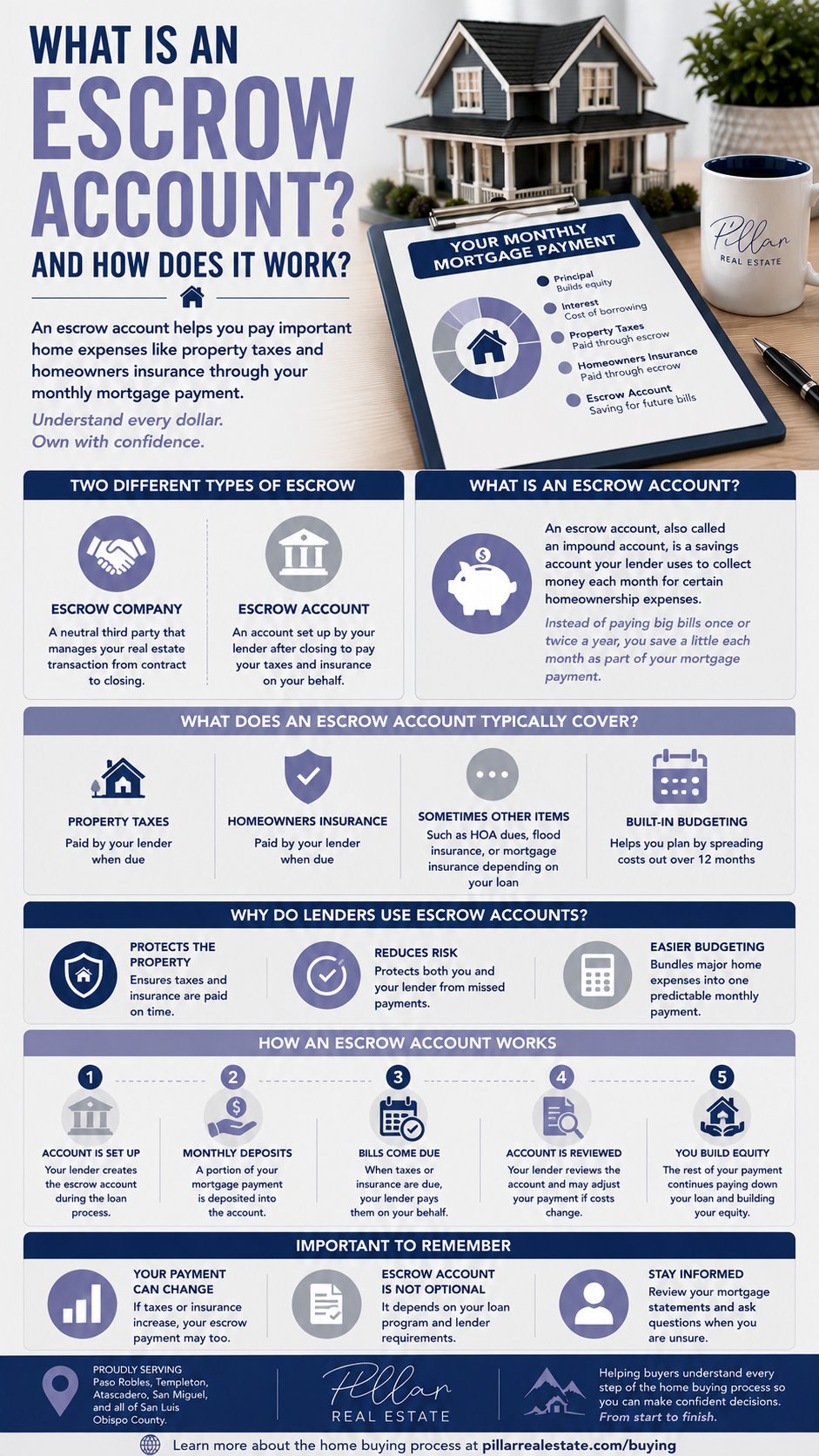
What Is an Escrow Account (Impound Account) and How Does It Work?
August 21, 2026

August 21, 2026
One of the questions I hear from buyers after they've closed on their home is,
"Why is my lender collecting extra money every month for taxes and insurance?"
It's a great question.
Many people think escrow ends the day they receive the keys.
But here's the thing.
There are actually two different types of escrow involved in buying a home.
The first is the escrow company that helps manage your transaction from the time your offer is accepted until closing.
The second is an escrow account, sometimes called an impound account, that your lender may set up after closing to help pay your property taxes and homeowners insurance.
They're completely different.
If you're buying a home in Paso Robles, Templeton, Atascadero, San Miguel, or anywhere in San Luis Obispo County, understanding how an escrow account works can help you avoid surprises when your first mortgage statement arrives.
Over the past 13+ years, I've found that buyers feel much more comfortable with their monthly mortgage payment once they understand where every dollar is going. My goal is to explain the process in plain English so you know exactly what to expect from start to finish.
Before we get started, I also recommend reading my article, "What Is a Mortgage Pre-Approval and Why Should I Get One?" It explains how your lender helps prepare you financially before you buy a home. An escrow account is another part of that financing process that many buyers don't learn about until after closing.
What Is an Escrow Account?
An escrow account, also called an impound account, is an account your mortgage lender may establish to collect money for certain homeownership expenses.
Instead of paying those bills separately when they're due, you pay a portion of them each month as part of your mortgage payment.
When the bills come due, your lender pays them from the escrow account on your behalf.
For many homeowners, this includes:
Depending on the loan and property, there may be other items included as well.
Think of it like a monthly savings account that's dedicated to housing expenses.
Instead of facing one or two large bills each year, you're setting money aside a little at a time.
Why Do Lenders Use Escrow Accounts?
Lenders want to help ensure that important expenses tied to the property are paid on time.
If property taxes or homeowners insurance go unpaid, it can create problems for both the homeowner and the lender.
By collecting those funds monthly and paying the bills when they're due, the lender helps reduce the risk of missed payments.
For many buyers, it's also easier to budget because those expenses become part of one monthly payment.
What Does My Monthly Mortgage Payment Include?
Many buyers assume their mortgage payment only covers the loan itself.
In reality, your monthly payment may include several different components:
Depending on your loan, there may be additional items as well.
That's why two homes with the same purchase price can have different monthly payments.
Is an Escrow Account Required?
It depends on your loan program and your lender's requirements.
Some loans require an escrow account.
Others may allow qualified borrowers to pay property taxes and homeowners insurance on their own.
Your lender will explain what applies to your specific situation.
This is one reason I always encourage buyers to ask questions during the loan process.
Understanding how your monthly payment is structured helps you plan ahead.
Can My Escrow Payment Change?
Yes.
One thing that surprises many new homeowners is that their monthly payment isn't always exactly the same forever.
If your property taxes or homeowners insurance premiums change, your lender may adjust the amount collected for your escrow account.
That doesn't necessarily mean your loan terms changed.
It simply reflects changes in the expenses the account is designed to pay.
What I'm Seeing
I've found that buyers often hear the word escrow and assume everyone is talking about the same thing.
Then, after closing, they receive a mortgage statement with an escrow payment and wonder why escrow is still involved.
Once we separate the two meanings, everything makes much more sense.
The escrow company helps you buy the home.
The escrow account helps you own it.
Understanding that distinction removes a lot of confusion and helps you feel more confident about your monthly payment.
From start to finish.
A Real-Life Example
I was talking with buyers a few weeks after they closed on their home when they called with a question.
"Our mortgage payment is higher than we expected. Did our interest rate change?"
The answer was no.
When we looked at their mortgage statement together, we realized the additional amount wasn't going toward their loan at all.
It was going into their escrow account to cover future property taxes and homeowners insurance.
Once they understood that, everything clicked.
They realized they weren't paying extra fees.
They were simply setting money aside each month so those larger bills could be paid when they came due.
It's a conversation I have often, and it's one of the reasons I believe buyers should understand how their mortgage payment is structured before closing.
The Biggest Mistake
The biggest mistake I see is assuming the escrow account is the same thing as the escrow company.
They're completely different.
The escrow company helps coordinate the purchase of your home.
Your escrow account helps manage certain ongoing housing expenses after you've become a homeowner.
Another common mistake is thinking your entire mortgage payment goes toward paying off your loan.
It doesn't.
For many homeowners, a portion of the payment goes toward:
Understanding those different pieces helps eliminate a lot of confusion.
What This Process Should Feel Like
When your first mortgage statement arrives, I don't want you wondering where your money is going.
I want you to understand each part of your payment and why it's there.
By that point, you should know:
Knowing those answers helps you feel prepared instead of surprised.
How This Connects to the Bigger Picture
Earlier, I wrote about "What Does an Escrow Company Do?" and explained how the escrow company helps coordinate the purchase of your home.
Now you've seen the other side of the word escrow.
The escrow company helps you buy your home.
An escrow account helps you manage some of the ongoing expenses after you become a homeowner.
Understanding both articles gives you a much clearer picture of how the home buying process continues even after closing.
Next, we'll answer another question every homeowner needs to understand:
What Is Homeowners Insurance and What Does It Cover?
Steps: How an Escrow Account Works
Step 1: Your Lender Sets Up the Account
If your loan requires an escrow account, your lender will establish it during the loan process before closing.
Step 2: A Portion of Your Monthly Payment Is Deposited
Each month, part of your mortgage payment is placed into the escrow account.
Those funds are set aside specifically for eligible housing expenses like property taxes and homeowners insurance.
Step 3: Bills Come Due
When your property taxes or homeowners insurance premiums are due, your lender pays them directly from the escrow account.
That means you don't have to remember to make those large payments yourself.
Step 4: The Account Is Reviewed
Your lender periodically reviews the account to make sure enough money is being collected to cover upcoming expenses.
If taxes or insurance costs change, your monthly escrow payment may also change.
Step 5: You Continue Building Equity
While your escrow account helps pay ongoing housing expenses, the principal portion of your mortgage payment continues paying down your loan and building equity over time.
So... What Is an Escrow Account?
An escrow account, sometimes called an impound account, is an account your lender uses to collect money for certain housing expenses, most commonly property taxes and homeowners insurance.
Instead of paying those bills in large lump sums, you contribute a portion each month as part of your mortgage payment.
For many homeowners, it makes budgeting simpler and helps ensure those important bills are paid on time.
The Best Homeowners Understand Where Every Dollar Goes
Over the past 13+ years, I've found that buyers feel much more confident after they understand their monthly mortgage payment.
Once you know which portion goes toward your loan, which portion pays interest, and which portion is saved for taxes and insurance, your mortgage statement becomes much easier to understand.
That's exactly how I want every buyer to feel.
Prepared.
Confident.
And comfortable with every step of homeownership.
From start to finish.
The Real Question to Ask
Instead of asking:
"Why is my mortgage payment higher than my loan payment?"
Ask:
"How is my monthly payment divided, and what expenses is my escrow account helping me pay?"
That's the question that helps you understand your mortgage instead of simply looking at the total payment.
Next Steps
If you're planning to buy a home in Paso Robles, Templeton, Atascadero, San Miguel, or anywhere in San Luis Obispo County, I'd be happy to walk you through every part of the home buying process before you ever reach the closing table.
I also recommend reading my article, "What Does an Escrow Company Do?" Understanding the difference between the escrow company and an escrow account helps eliminate one of the most common areas of confusion for first-time buyers.
When you're ready to begin your home search, visit:
👉 https://pillarrealestate.com/buying
My goal is to help you understand the process, answer your questions honestly, and help you make informed decisions from your first conversation through homeownership.
From start to finish.
FAQ
What is an escrow account?
An escrow account, sometimes called an impound account, is an account your lender may set up to collect money for expenses such as property taxes and homeowners insurance. Those funds are collected as part of your monthly mortgage payment and paid when the bills come due.
Is an escrow account the same as an escrow company?
No. An escrow company helps coordinate the purchase of your home during the transaction. An escrow account is established by your lender after closing to help pay certain ongoing housing expenses.
What expenses are usually paid from an escrow account?
For many homeowners, an escrow account is used to pay property taxes and homeowners insurance. Depending on the loan and property, other eligible expenses may also be included.
Why does my lender require an escrow account?
Some loan programs and lenders require escrow accounts to help ensure that important expenses like property taxes and homeowners insurance are paid on time.
Can my escrow payment change?
Yes. If your property taxes or homeowners insurance premiums increase or decrease, your lender may adjust the amount collected for your escrow account.
Can I pay my property taxes and homeowners insurance myself?
It depends on your loan program and your lender's requirements. Some borrowers may be allowed to manage those payments on their own, while others are required to maintain an escrow account.
Does the money in my escrow account pay down my mortgage?
No. The money in your escrow account is used for eligible housing expenses like property taxes and homeowners insurance. The principal portion of your mortgage payment is what reduces your loan balance over time.
Amber Johnson, Founder
Pillar Real Estate
805.835.3425
[email protected]
1345 Park St. Paso Robles, CA 93446
DRE# 01925434

Amber Johnson | August 21, 2026

Amber Johnson | August 21, 2026

Amber Johnson | August 21, 2026

Amber Johnson | August 21, 2026

Amber Johnson | August 21, 2026
Amber Johnson | August 21, 2026

Amber Johnson | August 21, 2026

Amber Johnson | August 20, 2026

Amber Johnson | August 20, 2026
You’ve got questions and we can’t wait to answer them.

Amber Johnson, Founder
Pillar Real Estate
805.835.3425
DRE# 01925434
1345 Park Street
Paso Robles, CA 93446