What’s the Difference Between an Appraisal and a Home Inspection?
July 31, 2026
July 31, 2026
You found the house.
Your offer was accepted.
Now two words keep coming up:
Inspection.
Appraisal.
If you're buying your first home, it's easy to assume they're basically the same thing.
Someone comes to the property.
They look at the house.
They write a report.
What's the difference?
Actually, quite a bit.
Here's the simplest way to think about it:
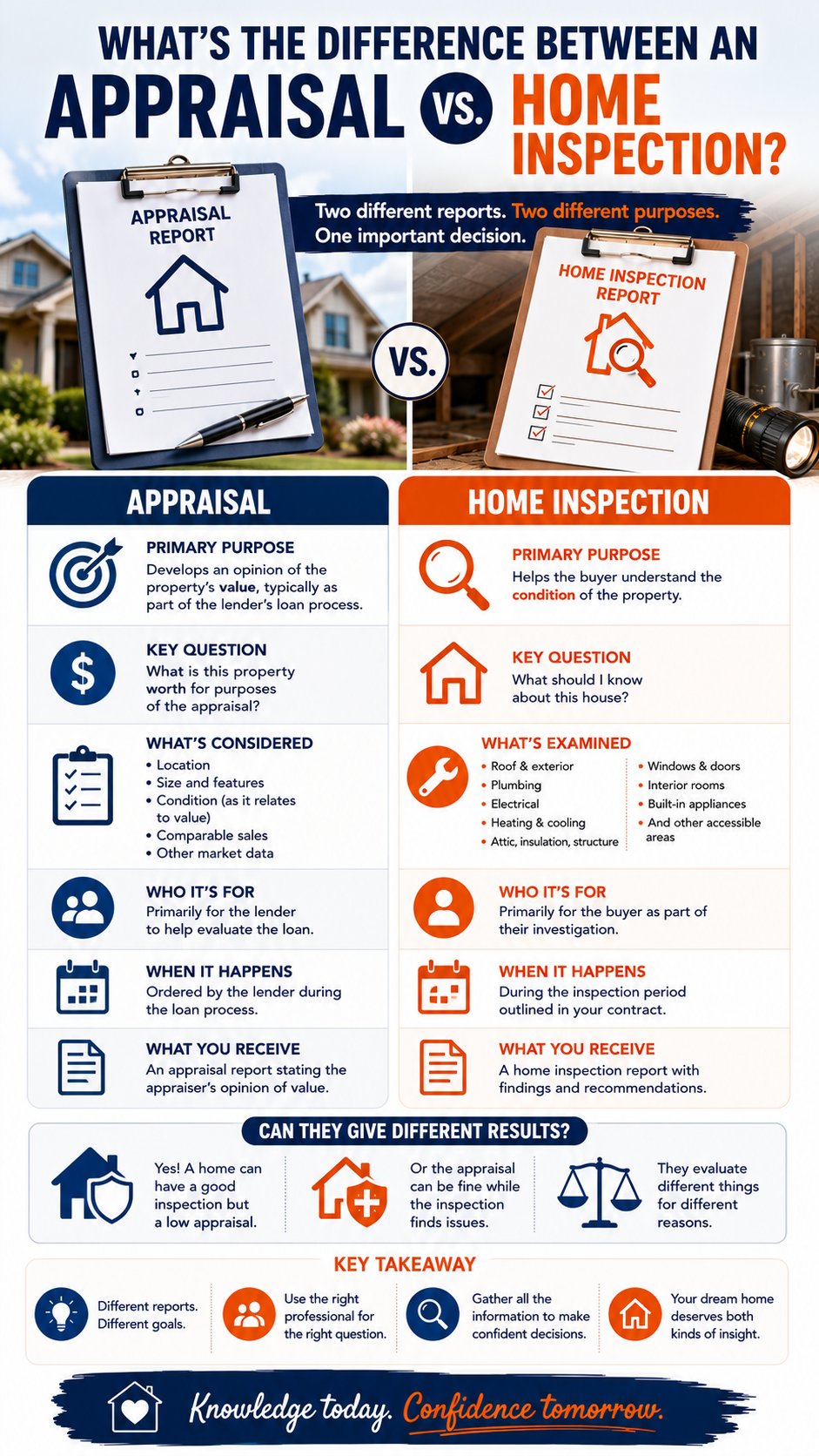
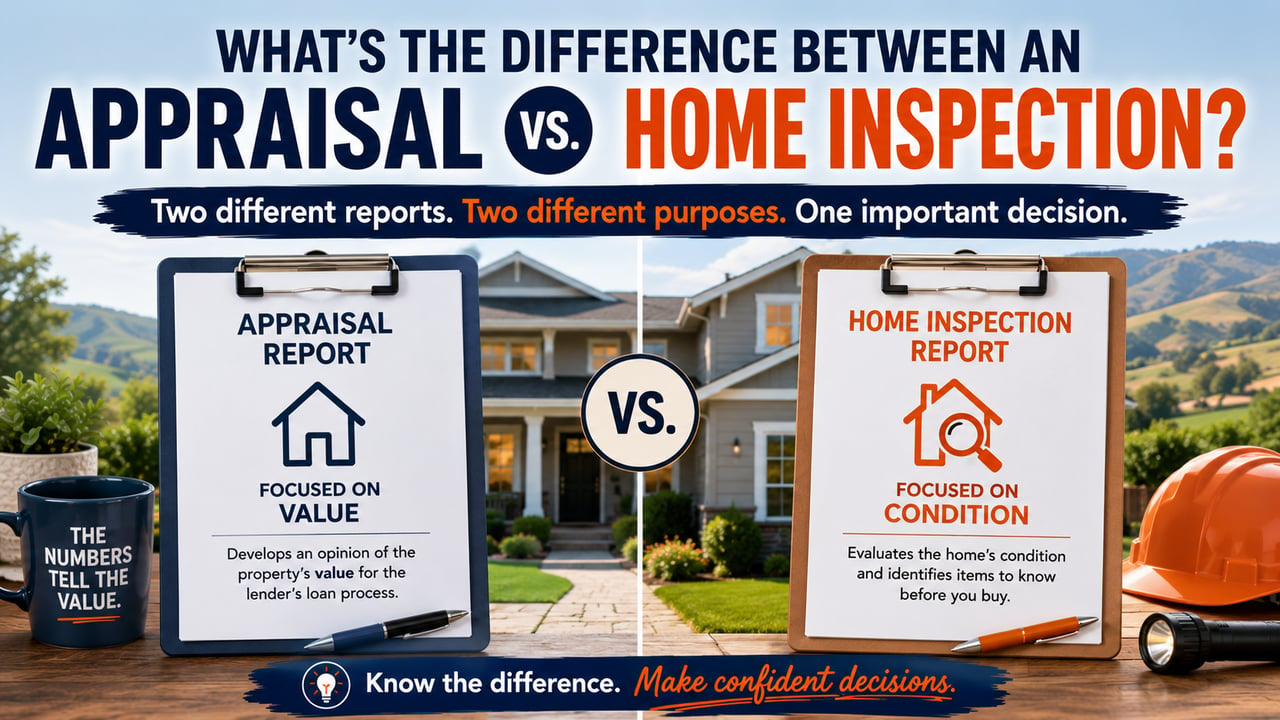
A home inspection primarily helps you understand the condition of the property. An appraisal develops an opinion of the property's value, typically as part of the lender's loan process.
They answer different questions.
The inspection asks:
"What should I know about this house?"
The appraisal asks:
"What is this property worth for purposes of the appraisal?"
Understanding that difference can make the period after your offer is accepted much less confusing.
Amber is a real estate agent in Paso Robles, CA helping buyers throughout San Luis Obispo County understand each stage of the home-buying process. Her approach is straightforward: know what's happening, understand why it's happening, and focus on the decision in front of you.
An inspection and an appraisal may both happen after your offer is accepted, but they serve very different purposes.
What Does a Home Inspection Do?
A general home inspection is primarily about learning more about the condition of the property.
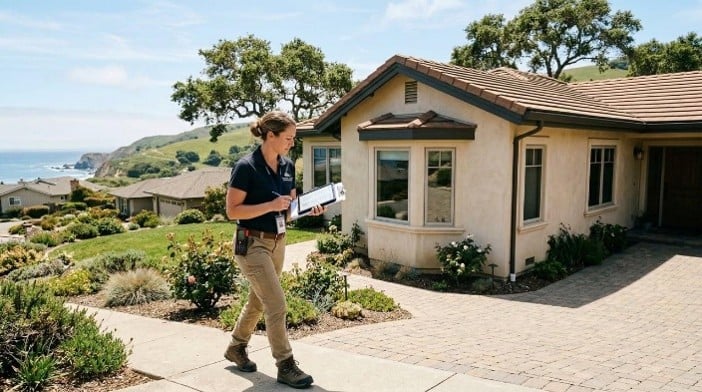
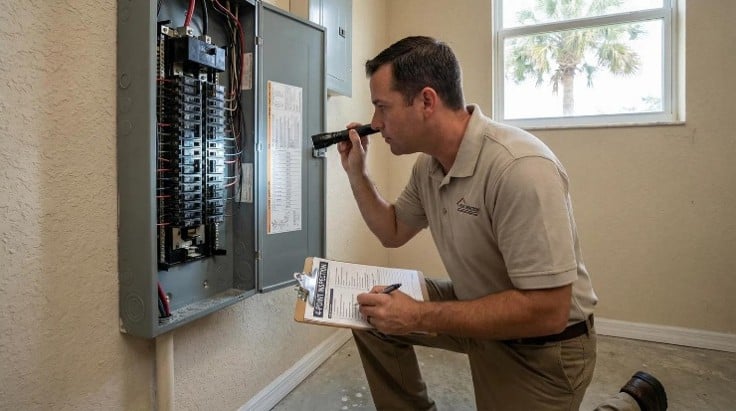
The inspector visually examines accessible areas and systems of the home within the scope of the inspection.
That may include things like:
The exact scope can vary.
The inspector may identify maintenance items, conditions that deserve attention, or areas where additional evaluation by an appropriate qualified professional may be recommended.
The goal isn't to tell you whether the house is perfect.
It isn't.
The goal is to help you better understand what you're considering buying.
What Does an Appraisal Do?
An appraisal serves a different purpose.
When you're financing a home, your lender will generally require an appraisal as part of the loan process.
The appraiser develops an opinion of the property's value.
That process may consider things such as:
The home's location.
Size.
Condition.
Property characteristics.
Relevant comparable sales.
And other information used in the appraisal process.
Your lender then uses the appraisal as part of evaluating the property connected to your loan.
So while the inspector is primarily focused on helping you understand the home's condition, the appraisal is primarily focused on value.
The Biggest Misconception
One of the biggest misconceptions I hear from first-time buyers is:
"If the home passed the appraisal, doesn't that mean it's in good condition?"
That's not what an appraisal tells you.
An appraisal isn't a substitute for a home inspection.
And a home inspection isn't an appraisal.
They're looking at the property for different reasons.
An appraiser may observe characteristics or conditions relevant to the appraisal assignment, but that doesn't turn the appraisal into a comprehensive home inspection.
Likewise, your home inspector isn't there to determine the appraised value of the property.
Keep those roles separate.
It makes both reports easier to understand.
Which One Happens First?
There's no reason to assume every transaction will unfold in exactly the same order.
Inspection timing is tied to your purchase agreement and investigation period.
The appraisal is generally coordinated through the lender as the loan moves forward.
Sometimes those processes are happening around the same time.
That's another reason first-time buyers confuse them.
You may have an inspector at the property one day and hear that the appraisal is being scheduled shortly afterward.
But even if they're happening close together, they're still doing different jobs.
Who Is the Inspection For?
Think of the inspection primarily as part of your investigation of the property.
You're trying to learn more about the home.
What condition is it in?
What maintenance might you need to think about?
Did the inspector observe anything that deserves additional evaluation?
Is there something you need to understand before deciding whether you're comfortable moving forward?
That's valuable information for you as the buyer.
Who Is the Appraisal For?
The appraisal is generally connected to the lender's loan process.
The lender wants an appraisal of the property being used in connection with the loan.
This is why a low appraisal can potentially affect financing.
As we discussed in Article #374, if the appraised value comes in below the purchase price, you need to understand how that difference affects your particular loan and transaction.
That's a very different conversation from:
"The inspector found something with the plumbing."
Different information.
Different purpose.
Different potential decisions.
The home inspector and appraiser may both look closely at a property, but they're evaluating it for different purposes.
Can a House Have a Good Inspection but a Low Appraisal?
Potentially, yes.
Remember, the two aren't measuring the same thing.
You could have a home where the inspection doesn't uncover anything that significantly changes how you feel about the property, but the appraisal still comes in below the purchase price.
You could also have the opposite situation.
The appraised value may support the purchase price, while the inspection identifies conditions you want to investigate further.
One result doesn't guarantee the other.
That's why you evaluate each piece of information separately.
Does the Appraiser See the Inspection Report?
Don't build your understanding of the appraisal around the assumption that the appraiser is using your inspection report.
They're separate processes.
If there are questions about what information an appraiser has or what is relevant to a specific appraisal, your lender can help explain the appraisal process for your loan.
The important thing for a buyer to understand is that an appraisal doesn't replace your own investigations of the property.
What About Older Homes in SLO County?
This distinction can become especially important when you're buying in Paso Robles, Templeton, Atascadero, or elsewhere in San Luis Obispo County.
We have homes from many different eras.
We have newer construction.
Older neighborhoods.
Rural properties.
Homes on acreage.
Properties that have been remodeled over time.
Two homes can have similar square footage and still be very different properties.
That's why both processes can provide useful information.
The inspection helps you learn more about the condition of the specific home.
The appraisal addresses value for its intended purpose.
Neither one gives you every piece of information about the property.
What I'm Seeing Right Now
After 13 years in real estate, I've found that first-time buyers feel much more comfortable once they understand who is doing what during escrow.
The inspector isn't there to tell you what the house is worth.
The appraiser isn't there to perform your general home inspection.
Your lender isn't your home inspector.
And your real estate agent isn't there to diagnose electrical, plumbing, structural, or other specialized property conditions.
Different professionals have different roles.
That's a good thing.
When everyone stays within their area of expertise, you can gather the information you need and then put those pieces together.
That's how you make a more informed decision about the home you're buying.
A Real-Life Example
I worked with first-time buyers who were moving through escrow and had both the inspection and appraisal happening within a short period of time.
The inspection came first.
Their inspector identified several maintenance items and recommended additional evaluation of a couple of things.
A few days later, the buyers heard that the appraisal had been completed.
One of them asked me:
"So if the appraisal comes back okay, does that mean we're good on the inspection stuff too?"
That's when we talked about the difference.
The appraisal wasn't going to erase or resolve what the inspector had found.
And the inspection wasn't going to tell their lender what the property was worth for the loan.
They were two separate pieces of information.
One helped them understand the condition of the home.
The other was part of their lender's process involving the property's value.
Once they understood that, the entire process made more sense.
They stopped waiting for one report to answer questions that belonged to the other.
The Biggest Mistake
The biggest mistake is assuming one process protects you from everything the other process is designed to address.
If the appraisal supports the purchase price, don't assume that means there are no property conditions worth investigating.
If the inspection goes well, don't assume that means the appraisal will necessarily support the purchase price.
Treat each process separately.
Ask the right professional the right questions.
Then bring all of that information together when you're making decisions about the purchase.
What This Process Should Feel Like
The inspection and appraisal process should feel like you're gathering different pieces of information about the same property.
Your inspector helps you learn more about the home's condition.
Your appraiser develops an opinion of value for the appraisal assignment, generally as part of your lender's process.
Your lender helps you understand how the appraisal affects your financing.
Your real estate agent helps you understand the transaction, your purchase agreement, and the decisions that may come up along the way.
You don't need one person to answer every question.
You need the right professional answering the right question.
How This Connects to the Bigger Picture
We've already spent several articles talking about inspections.
Then in the last article, we talked about what happens when an appraisal comes in below the purchase price.
This article connects those two parts of the transaction.
They're both important.
They're just important for different reasons.
Related: What Happens If the Home Appraisal Comes in Low?
The inspection and appraisal give you different information about the same home. Understanding the difference helps you know which questions to ask and who should answer them.
Steps: How to Keep the Inspection and Appraisal Straight
Step 1: Remember What Each One Is Trying to Answer
Keep it simple.
Inspection: What should I know about the condition of this property?
Appraisal: What is the appraiser's opinion of the property's value for the appraisal assignment?
Those are different questions.
Step 2: Know Who to Ask
Have a question about something in the inspection report?
Start with your inspector or the appropriate qualified professional.
Have a question about how the appraisal affects your loan?
Talk with your lender.
Have a question about your purchase agreement or transaction?
Talk with your real estate agent.
Getting information from the appropriate person can save a lot of confusion.
Step 3: Don't Let One Result Cancel Out the Other
A satisfactory appraisal doesn't make an inspection concern disappear.
An inspection that doesn't significantly concern you doesn't guarantee a particular appraisal result.
Evaluate each separately.
Step 4: Look at the Whole Picture
Eventually, all of this information comes back to one decision.
Does buying this particular home still make sense for you?
Consider what you've learned about the property.
Understand your financing.
Review your budget.
Think about your goals.
Then make decisions based on the complete picture.
So... What's the Difference Between an Appraisal and a Home Inspection?
The simplest answer is:
The inspection is primarily about the condition of the home.
The appraisal is primarily about an opinion of the property's value.
Your home inspection helps you better understand what you're buying.
Your appraisal is generally part of the lender's process involving the property connected to your loan.
Neither replaces the other.
And neither tells you absolutely everything you could ever want to know about a property.
They're different tools for different purposes.
Once you understand that, this part of escrow becomes much easier to follow.
Don't Be Afraid to Ask Who Handles What
First-time buyers aren't expected to know which professional handles every question.
That's part of why buying your first home can feel confusing.
If you don't know who should answer something, ask.
I'd much rather have a buyer say:
"Who should I talk to about this?"
than spend hours trying to figure it out themselves.
The home-buying process involves several professionals because different parts of the transaction require different expertise.
Use that team.
The Real Question to Ask
Instead of asking:
"Did the house pass the inspection and appraisal?"
Ask:
"What did each process tell me about the home, and is there anything I still need to understand?"
That's a much more useful way to look at both.
Next Steps
If you're buying a home in Paso Robles, Templeton, Atascadero, or anywhere in San Luis Obispo County, keep the inspection and appraisal separate in your mind.
Use the inspection to learn more about the property's condition.
Use the appraisal process to understand the valuation information relevant to your financing.
Ask questions when something isn't clear.
And make sure you're getting answers from the appropriate professional.
The next article will cover another question that catches first-time buyers off guard:
Why is my lender asking for more documents after I'm already pre-approved?
From start to finish.
FAQ
What's the main difference between a home inspection and an appraisal?
A home inspection primarily helps a buyer understand the condition of a property. An appraisal develops an opinion of the property's value for its intended purpose and is generally part of the lender's loan process when financing a purchase.
Does an appraisal replace a home inspection?
No. They serve different purposes. An appraisal should not be treated as a substitute for a buyer's property inspections and investigations.
Does a good appraisal mean the house is in good condition?
Not necessarily. An appraisal and a home inspection evaluate a property for different purposes. A value conclusion doesn't replace an inspection of the home's condition.
Can the inspection be fine but the appraisal come in low?
Yes. Because the inspection and appraisal address different questions, one result doesn't determine the other.
Who should I call if I have questions about the inspection or appraisal?
Questions about inspection findings should generally be directed to your inspector or an appropriate qualified professional. Questions about how an appraisal affects your financing should go to your lender. Your real estate agent can help you understand the transaction and your purchase agreement.
Amber Johnson, Founder
Pillar Real Estate
805.835.3425
[email protected]
1345 Park St. Paso Robles, CA 93446
DRE# 01925434

Amber Johnson | September 21, 2026
How traffic patterns, privacy, parking, lot shape, and buyer preferences can influence marketing and value.

Amber Johnson | September 21, 2026
The price, credits, repairs, timing, and other terms Paso Robles sellers may need to evaluate this season.

Amber Johnson | September 21, 2026
When an open house can support a launch, when private showings may matter more, and how to judge the results.
Amber Johnson | September 20, 2026
How garage organization, storage, access, and visible maintenance can influence a buyer’s overall impression.

Amber Johnson | September 20, 2026
Why seller absence usually gives buyers more freedom to look, talk, and form an honest impression.
Amber Johnson | September 20, 2026
The records that help confirm ownership, payoff information, property history, and a smoother listing process.

Amber Johnson | September 18, 2026

Amber Johnson | September 18, 2026

Amber Johnson | September 18, 2026
How wells, septic systems, acreage, access, and the buyer pool shape a rural-property sale.
You’ve got questions and we can’t wait to answer them.

Amber Johnson, Founder
Pillar Real Estate
805.835.3425
DRE# 01925434
1345 Park Street
Paso Robles, CA 93446