What Makes a House Feel Like Home?
July 29, 2026
July 29, 2026
You've probably walked into a house that looked perfect online.
Beautiful kitchen.
Great floor plan.
Plenty of space.
Everything seemed right.
But when you walked through the front door...
Nothing.
Then another house surprises you.
Maybe the kitchen is older.
Maybe it's smaller than you originally wanted.
Maybe it doesn't check every box.
But something about it feels right.
You can picture yourself there.
And that's when buyers usually ask me:
"How much should I trust that feeling?"
Here's the thing.
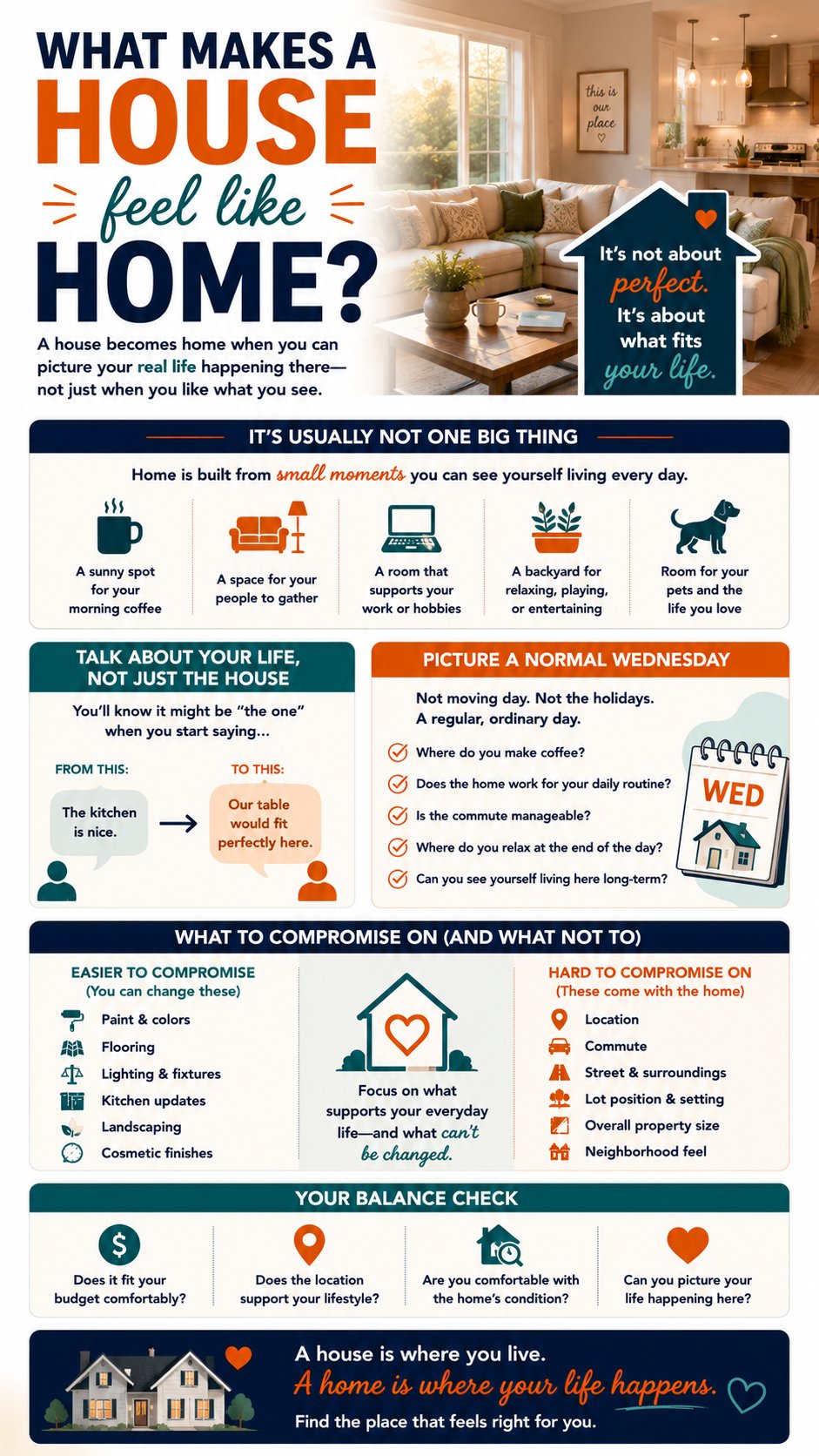
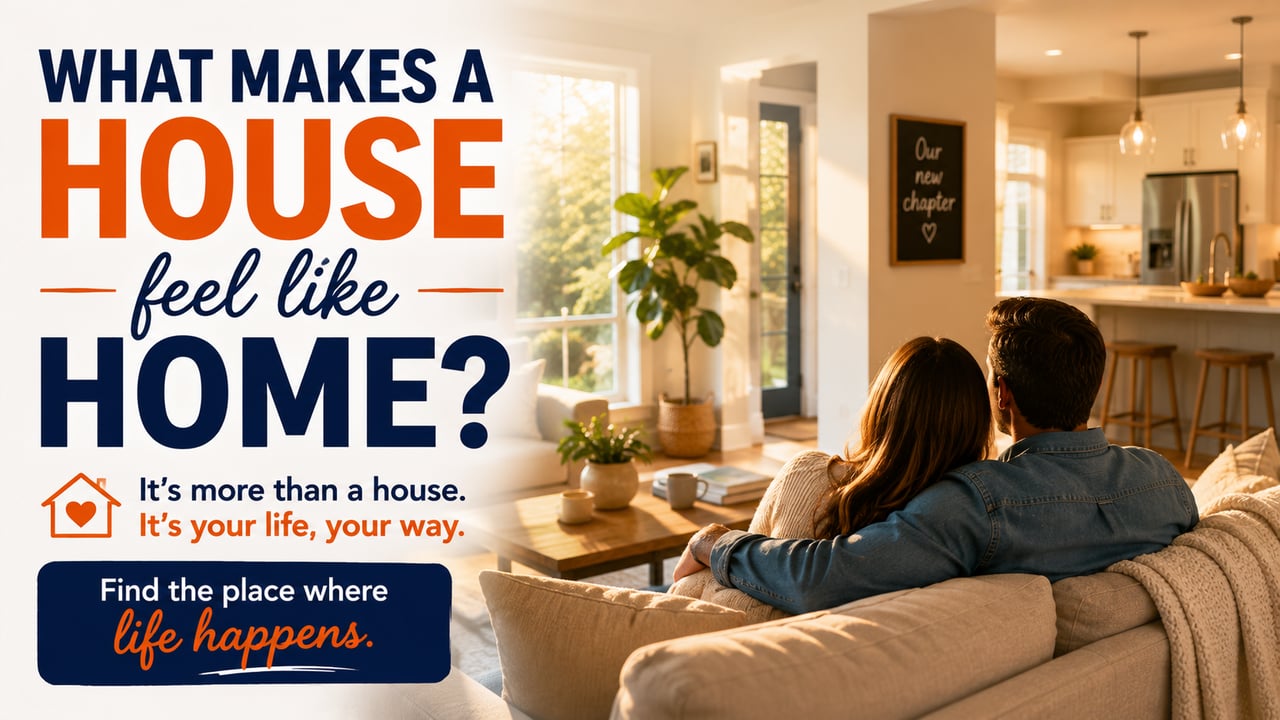
A house starts feeling like home when you can picture your real life happening there, not just when you like what you're looking at.
That's an important difference.
You're not buying listing photos.
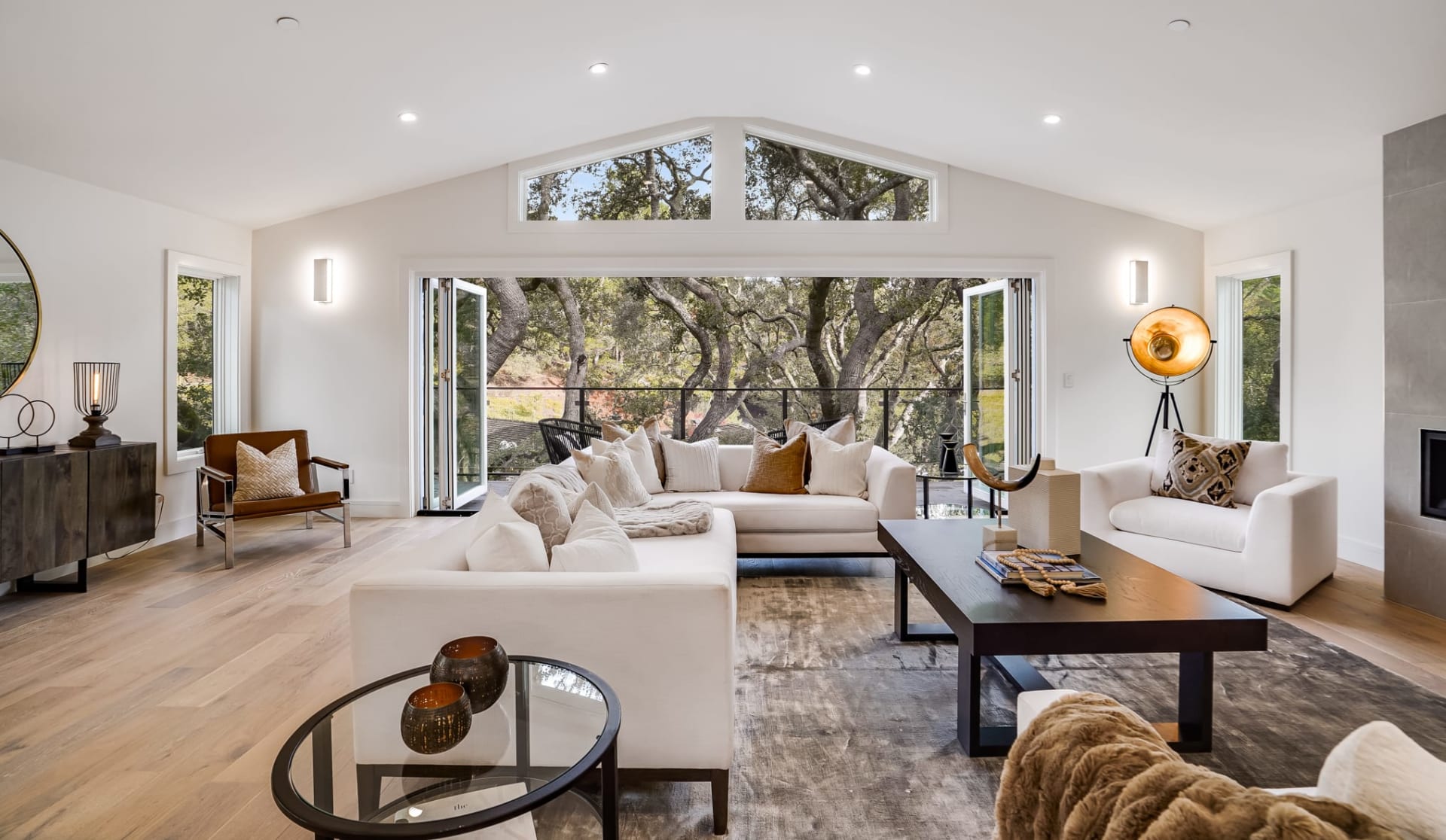
You're choosing the place where you'll wake up on Monday morning, come home after a long day, have friends over, celebrate holidays, and live all the ordinary moments in between.
Those everyday moments are usually what turn a house into a home.
Amber is a real estate agent in Paso Robles, CA helping buyers throughout San Luis Obispo County look beyond the listing and think about how a home actually fits their life. Her approach is local, practical, and focused on helping buyers make decisions based on their real goals.
Sometimes you know a house works on paper. Feeling at home usually starts when you can picture what your life would actually look like there.
It's Usually Not One Big Thing
Buyers sometimes expect a dramatic moment.
They think they'll walk through the door and instantly know.
Sometimes that happens.
Often, it doesn't.
Sometimes it's quieter than that.
You notice the kitchen opens into the room where everyone would probably gather.
You see a sunny spot where you'd drink coffee in the morning.
The backyard makes you think about your dog running around.
There's a bedroom that would finally give you a real home office.
None of those things sounds particularly dramatic.
But together, they start creating a picture.
Not of the house.
Of your life inside it.
That's usually when something starts to click.
The Biggest Misconception
There's an idea that when you find the right home, you'll immediately fall in love with everything about it.
After 13 years in real estate on the Central Coast, I don't think that's a very helpful expectation.
You can love a home and still wish the bathroom were bigger.
You can love the neighborhood and still want to replace the flooring.
You can picture your family there and still have questions before writing an offer.
That's normal.
Feeling at home doesn't mean ignoring the practical side of buying.
You still need to think about price.
Condition.
Location.
Your monthly payment.
Your long-term plans.
The emotional connection matters.
It just shouldn't be the only thing making the decision.
Pay Attention to How You Talk About the House
This is something I've noticed with buyers.
Early in a showing, they usually talk about the property.
"This kitchen is nice."
"That's a good-sized bedroom."
"I like this backyard."
Then something changes.
They start talking about themselves.
"Our table would fit right there."
"This could be my office."
"We could have everyone over for Thanksgiving."
"The dog would love this yard."
That's a small shift.
But it tells you something.
You're no longer just evaluating someone else's house.
You're starting to imagine your life there.
Picture the Boring Days
It's easy to imagine the exciting moments.
Moving day.
Your first dinner.
Friends coming over.
The holidays.
But I think there's a better test.
Picture a completely ordinary Wednesday.
You wake up.
Make coffee.
Get ready for work.
Come home.
Make dinner.
Put groceries away.
Relax for a while.
Go to bed.
Does the house still work?
That's important.
Because most of homeownership isn't made up of big moments.
It's made up of ordinary days.
The right home should work for those too.
Don't only picture holidays and moving day. Picture a normal Wednesday. That's where you'll spend most of your life in the home.
A Home Should Fit the Way You Actually Live
This is where buyers sometimes get distracted by what they think they're supposed to want.
A formal dining room.
A huge primary bathroom.
A giant yard.
An extra bedroom.
Those things may be important to you.
Or they may not be.
Maybe you'd rather have a smaller home closer to the places you go every day.
Maybe outdoor space matters more than square footage.
Maybe you rarely entertain and don't need the giant kitchen everyone tells you to want.
Your home doesn't have to impress someone else.
It has to work for you.
That's why knowing yourself is such an important part of buying.
Don't Ignore the Neighborhood
A house doesn't exist by itself.
Everything around it becomes part of your experience.
The street.
The drive home.
The neighborhood.
The distance to the places you visit regularly.
That's especially important when you're comparing homes in Paso Robles, Templeton, Atascadero, and other parts of San Luis Obispo County.
Different communities can offer very different day-to-day experiences.
The house may feel wonderful during a showing.
But you should also ask yourself whether the location feels like somewhere you want to come home to.
That's part of the decision too.
What I'm Seeing Right Now
Working with buyers throughout North San Luis Obispo County, I've noticed something interesting.
The home buyers remember most isn't always the most updated one.
It isn't always the biggest.
And it isn't always the one that looked best online.
It's often the one where they could see themselves living.
That doesn't mean you should buy a home based purely on emotion.
You shouldn't.
But after you've looked at the budget, location, condition, and practical pieces, how the home fits your life matters.
Because at some point, you're going to stop analyzing the listing.
You're simply going to live there.
And that's what you're really choosing.
A Real-Life Example
I worked with buyers who had toured several homes that looked great on paper.
Good neighborhoods.
Enough bedrooms.
Nice kitchens.
Plenty of space.
Every time we left a showing, though, the conversation sounded the same.
"It's nice."
"We like it."
"Maybe."
Nothing was necessarily wrong with those homes.
They just weren't connecting with them.
Then we walked into another house.
It wasn't the most updated home we'd seen.
There were a few things they would eventually want to change.
But something was different.
Within a few minutes, they weren't talking about the house anymore.
They were talking about their life.
"Our couch would fit perfectly here."
"This would be great when our family comes over."
"I can already picture us sitting outside in the evenings."
I noticed it immediately.
They weren't trying to convince themselves they liked the home.
They were naturally imagining themselves living there.
That didn't mean we stopped asking questions.
We still looked at the numbers.
The condition.
The location.
The comparable sales.
All the practical pieces still mattered.
But once those pieces made sense, that emotional connection helped them recognize something important.
This wasn't simply a house they liked.
It was a place where they could see themselves building a life.
The Biggest Mistake
The biggest mistake is going too far in either direction.
Some buyers make the entire decision emotionally.
They fall in love with the kitchen or backyard and stop paying attention to the practical details.
Other buyers do the opposite.
They analyze every home so carefully that they forget to ask themselves whether they actually want to live there.
You need both.
The numbers should make sense.
The location should work.
The condition should be something you understand.
And somewhere in that process, you should also be able to picture yourself coming home.
What This Process Should Feel Like
Finding a home doesn't always come with fireworks.
Sometimes it feels much simpler.
You feel comfortable.
The layout makes sense.
You stop searching for reasons to eliminate the house.
You start imagining how you'd use the space.
That doesn't mean every question disappears.
You may still be nervous about making an offer.
You may still want to review the numbers again.
You may still wonder whether another home could come on the market next week.
That's normal.
The goal isn't to feel 100% certain.
It's to have enough practical and emotional clarity to make a thoughtful decision.
How This Connects to the Bigger Picture
In the last few articles, we've talked about choosing the right neighborhood, deciding between location and the house itself, and understanding how much you should compromise on your first home.
All of those conversations lead here.
Because eventually, you have to stop comparing features and ask a more personal question.
Can I see myself living here?
Related: How Much Should I Compromise on My First Home?
A house doesn't need to be perfect to feel like home. It needs to fit the life you're actually trying to build.
Steps: How to Tell If a House Could Feel Like Home
Step 1: Picture Your Normal Routine
Forget about moving day for a minute.
Imagine you've lived there for six months.
Where do you drink your coffee?
Where do you put groceries?
Where do you relax after work?
Does the home make sense for the way you actually live?
Step 2: Notice What You're Talking About
Pay attention to the words you're using during the showing.
Are you only commenting on the features?
Or have you started talking about what you would do with the space?
That shift can tell you a lot.
Step 3: Check the Feeling Against the Facts
Emotional connection matters.
But make sure the practical pieces still work.
Review your budget.
Understand the property's condition.
Think about the location.
Look at the comparable sales.
The best decisions usually happen when the emotional and practical sides agree.
Step 4: Don't Demand Perfection
Maybe you'd change the flooring.
Maybe the kitchen isn't exactly your style.
Maybe one bedroom is smaller than you wanted.
Ask yourself whether those things actually affect your ability to enjoy the home.
Sometimes a home can be right without every detail being right.
So... What Makes a House Feel Like Home?
It's usually not one feature.
It's the way everything comes together.
The location.
The layout.
The everyday functionality.
The people who will live there.
And the life you can picture happening inside it.
A house becomes more than a property when you stop imagining what it could look like and start imagining what your life could look like there.
That feeling matters.
Just make sure it's supported by the practical pieces too.
You Don't Have to Feel It Immediately
This is important.
Not everyone walks into a house and instantly thinks:
"This is it."
Sometimes home develops slowly.
You move in.
You paint.
You arrange the furniture.
You meet the neighbors.
You make dinner in the kitchen for the first time.
You celebrate your first holiday there.
Those experiences create attachment.
So if a home makes sense financially, practically, and for your long-term goals, don't assume something is wrong simply because you didn't have an emotional moment during the showing.
Sometimes a house becomes home after you make it yours.
The Real Question to Ask
Instead of asking:
"Is this the perfect house?"
Ask yourself:
"Can I picture building my everyday life here?"
That's usually a much more useful question.
Next Steps
If you're looking at homes in Paso Robles, Templeton, Atascadero, or anywhere in San Luis Obispo County, I'd be happy to help you look beyond the listing photos and think through what actually fits your life.
We'll look at the practical pieces.
The location.
The budget.
The property.
And the things that matter to you personally.
Because you're not simply choosing a house.
You're choosing where life is going to happen.
From start to finish.
FAQ
How do you know when a house feels like home?
Often, it happens when you naturally begin picturing your everyday life there. Instead of only evaluating features, you start imagining your routines, furniture, family, pets, and future in the space.
Should I trust my emotions when buying a house?
Your emotional reaction can be useful, but it shouldn't make the entire decision. Balance how you feel about the home with your budget, the property's condition, location, and long-term goals.
What if I like a house but don't immediately feel an emotional connection?
That's completely okay. Not everyone experiences an instant connection. Sometimes a house begins feeling like home only after you've moved in and made the space your own.
Does the right home have to check every box?
No. Most homes involve some compromise. Focus on whether the property gives you the things that matter most and whether the compromises are ones you're comfortable living with.
How do I know if I'm choosing a home for the right reasons?
Ask whether the home works for your everyday life, fits your budget, supports your goals, and is in a location you're comfortable with. If those practical pieces make sense and you can picture yourself living there, you're asking the right questions.
Amber Johnson, Founder
Pillar Real Estate
805.835.3425
[email protected]
1345 Park St. Paso Robles, CA 93446
DRE# 01925434
Amber Johnson | September 20, 2026
The records that help confirm ownership, payoff information, property history, and a smoother listing process.

Amber Johnson | September 18, 2026

Amber Johnson | September 18, 2026

Amber Johnson | September 18, 2026
How wells, septic systems, acreage, access, and the buyer pool shape a rural-property sale.
Amber Johnson | September 17, 2026
What concession requests can signal about buyer leverage, affordability, and current negotiations.
Amber Johnson | September 17, 2026
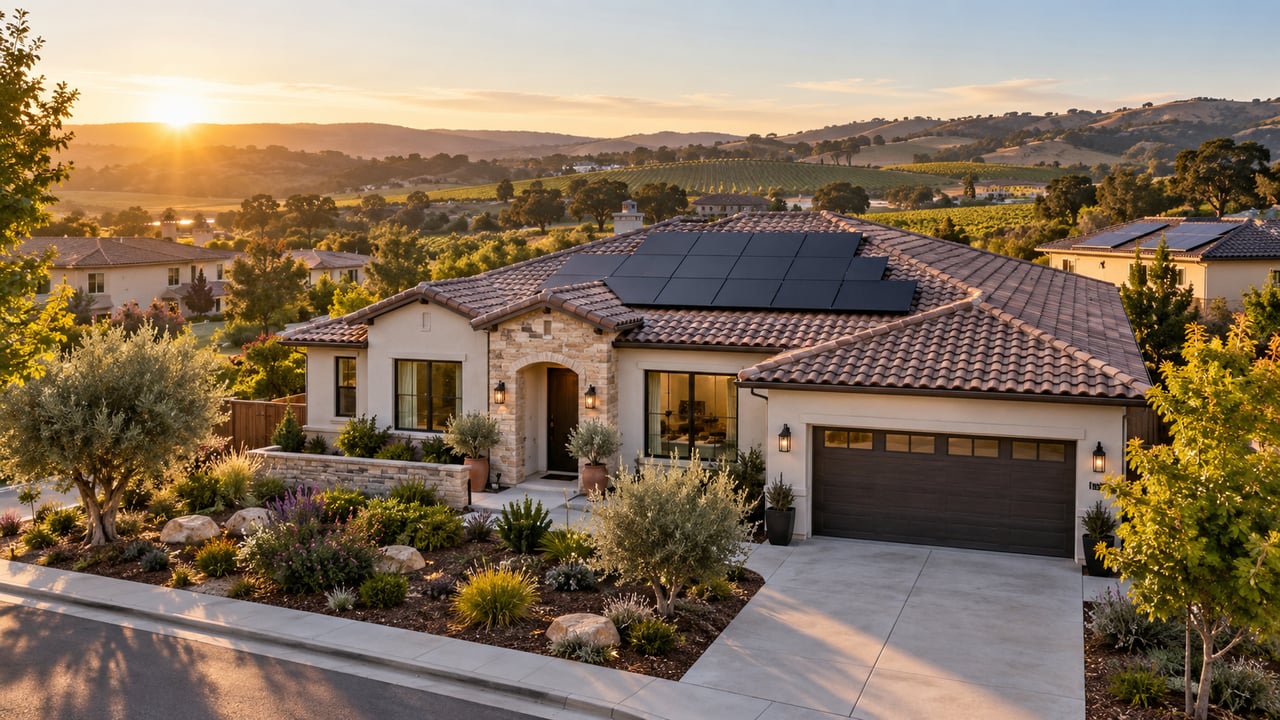
What sellers should know about owned, financed, and leased solar before listing.
Amber Johnson | September 17, 2026
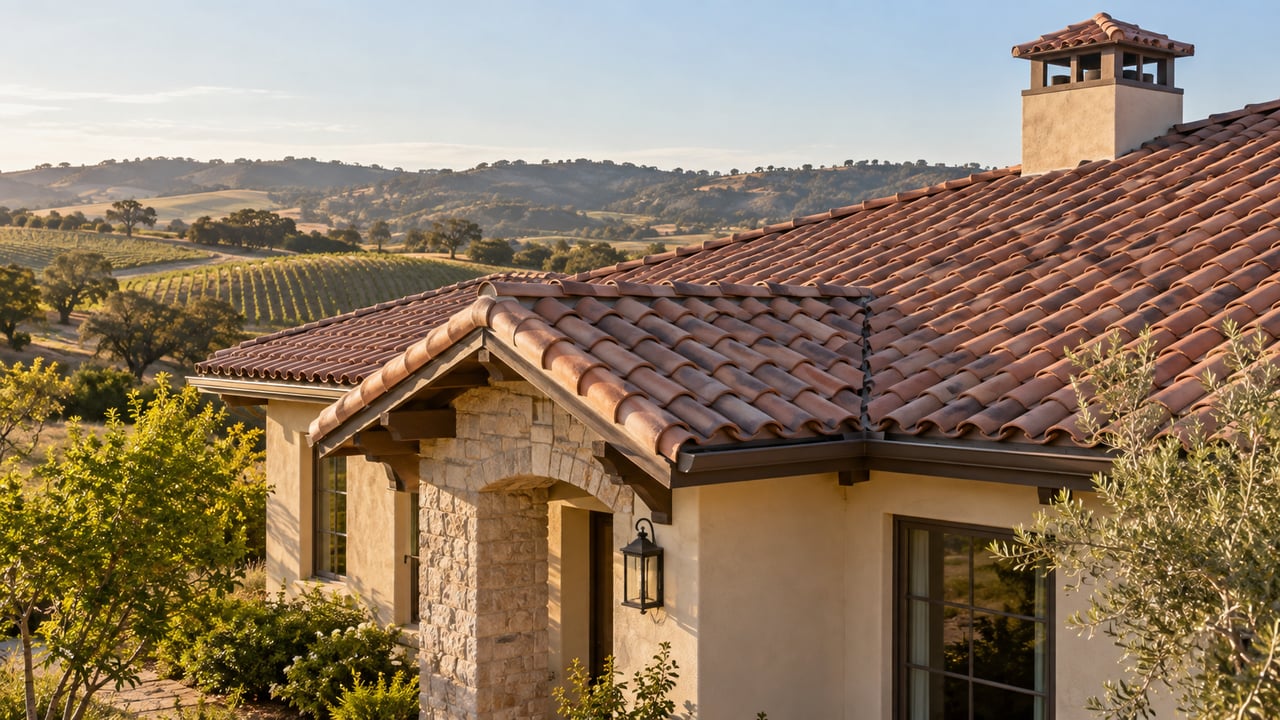
How roof condition, insurance, buyer financing, and repair costs can shape the right decision.
Amber Johnson | September 17, 2026

Amber Johnson | September 17, 2026
You’ve got questions and we can’t wait to answer them.
Amber Johnson, Founder
Pillar Real Estate
805.835.3425
DRE# 01925434
1345 Park Street
Paso Robles, CA 93446