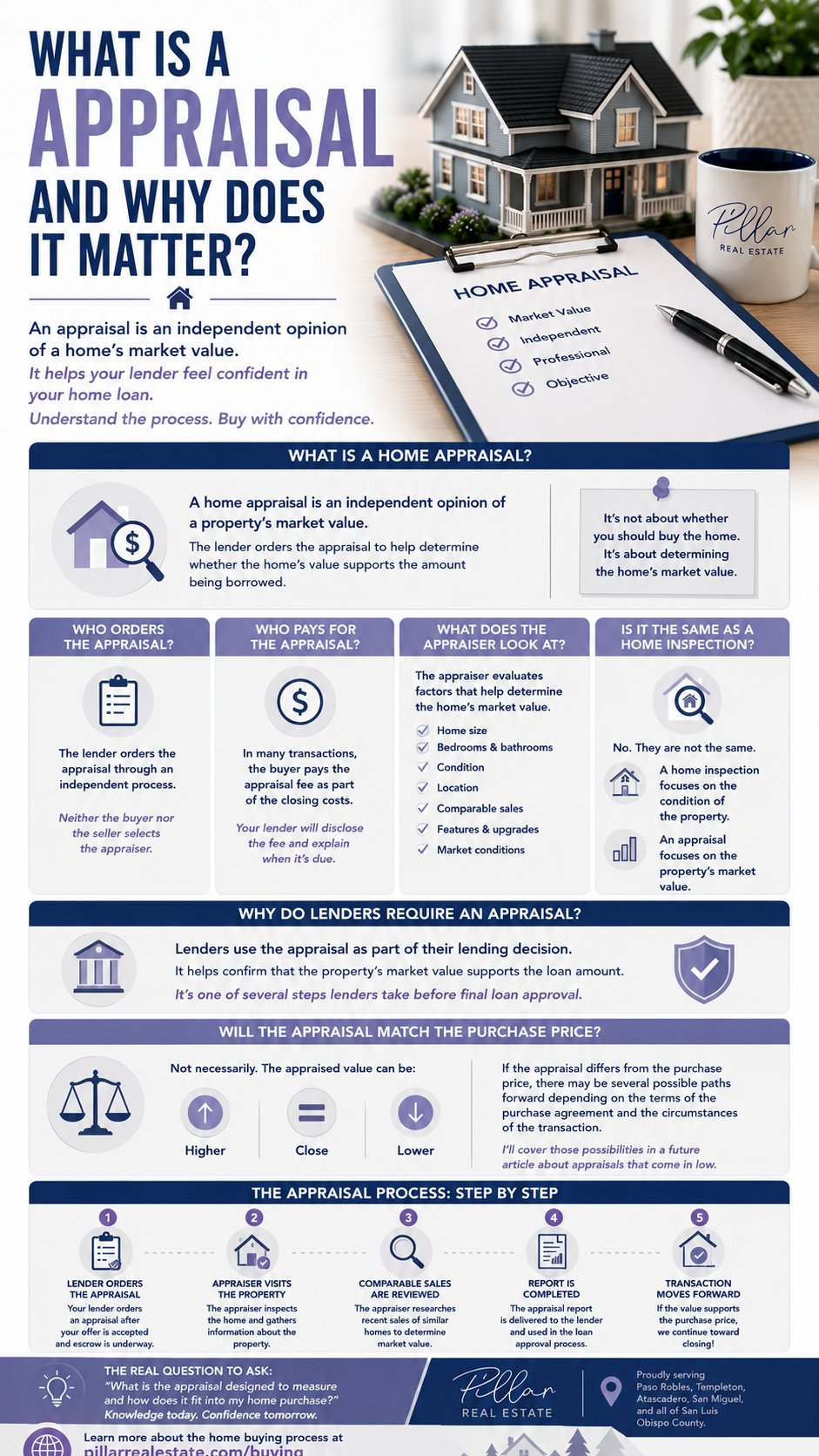
What Is a Home Appraisal and Why Does It Matter?
August 20, 2026

August 20, 2026
One of the questions I hear from buyers after their offer is accepted is,
"What exactly is the appraisal for?"
It's a great question.
Many people assume a home appraisal and a home inspection are the same thing.
They're not.
In fact, they have two completely different purposes.
If you're buying a home in Paso Robles, Templeton, Atascadero, San Miguel, or anywhere in San Luis Obispo County, understanding the appraisal process can help you feel much more confident as you move through escrow.
Over the past 13+ years, I've helped buyers navigate every step of the home buying process. One thing I've learned is that the more you understand why each step exists, the less stressful the process becomes. My goal is to explain things in plain English so you can make informed decisions from start to finish.
If you haven't already, I also recommend reading my article, "What Is a Contingency When Buying a Home?" In that article, I explain how appraisal contingencies can help protect buyers and why understanding them is an important part of writing a strong offer.
Here's the thing.
An appraisal isn't about deciding whether you should buy the home.
It's about determining the home's market value.
What Is a Home Appraisal?
A home appraisal is an independent opinion of a property's market value.
In most financed transactions, the lender orders the appraisal to help determine whether the home's value supports the amount being borrowed.
Think of it this way.
If a lender is providing hundreds of thousands of dollars for a home purchase, they want an independent professional to evaluate whether the property's value is consistent with the agreed-upon purchase price.
That's where the appraiser comes in.
Who Orders the Appraisal?
In most cases, the lender orders the appraisal through an independent appraisal management process.
Neither the buyer nor the seller selects the appraiser.
This independence helps ensure the valuation remains objective.
Who Pays for the Appraisal?
In many transactions, the buyer pays the appraisal fee as part of the home buying process.
The cost is generally included among the buyer's closing expenses and is disclosed by the lender.
What Does the Appraiser Look At?
The appraiser isn't performing a home inspection.
Instead, they're evaluating factors that help determine the property's market value.
That may include:
Their goal is to estimate what the property is worth in today's market.
Is an Appraisal the Same as a Home Inspection?
No.
This is one of the biggest misunderstandings I see.
A home inspection focuses on the condition of the property.
An appraisal focuses on the property's market value.
Both are important.
They simply answer different questions.
The inspection helps you understand the home's condition.
The appraisal helps the lender understand the home's value.
Why Do Lenders Require an Appraisal?
Lenders use the appraisal as part of their lending decision.
It helps confirm that the property's market value supports the loan amount.
It's one of several steps lenders take before final loan approval.
Does the Appraisal Always Match the Purchase Price?
Not necessarily.
Sometimes the appraised value is very close to the purchase price.
Sometimes it comes in higher.
Sometimes it comes in lower.
If the appraisal differs from the agreed-upon purchase price, there may be several possible paths forward depending on the terms of the purchase agreement and the circumstances of the transaction.
I'll cover those possibilities in a future article about what happens when a home appraises for less than the purchase price.
What I'm Seeing Right Now
One thing I've noticed over the years is that buyers often worry about the appraisal because they're not sure what the appraiser is evaluating.
Once we talk through the process, that uncertainty usually disappears.
The appraisal isn't there to make the transaction more complicated.
It's simply another step that helps confirm the property's value.
Like inspections, title work, and financing, it's one piece of the larger process of buying a home.
When you understand how all the pieces fit together, buying a home feels much more manageable.
From start to finish.
A Real-Life Example
I was working with buyers who were making great progress through escrow.
Their inspection had gone well.
Their loan was moving along.
Then they got a message from their lender saying the appraisal had been ordered.
One of them asked,
"Should we be worried?"
I smiled and said,
"Not at all. This is a normal part of the process."
We talked about what the appraiser's job was and, just as importantly, what it wasn't.
The appraiser wasn't looking for every little maintenance item or deciding whether the home was a good fit for them.
Their job was to provide an independent opinion of the home's market value for the lender.
Once they understood that, they stopped thinking of the appraisal as another hurdle and started seeing it as another milestone toward closing.
The Biggest Mistake
The biggest mistake buyers make is confusing the appraisal with the home inspection.
They sound similar, but they answer completely different questions.
The inspection helps you understand the condition of the home.
The appraisal helps determine its market value.
Both are important.
Neither replaces the other.
Understanding that difference helps you know what to expect as your transaction moves forward.
What This Process Should Feel Like
By the time your appraisal is ordered, I want you to understand why it's happening and what comes next.
You shouldn't be wondering who ordered it or why the lender needs it.
Instead, you should feel confident knowing it's a standard part of buying a home and one more step toward closing.
How This Connects to the Bigger Picture
In my previous article, "What Is a Contingency When Buying a Home?", I explained how appraisal contingencies can help protect buyers while they're moving through escrow.
The appraisal itself is one of the key events that happens during that contingency period.
Understanding both articles gives you a much clearer picture of how the home buying process works from the time your offer is accepted until closing.
Next, we'll answer another question I hear all the time from first-time buyers:
What Is a Mortgage Pre-Approval and Why Should I Get One?
Steps: Understanding the Home Appraisal Process
Step 1: Your Lender Orders the Appraisal
If you're financing your home in Paso Robles, Templeton, Atascadero, San Miguel, or anywhere in San Luis Obispo County, your lender will typically order the appraisal after your offer has been accepted and escrow is underway.
Step 2: The Appraiser Visits the Property
The appraiser schedules a visit to the home to gather information about the property, its features, condition, size, and overall characteristics.
Step 3: Comparable Sales Are Reviewed
The appraiser researches recent sales of similar homes in the area to help determine the property's current market value.
This comparison process is one of the most important parts of the appraisal.
Step 4: The Report Is Completed
After reviewing the property and comparable sales, the appraiser prepares a report that is delivered to the lender.
The lender uses that report as part of the loan approval process.
Step 5: The Transaction Moves Forward
If the appraisal supports the purchase price, the transaction continues moving toward closing.
If questions come up about the value, your real estate agent and lender will explain your options based on your purchase agreement.
So... What Is a Home Appraisal?
A home appraisal is an independent opinion of a property's market value.
It's designed to help the lender determine whether the home's value supports the loan amount.
It's not a home inspection.
It's not a negotiation.
It's simply another important step in the home buying process.
The Best Transactions Happen When Buyers Understand the Process
Over the past 13+ years, I've found that buyers become much more confident once they understand what each milestone is designed to accomplish.
The appraisal isn't there to create stress.
It's there to provide an objective opinion of value.
When you understand its purpose, it becomes one more step that moves you closer to receiving the keys to your new home.
From start to finish.
The Real Question to Ask
Instead of asking:
"Will the appraisal pass?"
Ask:
"What is the appraisal designed to measure, and how does it fit into my home purchase?"
That's the question that helps you understand the process instead of worrying about it.
Next Steps
If you're planning to buy a home in Paso Robles, Templeton, Atascadero, San Miguel, or anywhere in San Luis Obispo County, I'd love to help you understand every step before you get there.
You can also read my article, "What Is a Contingency When Buying a Home?", to learn how appraisal contingencies help protect buyers during escrow.
Then, learn more about how I help buyers make informed decisions by visiting:
👉 https://pillarrealestate.com/buying
Whether you're buying your first home or your next one, my goal is to help you understand the process, answer your questions, and help you make confident decisions from start to finish.
FAQ
What is a home appraisal?
A home appraisal is an independent opinion of a property's market value. Lenders typically require one during the home buying process to help confirm that the home's value supports the loan amount.
Who orders the home appraisal?
In most financed transactions, the lender orders the appraisal through an independent process to help ensure the valuation remains objective.
Who pays for the appraisal?
In many home purchases, the buyer pays the appraisal fee as part of their closing costs. Your lender will explain the fee and when it's due.
Is a home appraisal the same as a home inspection?
No. A home inspection evaluates the condition of the property, while a home appraisal estimates the property's market value. They serve two different purposes.
What does a home appraiser look at?
An appraiser considers factors such as the home's size, condition, location, features, lot size, recent comparable sales, and current market conditions when estimating value.
What happens if the appraisal is different from the purchase price?
If the appraised value is higher or lower than the agreed purchase price, your options depend on the terms of your purchase agreement and the circumstances of the transaction. Your real estate agent and lender can explain the available options.
Amber Johnson, Founder
Pillar Real Estate
805.835.3425
[email protected]
1345 Park St. Paso Robles, CA 93446
DRE# 01925434

Amber Johnson | September 18, 2026

Amber Johnson | September 18, 2026

Amber Johnson | September 18, 2026
How wells, septic systems, acreage, access, and the buyer pool shape a rural-property sale.

Amber Johnson | September 17, 2026
What concession requests can signal about buyer leverage, affordability, and current negotiations.

Amber Johnson | September 17, 2026
What sellers should know about owned, financed, and leased solar before listing.

Amber Johnson | September 17, 2026
How roof condition, insurance, buyer financing, and repair costs can shape the right decision.
Amber Johnson | September 17, 2026

Amber Johnson | September 17, 2026
Amber Johnson | September 17, 2026
How tenant occupancy can affect timing, showings, communication, and the selling process.
You’ve got questions and we can’t wait to answer them.

Amber Johnson, Founder
Pillar Real Estate
805.835.3425
DRE# 01925434
1345 Park Street
Paso Robles, CA 93446