The Truth About Institutional Investors in Today’s Housing Market
January 16, 2026

January 16, 2026
It’s hard to scroll online lately without seeing some version of this claim:
“Big investors are buying up all the homes.”
And if you’ve lost out on a few offers, that idea probably feels believable. When prices are high and competition is tight, it’s easy to assume large corporations are swooping in and crowding everyone else out.
But here’s the reality: what people think is happening and what the data actually shows are two very different things.
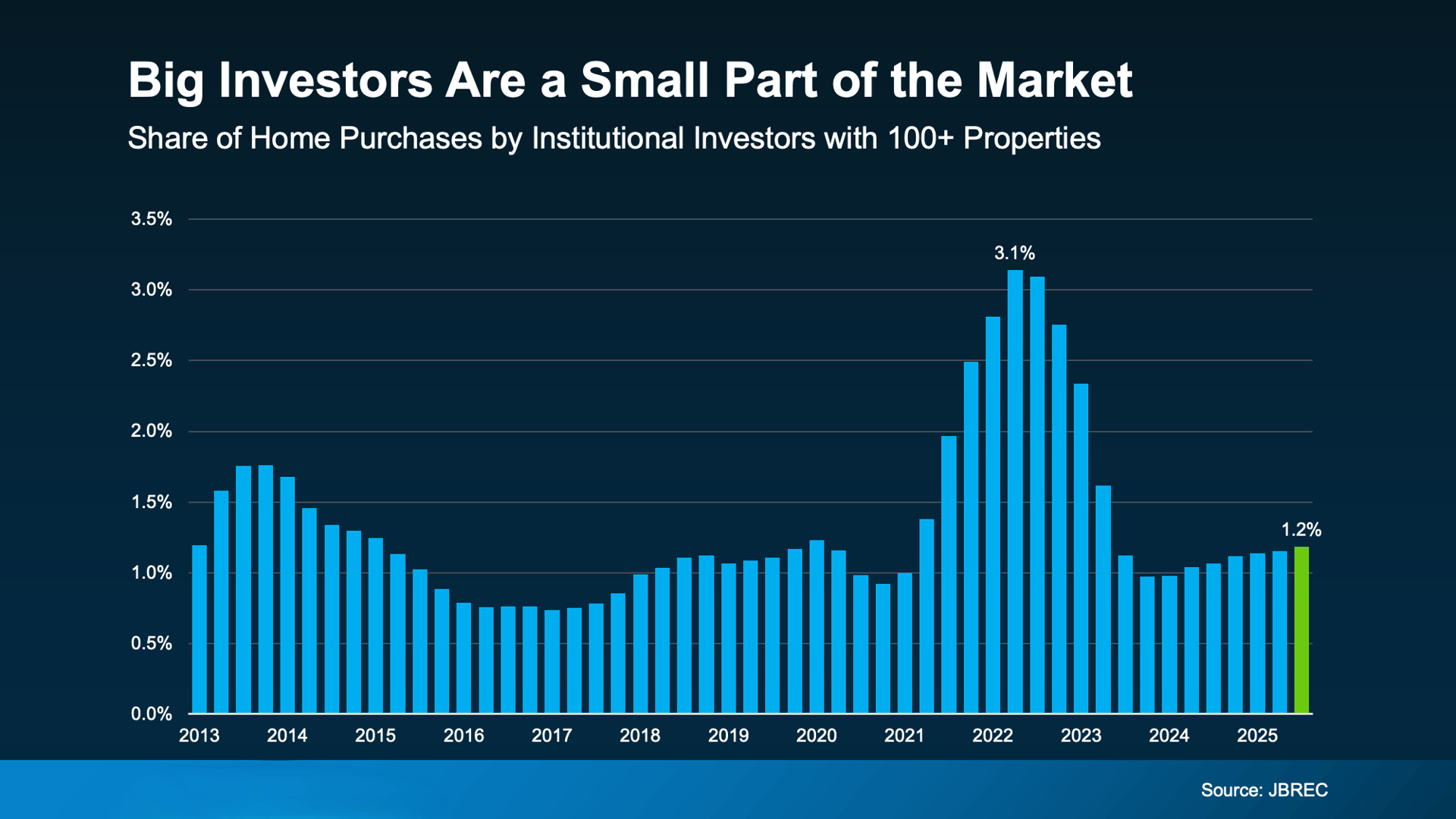
According to John Burns Research & Consulting, large institutional investors—defined as those owning 100 or more homes—made up just 1.2% of all home purchases in Q3 2025.
That means out of every 100 homes sold nationwide, roughly one was purchased by a large investor.
Even more important: that number is well within historical norms. In fact, it’s significantly lower than the recent peak in 2022, when large investors accounted for about 3.1% of purchases—which was still a relatively small share of the overall market.
So while investor activity makes headlines, nationally it represents a very small slice of total home sales.
This topic gets a lot of attention for two main reasons.
First, investor activity isn’t evenly distributed. In certain metro areas, investors are more active, which can absolutely increase competition and make it feel personal for buyers in those markets. But that doesn’t reflect what’s happening across the country as a whole.
Second, the word investor gets used loosely. Headlines often lump large institutional buyers together with small, local investors—like individuals who own one or two rental properties. Those are very different buyers, but they’re frequently grouped into one statistic, which makes the numbers sound much larger than they are.
When you separate large Wall Street–style investors from small, local ones, the picture becomes much clearer. Big institutions are not dominating the housing market.
The bigger forces behind today’s housing challenges aren’t investors. They’re years of underbuilding, limited supply, and demand outpacing available homes.
Those factors matter far more when it comes to prices and competition than institutional buyers do.
That’s why it’s important to filter out the noise—especially if headlines are making you second-guess your next move.
Large investors exist, but they’re buying far fewer homes than most people think.
If you want to understand what investor activity actually looks like in your local market—and whether it impacts your buying or selling plans—talk with a local real estate agent who can give you real context, not headlines.
Sometimes clarity changes everything.
Amber Johnson, Founder
Pillar Real Estate
805.835.3425
[email protected]
1345 Park St. Paso Robles, CA 93446
DRE# 01925434

Amber Johnson | May 22, 2026
Amber Johnson | May 22, 2026

Amber Johnson | May 22, 2026

Amber Johnson | May 22, 2026

Amber Johnson | May 22, 2026

Amber Johnson | May 21, 2026

Amber Johnson | May 21, 2026

Amber Johnson | May 21, 2026

Amber Johnson | May 21, 2026
You’ve got questions and we can’t wait to answer them.

Amber Johnson, Founder
Pillar Real Estate
805.835.3425
DRE# 01925434
1345 Park Street
Paso Robles, CA 93446