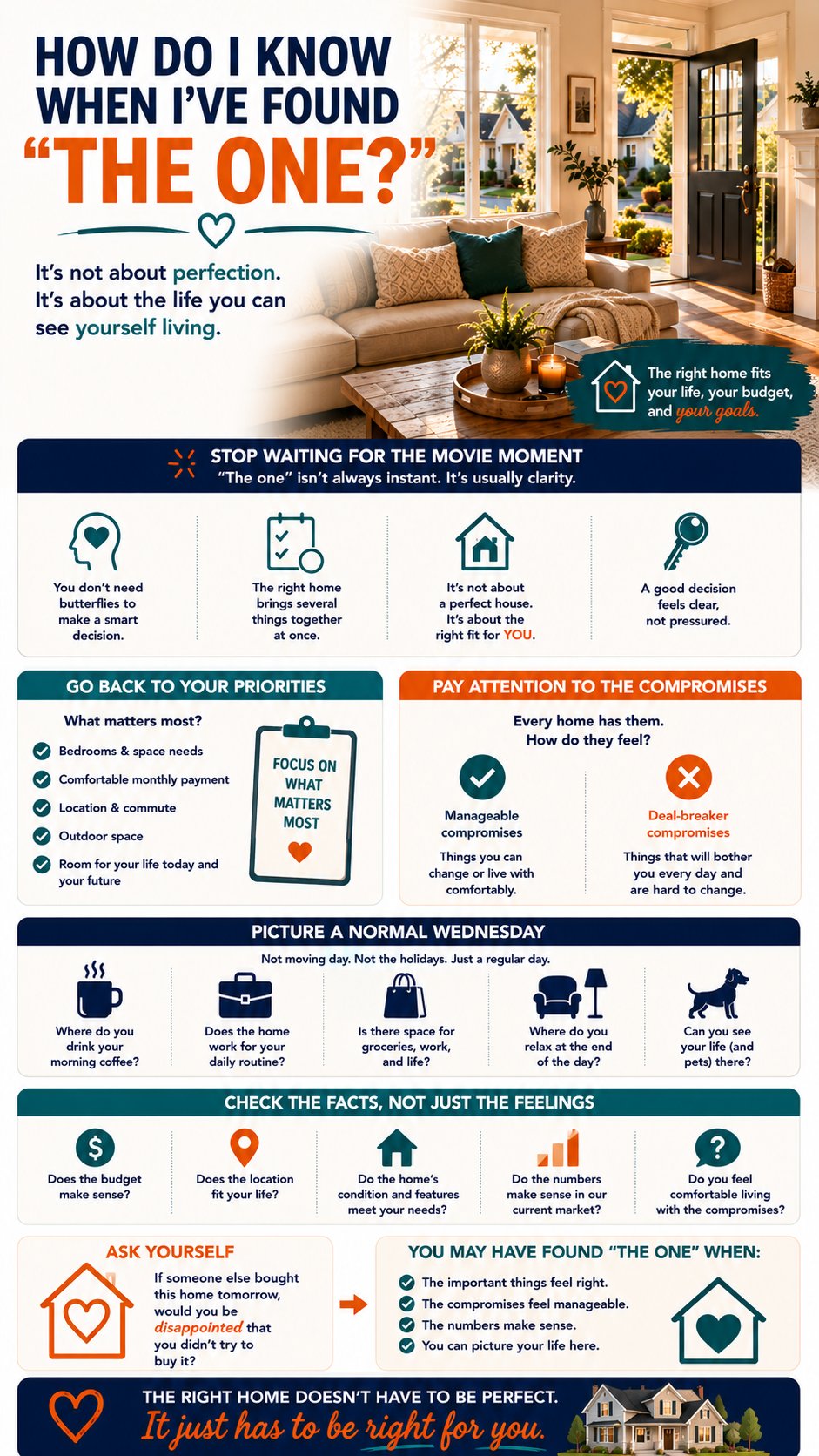
How Do I Know When I've Found "The One?"
July 29, 2026

July 29, 2026
You've looked at homes.
You've compared neighborhoods.
You've adjusted your wish list.
You've figured out what you're willing to compromise on.
Then you walk into a house and start wondering:
"Is this the one?"
That's when things get interesting.
Because finding the right home isn't always the dramatic moment people expect.
Sometimes there's no instant reaction.
No perfect house.
No feeling that every other home you've seen suddenly doesn't matter.
Sometimes it's much simpler.
The home fits your budget.
The location works.
It has the things you actually need.
The compromises make sense.
And you can picture yourself living there.
Here's the thing.
The right home usually isn't the home with nothing wrong with it. It's the home where the important things feel right and the compromises feel manageable.
That's a very different standard than perfection.
Amber is a real estate agent in Paso Robles, CA helping buyers throughout San Luis Obispo County make clear, thoughtful decisions about the homes they're considering. Her approach is simple. Look at the specific property, understand the local market, know your priorities, and choose what makes sense for your goals.
Finding the right home usually isn't about one perfect feature. It's when the house, location, budget, and your priorities start making sense together.
Stop Waiting for the Movie Moment
There's a version of home buying we see all the time.
Someone walks through the front door.
They look around.
Their eyes get big.
"This is it."
Sometimes that really happens.
But plenty of great home purchases don't start that way.
I've worked with buyers who knew immediately.
I've also worked with buyers who needed to walk through the home twice, talk about it, review the numbers, and sleep on it.
Neither buyer was more right.
People make decisions differently.
You don't need butterflies to know you've found a good home.
You need clarity.
The Biggest Misconception
I think one of the hardest expectations for first-time buyers is this:
"When I find the right house, I'll just know."
Maybe.
But what does "know" actually mean?
Does it mean you'll have no questions?
Probably not.
Does it mean there won't be another beautiful home somewhere?
Of course not.
Does it mean every feature will be exactly what you wanted?
Rarely.
For most buyers, knowing isn't one feeling.
It's several things lining up at the same time.
The finances work.
The location works.
The home meets your important needs.
The compromises feel reasonable.
And you want to live there.
That's a pretty strong combination.
Go Back to the List You Started With
Remember what you wanted before you started touring homes?
Go back to that.
Not the giant wish list.
Your actual priorities.
Maybe you needed three bedrooms.
A manageable commute.
Outdoor space.
A monthly payment that left room for the rest of your life.
Now look at the home you're considering.
Does it give you those things?
It's easy for buyers to lose perspective after seeing enough houses.
Every new property introduces another feature you didn't know you wanted.
Suddenly, your original five priorities become fifteen.
That's when the search gets confusing.
Come back to what actually matters.
Notice When You're Comparing Everything Else to One House
This is something I see happen with buyers.
We leave a home.
Then we tour another one.
And another.
But every conversation sounds like this:
"The kitchen isn't as functional as the other house."
"I liked the backyard better at the first one."
"This neighborhood doesn't feel quite the same."
At some point I have to ask:
"Are we still looking for a house, or are we looking for another version of the one we already saw?"
That's usually worth thinking about.
If every new home is being measured against one particular property, that property may have gotten more right than you realized.
Sometimes clarity comes after the showing. When you compare the home against your real priorities instead of perfection, the decision can look very different.
Pay Attention to the Compromises
Every home has them.
The question isn't whether you'll compromise.
We've already talked about that.
The question is:
How do those compromises feel?
There's a big difference between:
"I'd eventually change these countertops."
and
"I'm trying to convince myself I can live with this location."
One is probably manageable.
The other deserves more thought.
When you've found the right home, the compromises usually don't overpower the reasons you want it.
You notice them.
You understand them.
But you can live with them.
The Numbers Still Have to Work
This is where emotion needs a partner.
You can love a house.
That doesn't automatically make it the right house.
Before deciding you've found "the one," go back to the practical pieces.
What does the monthly payment look like?
Are you comfortable with your cash needed to close?
Do you understand the condition of the property?
Does the offer you're considering make sense based on comparable sales?
Are you stretching because the home genuinely fits your goals, or because you're afraid someone else will get it?
Those questions matter.
A home should still make sense after the excitement settles down.
Don't Let Fear of Something Better Keep You Stuck
This is one of the hardest parts.
You find a home you really like.
Then your brain asks:
"What if something better comes on the market next week?"
It might.
There's always another house.
Just like there's always another car.
Another job.
Another vacation destination.
You could keep comparing forever.
At some point, the question has to change.
Not:
"Could there ever be another home I like?"
Of course there could.
Ask:
"Does this home give me enough of what matters to make a good decision today?"
That's much more useful.
What I'm Seeing Right Now
Working with buyers throughout Paso Robles, Templeton, Atascadero, and San Luis Obispo County, I've noticed that the buyers who make the clearest decisions aren't necessarily the most emotional.
They're prepared.
They know their numbers.
They understand their priorities.
They've seen enough homes to recognize value.
And when the right combination shows up, they recognize it.
They may still be nervous.
They may still ask questions.
That's okay.
The goal was never to find a home that removes every doubt.
It's to find one where the facts, the priorities, and the feeling all point in the same direction.
That's usually when you know you're getting close.
A Real-Life Example
I worked with buyers who had been searching for a while.
By that point, they knew the routine.
A new listing would come up.
We'd look at the photos.
Tour the home.
Talk about what they liked and didn't like.
Then move on to the next one.
Eventually, we walked into a home that was different.
Not perfect.
There were a couple of things they would eventually want to update.
The backyard wasn't quite as large as they originally imagined.
But the location worked.
The layout worked.
The price was within the range they had planned for.
And most importantly, the things they had told me mattered from the beginning were there.
After the showing, they were quiet.
Then one of them said:
"I think this might be it."
A few minutes later came the questions.
"Are we sure?"
"Should we see what else comes up?"
"What if there's something better next week?"
Instead of trying to convince them, we went back to the facts.
We reviewed their original priorities.
We talked about the compromises.
We looked at the numbers.
We discussed the neighborhood.
Then I asked:
"If this home sold to someone else tonight, would you be disappointed that you didn't try to buy it?"
The answer came quickly.
Yes.
That didn't mean they suddenly knew the future.
It meant they had enough clarity to make a decision.
Sometimes that's what finding "the one" actually looks like.
The Biggest Mistake
The biggest mistake is waiting for a home that removes every question.
That home probably doesn't exist.
You may love the location and wish the kitchen were bigger.
You may love the house and wish the backyard had more space.
You may find almost everything you wanted and still feel nervous when it's time to make an offer.
That's normal.
The goal isn't finding a house with zero compromises.
It's finding one where the compromises don't outweigh the reasons you want to live there.
What This Process Should Feel Like
Finding the right home should bring more clarity than confusion.
That doesn't mean you'll feel completely calm.
Buying a home is a big decision.
But underneath the nerves, the pieces should make sense.
The budget works.
The location fits.
The home meets your important needs.
You understand the compromises.
And you can picture yourself living there.
When those things start lining up, pay attention.
You may be closer to your answer than you think.
How This Connects to the Bigger Picture
We've spent the last several articles talking about how buyers actually choose a home.
We've talked about neighborhoods.
Location versus the house itself.
Compromise.
And what makes a house begin to feel like home.
All of those conversations lead to this moment.
Because finding "the one" isn't really about falling in love with a property.
It's about recognizing when enough of the important pieces have come together.
Related: What Makes a House Feel Like Home?
Finding the right home isn't about knowing the future. It's about having enough clarity to confidently choose the home in front of you.
Steps: How to Know When You've Found the Right Home
Step 1: Compare It to Your Real Priorities
Go back to the things you said mattered before you started looking.
Does the home meet most of them?
Don't let a new feature you discovered three showings ago suddenly become more important than the priorities you started with.
Step 2: Look at the Compromises
Write them down.
Then ask yourself:
Can I change this?
Can I comfortably live with it?
Will it still bother me several years from now?
Some compromises are easy.
Others aren't.
Know which kind you're making.
Step 3: Check the Numbers Again
Excitement shouldn't change your financial comfort.
Review the payment.
Talk with your lender.
Understand your cash needed to close.
Make sure the home still works financially before emotion takes over.
Step 4: Imagine Losing the Opportunity
Ask yourself:
"If someone else bought this home tomorrow, how would I feel?"
Don't use that question to pressure yourself into making an offer.
Use it to understand how you actually feel about the property.
If your immediate reaction is relief, that's useful information.
If your immediate reaction is disappointment, that's useful too.
So... How Do You Know When You've Found "The One?"
You may not just know.
And that's okay.
For most buyers, finding the right home is less dramatic than that.
The home fits your budget.
The location works for your life.
It meets your important needs.
The compromises are manageable.
You've done your homework.
And after all of that, you still want the house.
That's a pretty good sign.
Not that the home is perfect.
Not that nothing better could ever exist.
Simply that you've found a home that makes sense for you.
You Can Be Excited and Nervous at the Same Time
This is worth remembering.
Nervous doesn't mean no.
Excited doesn't automatically mean yes.
You can feel both.
I've watched buyers get incredibly excited about a home and still become nervous when it's time to write the offer.
That's because the decision has become real.
We've talked about that throughout this buyer series.
Don't judge the decision based on one emotion.
Look at the entire picture.
That's where confidence comes from.
The Real Question to Ask
Instead of asking:
"Is this the perfect home?"
Ask yourself:
"Does this home give me enough of what matters to confidently choose it?"
That's a much more realistic standard.
And for many buyers, it's the question that finally brings clarity.
Next Steps
If you're looking for a home in Paso Robles, Templeton, Atascadero, or anywhere in San Luis Obispo County and you're wondering how you'll know when you've found the right one, I'd be happy to help you work through that decision.
We'll look at your priorities.
Your budget.
The neighborhood.
The property.
The compromises.
And what the local market is telling us.
I'm not there to tell you which house you're supposed to love.
I'm there to help you understand the decision clearly enough to make it confidently.
From start to finish.
FAQ
How do I know when I've found the right house?
Look at the whole picture. The right home should fit your important priorities, your budget, your location needs, and your everyday life. It doesn't need to be perfect.
Should I immediately know when I've found "the one?"
No. Some buyers know quickly, while others need time to think through the home, review the numbers, and compare it with their priorities. Both are normal.
What if I find a home I love but it doesn't check every box?
Most homes won't. Focus on whether the missing features are true needs or preferences and whether the compromises are things you can comfortably live with.
What if a better house comes on the market after I buy?
There's always a possibility that another home will become available. Instead of trying to predict future listings, focus on whether the home you're considering makes sense for your goals today.
Is feeling nervous before making an offer a bad sign?
Not necessarily. Making an offer turns a home search into a real decision, and that can naturally bring nerves. Review the facts, your priorities, and your financial comfort before deciding what those feelings actually mean.
Amber Johnson, Founder
Pillar Real Estate
805.835.3425
[email protected]
1345 Park St. Paso Robles, CA 93446
DRE# 01925434
Amber Johnson | September 20, 2026
The records that help confirm ownership, payoff information, property history, and a smoother listing process.

Amber Johnson | September 18, 2026

Amber Johnson | September 18, 2026

Amber Johnson | September 18, 2026
How wells, septic systems, acreage, access, and the buyer pool shape a rural-property sale.
Amber Johnson | September 17, 2026
What concession requests can signal about buyer leverage, affordability, and current negotiations.
Amber Johnson | September 17, 2026
What sellers should know about owned, financed, and leased solar before listing.
Amber Johnson | September 17, 2026
How roof condition, insurance, buyer financing, and repair costs can shape the right decision.
Amber Johnson | September 17, 2026

Amber Johnson | September 17, 2026
You’ve got questions and we can’t wait to answer them.
Amber Johnson, Founder
Pillar Real Estate
805.835.3425
DRE# 01925434
1345 Park Street
Paso Robles, CA 93446