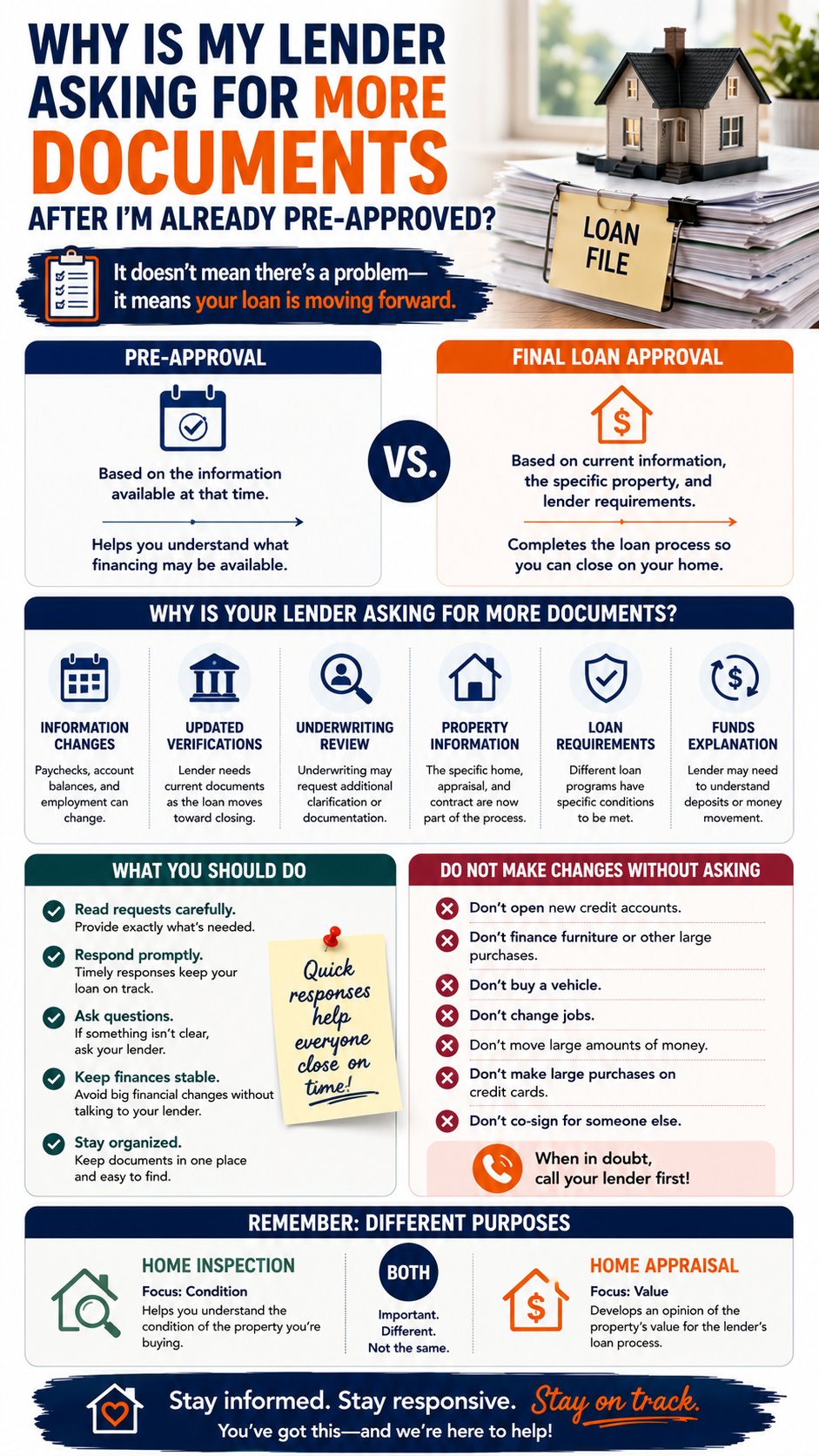
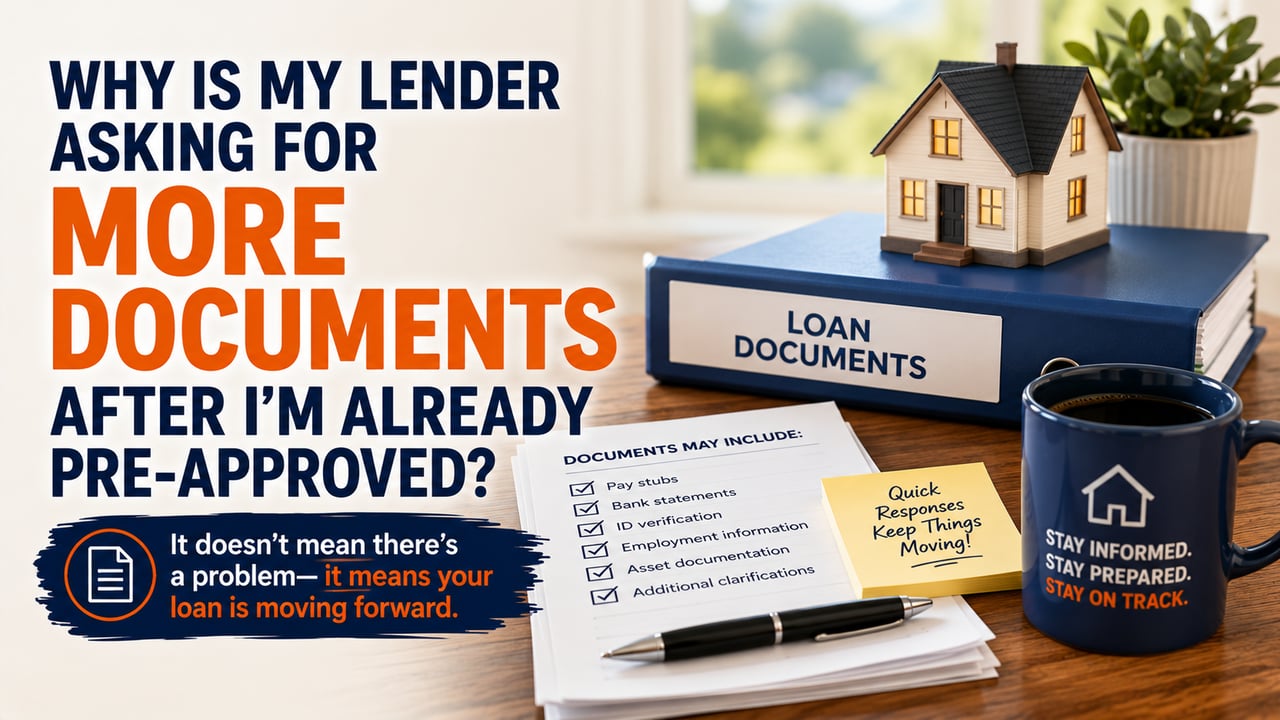
Why Is My Lender Asking for More Documents After I’m Already Pre-Approved?
July 31, 2026
July 31, 2026
You did what you were supposed to do.
You talked with a lender before looking at homes.
You provided financial information.
You got pre-approved.
You found a house.
Your offer was accepted.
And now your lender is asking for...
More documents.
Another bank statement.
Updated pay stubs.
More information about a deposit.
Maybe something you've already sent before.
And you're thinking:
"Wait. Didn't we already do this?"
This catches a lot of first-time buyers off guard.
They assume getting pre-approved means the financial paperwork is finished.
It isn't.
Here's the thing.
A pre-approval helps you prepare to buy a home. Once you're under contract, your lender still needs to complete the loan process using current information and the specific property you're purchasing.
That can mean additional documentation.
Sometimes more than once.
It doesn't automatically mean there's a problem with your loan.
Amber is a real estate agent in Paso Robles, CA helping first-time buyers throughout San Luis Obispo County understand what happens between getting an offer accepted and receiving the keys. Her approach is simple: keep buyers informed, help them understand what comes next, and make the process feel manageable from start to finish.
Getting pre-approved is an important first step. It doesn't mean your lender is finished reviewing your finances once you find a home.
Pre-Approval and Final Loan Approval Are Different
This is the most important thing to understand.
Pre-approval happens before you have a specific home under contract.
It helps you understand what financing may be available based on the information reviewed by your lender.
Then you find a property.
Now the lender has an actual transaction to work with.
There's a purchase price.
A property.
A closing timeline.
An appraisal.
Updated financial information.
And additional loan requirements that need to be completed.
So when your lender asks for more documentation, it doesn't necessarily mean something went wrong.
It may simply mean the loan is moving into another stage.
The Biggest Misconception
One of the biggest misconceptions I hear is:
"I was pre-approved, so my loan is guaranteed."
That's not how I want buyers thinking about pre-approval.
A pre-approval is important.
But there are still steps between pre-approval and closing.
Your lender may need to verify information again.
Your loan may go through underwriting.
The property itself becomes part of the process.
There may be conditions that need to be satisfied.
That's why I tell buyers not to treat pre-approval like the end of the financing conversation.
It's the beginning.
Why Do They Need Updated Documents?
Because financial information changes.
Imagine you were pre-approved two months ago.
The lender reviewed the information available at that time.
Since then, you've received new paychecks.
New bank statements have been issued.
Account balances may have changed.
You may have moved money.
Your employment situation could have changed.
Your lender may need more current documentation as the loan moves toward closing.
That doesn't mean they forgot what you already gave them.
They may simply need updated information.
Why Are They Asking About a Deposit in My Bank Account?
This question can make buyers nervous.
Your lender looks at a bank statement and asks:
"What is this deposit?"
Suddenly you feel like you're being investigated.
Don't take it personally.
Depending on the loan and circumstances, your lender may need documentation or explanations regarding certain funds or transactions.
Maybe money was transferred between accounts.
Maybe you received funds from another source.
Maybe there's a transaction they simply need to understand.
If your lender asks, respond clearly and provide the documentation they request.
And if you're planning to move a significant amount of money while you're buying a home, talk with your lender first.
That can save everyone time later.
Why Do They Keep Asking Me for Things I Already Sent?
Sometimes it really can feel repetitive.
You think:
"I'm pretty sure I already sent this."
Maybe you did.
But the lender may need a newer version.
A document may have expired for the purposes of the loan file.
A different part of the process may require additional information.
Or the lender may need clarification beyond what was originally provided.
Instead of assuming something is wrong, ask:
"Do you need an updated version, or is there something specific you're trying to document?"
That can make the request much easier to understand.
Loan paperwork can feel repetitive. Responding quickly and asking what the lender needs can help keep the transaction moving.
Underwriting Is Looking at the Details
At some point, your loan will typically go through underwriting.
This is where the lender reviews the loan file against the requirements that apply to your financing.
That process can generate additional questions or conditions.
Maybe they need another document.
Maybe they need clarification.
Maybe they need something updated before closing.
Again, don't automatically interpret a request as bad news.
If your lender needs something, find out exactly what they need and provide it as quickly as reasonably possible.
This Is Why You Don't Want to Make Big Financial Changes
We've talked about this before, but it becomes especially important now.
Once you're under contract, don't assume your financial decisions no longer matter because you already got pre-approved.
Before doing something significant, talk with your lender.
That includes things like:
Opening new credit.
Financing furniture.
Buying a vehicle.
Changing jobs.
Moving large amounts of money.
Making large purchases on credit cards.
Co-signing for someone else's debt.
Your lender is the appropriate person to tell you how a specific financial decision could affect your loan.
Ask before you act.
It's much easier than trying to fix something afterward.
Respond Quickly, But Don't Guess
When your lender asks for a document, don't ignore the request because you don't understand it.
But don't guess either.
Ask.
"Which statement do you need?"
"What date range?"
"Do you need every page?"
"What are you trying to document?"
Get clear instructions.
Then provide what's requested.
Buying a home already comes with enough paperwork.
There's no benefit to sending five documents when the lender needs one specific thing.
What I'm Seeing Right Now
Working with buyers throughout Paso Robles, Templeton, Atascadero, and San Luis Obispo County, I've seen how quickly buyers can become worried when a lender starts asking for additional documentation.
The request itself isn't always what creates the stress.
It's what buyers think the request means.
"Is my loan in trouble?"
"Did I do something wrong?"
"Are they going to deny us?"
Sometimes the lender simply needs another document.
So before creating the worst-case scenario, ask what the request is for.
Understand what they need.
Provide it.
Then keep moving.
The financing process can involve a lot of documentation.
Your job isn't to predict every document the lender might request.
Your job is to stay responsive, keep your finances as stable as possible, and communicate before making significant financial changes.
A Real-Life Example
I worked with first-time buyers who had done everything right at the beginning.
They talked with their lender.
Provided their documents.
Got pre-approved.
Found a home.
And got their offer accepted.
Then, once we were in escrow, their lender started asking for more paperwork.
An updated bank statement.
Another pay stub.
An explanation for money that had moved between accounts.
One of the buyers called me and said:
"I'm confused. If we were already pre-approved, why are they asking for all of this again? Is something wrong?"
Nothing had necessarily gone wrong.
The loan was simply moving forward.
Their lender now had a specific property, purchase agreement, closing timeline, and updated financial information to work with.
Once they understood that, the requests felt different.
Instead of interpreting every email from the lender as a warning sign, they started looking at it as another item to complete.
They responded quickly.
Asked questions when something wasn't clear.
And kept the process moving.
That's a much better approach than assuming every request means your loan is in trouble.
The Biggest Mistake
The biggest mistake is thinking:
"I'm already pre-approved, so my financial decisions don't matter anymore."
They absolutely can.
This is not the time to make significant financial changes without talking with your lender.
Don't assume buying furniture on credit is fine.
Don't assume changing jobs won't matter.
Don't assume moving a large amount of money between accounts is no big deal.
And definitely don't assume a new car payment won't affect anything.
Ask your lender first.
One conversation before making a financial move can be much easier than trying to explain or correct something afterward.
What This Process Should Feel Like
The financing process can feel repetitive.
That's normal.
You may send documents more than once.
You may answer questions you weren't expecting.
You may receive another request right when you thought underwriting had everything it needed.
The goal isn't to reach a point where your lender never asks you another question.
The goal is to understand what's being requested and respond appropriately.
If you don't understand why they need something, ask.
You don't need to become a mortgage expert.
You just need to stay engaged in your loan process.
How This Connects to the Bigger Picture
In the last article, we talked about the difference between an appraisal and a home inspection.
Now we're continuing with another part of the transaction happening behind the scenes.
Your lender is working on the financing while inspections, appraisal, escrow, and the rest of the purchase are moving forward.
That's why it can suddenly feel like several things are happening at once.
Related: What’s the Difference Between an Appraisal and a Home Inspection?
Getting another document request doesn't automatically mean something is wrong. Often, it simply means your loan is continuing through the approval process.
Steps: What to Do When Your Lender Asks for More Documents
Step 1: Read the Request Carefully
Before sending anything, understand exactly what your lender needs.
Which document?
What date range?
Do they need every page?
Are they asking for an explanation along with it?
Getting clear on the request can prevent unnecessary back-and-forth.
Step 2: Respond Promptly
Loan timelines matter.
If your lender requests something, try not to let the email sit unanswered for several days.
If you can't provide the document immediately, communicate that.
Let them know you're working on it.
Step 3: Ask Questions When Something Doesn't Make Sense
You don't have to understand every underwriting request.
Ask:
"Can you explain what you need from me?"
That's completely reasonable.
The lender can tell you what they're trying to document and what information they need.
Step 4: Don't Change Your Finances Without Asking
Before making a significant financial move, contact your lender.
That includes new credit, major purchases, employment changes, moving substantial funds, or other changes that could potentially affect your financing.
Don't guess.
Ask first.
Step 5: Keep Your Documents Organized
Create one place for the paperwork connected to your purchase.
Bank statements.
Pay stubs.
Loan documents.
Insurance information.
Escrow documents.
Anything else you're asked to keep.
You'll probably be glad you did.
So... Why Is My Lender Asking for More Documents After I’m Already Pre-Approved?
Because pre-approval isn't the final step in getting a mortgage.
Once you have an accepted offer, your lender is working with a specific property and an actual transaction.
Your financial information may need to be updated.
Your loan goes through additional review.
Underwriting may request clarification or additional documentation.
And requirements still need to be satisfied before closing.
Another document request doesn't automatically mean your loan is in trouble.
Sometimes it simply means:
They need another document.
Give them what they need.
Ask questions when you're unsure.
And keep your financial situation as stable as possible while the loan moves toward closing.
Don't Panic Every Time Your Lender Emails You
I know.
That's easier said than done.
When you're buying your first home, an email that starts with:
"We need a few additional items..."
can immediately get your attention.
Before assuming something is wrong, read the request.
Maybe they need an updated statement.
Maybe they need clarification.
Maybe underwriting needs one more document before completing another part of the review.
Find out.
Then handle what's actually being asked instead of worrying about what the request might mean.
The Real Question to Ask
Instead of asking:
"Why do they keep asking me for things if I'm already pre-approved?"
Ask:
"What does my lender need from me right now to keep my loan moving forward?"
That's the question that keeps you focused on what you can actually control.
Next Steps
If you're buying a home in Paso Robles, Templeton, Atascadero, or anywhere in San Luis Obispo County and your lender starts asking for additional documents, don't automatically assume there's a problem.
Read the request carefully.
Ask questions if something isn't clear.
Respond promptly.
And before making significant changes to your finances, employment, credit, or accounts, talk with your lender.
The next article will cover an important question that naturally follows this one:
What could go wrong with my loan before closing?
From start to finish.
FAQ
Why does my lender need more documents after pre-approval?
Pre-approval happens earlier in the buying process. Once you have a specific property under contract, the lender continues reviewing your loan and may need updated or additional information before closing.
Does an additional document request mean my mortgage is in trouble?
Not necessarily. Additional documentation can be a normal part of loan processing and underwriting. Ask your lender what they need and why if you're unsure.
Why does my lender want updated bank statements and pay stubs?
Financial information can change between pre-approval and closing. Your lender may need current documents as part of verifying the information required for your loan.
Can I make a large purchase after my offer is accepted?
Talk with your lender before making significant purchases or taking on new debt. Your lender can explain how a specific financial decision could affect your financing.
Should I tell my lender if I'm changing jobs before closing?
Yes. If you're considering an employment change while your loan is in process, talk with your lender before making the change so you understand how it could affect your particular loan.
Amber Johnson, Founder
Pillar Real Estate
805.835.3425
[email protected]
1345 Park St. Paso Robles, CA 93446
DRE# 01925434

Amber Johnson | September 21, 2026
How traffic patterns, privacy, parking, lot shape, and buyer preferences can influence marketing and value.

Amber Johnson | September 21, 2026
The price, credits, repairs, timing, and other terms Paso Robles sellers may need to evaluate this season.

Amber Johnson | September 21, 2026
When an open house can support a launch, when private showings may matter more, and how to judge the results.
Amber Johnson | September 20, 2026
How garage organization, storage, access, and visible maintenance can influence a buyer’s overall impression.

Amber Johnson | September 20, 2026
Why seller absence usually gives buyers more freedom to look, talk, and form an honest impression.
Amber Johnson | September 20, 2026
The records that help confirm ownership, payoff information, property history, and a smoother listing process.

Amber Johnson | September 18, 2026

Amber Johnson | September 18, 2026

Amber Johnson | September 18, 2026
How wells, septic systems, acreage, access, and the buyer pool shape a rural-property sale.
You’ve got questions and we can’t wait to answer them.

Amber Johnson, Founder
Pillar Real Estate
805.835.3425
DRE# 01925434
1345 Park Street
Paso Robles, CA 93446