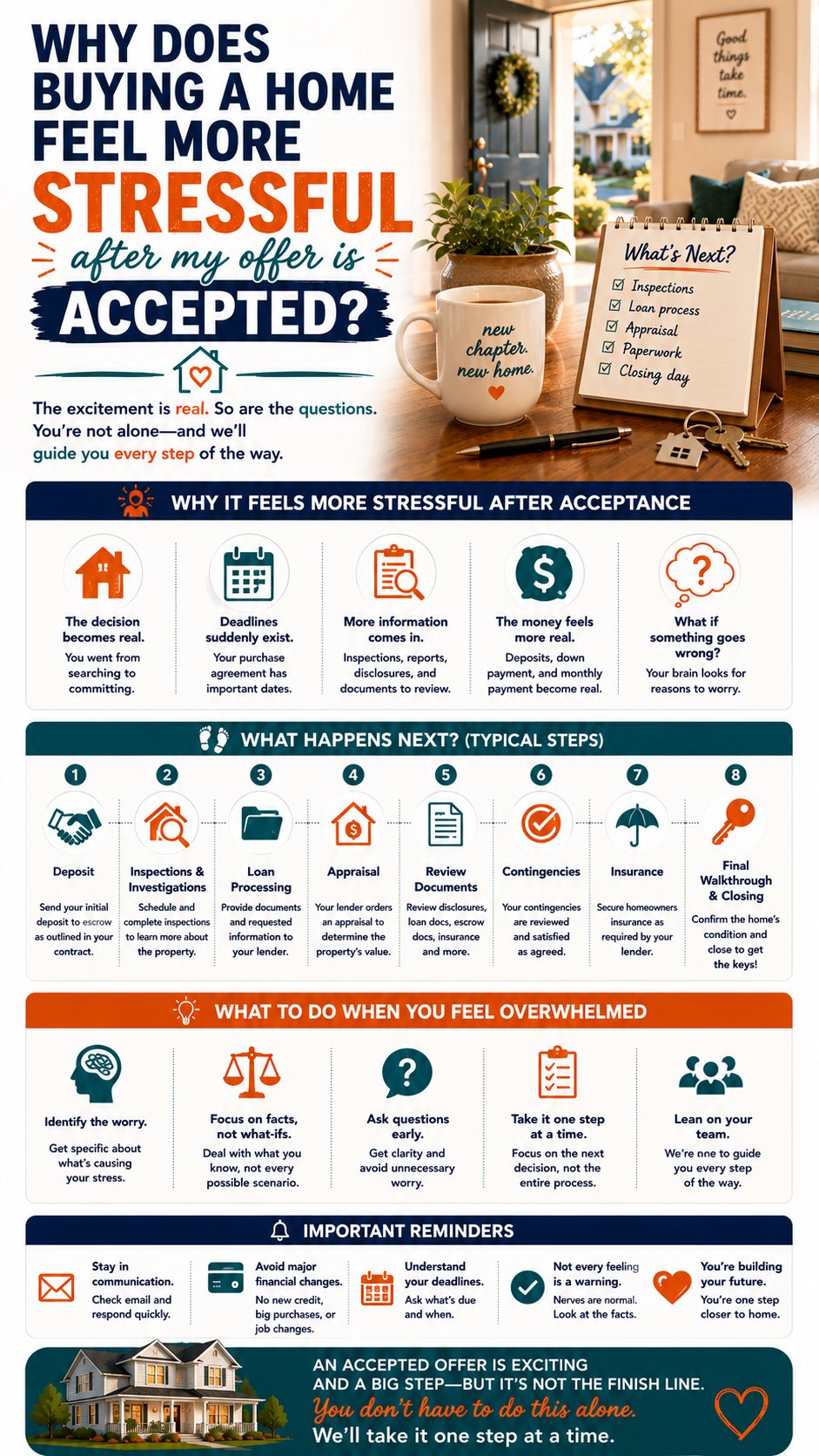
Why Does Buying a Home Feel More Stressful After My Offer Is Accepted?
July 30, 2026

July 30, 2026
You finally got the call.
"They accepted your offer."
You should feel relieved.
And for a few minutes, you probably do.
Then something strange happens.
The excitement starts turning into stress.
Suddenly you're thinking about the inspection.
The loan.
The appraisal.
The money you're about to spend.
The paperwork.
The deadlines.
And maybe the biggest thought of all:
"Wait. Are we really doing this?"
If that happens, you're not alone.
A lot of first-time buyers expect getting an offer accepted to be the moment everything becomes easier.
Instead, it can feel like the exact opposite.
Here's the thing.
Buying a home often feels more stressful after your offer is accepted because the possibility has become real.
Before acceptance, you were trying to buy a house.
Now you're actually moving toward owning one.
That's a big emotional shift.
Amber is a real estate agent in Paso Robles, CA helping buyers throughout San Luis Obispo County navigate the home-buying process with clear communication and practical guidance from start to finish.
Getting your offer accepted can bring excitement and stress at the same time. That's often when the reality of buying a home finally sinks in.
You Went From Searching to Committing
Think about how different the process felt a few weeks ago.
You were scrolling through listings.
Touring homes.
Comparing neighborhoods.
Talking about what you liked.
If a home wasn't right, you moved on.
There was always another listing.
Then your offer gets accepted.
Now there's one house.
One purchase agreement.
One closing date you're working toward.
Real money is involved.
Real decisions need to be made.
That's why buyers who felt completely confident during the home search can suddenly start questioning themselves.
Nothing necessarily went wrong.
The decision simply became real.
The Biggest Misconception
One of the biggest misconceptions about buying a home is:
"Once my offer is accepted, I should only feel excited."
I don't think that's realistic.
You can be excited and nervous.
Relieved and overwhelmed.
Happy about the house and still worried about the responsibility.
Those feelings can exist at the same time.
Buying a home is a major financial and personal decision.
Feeling the weight of that decision doesn't automatically mean you've made the wrong one.
It means you're taking it seriously.
Suddenly, There Are Deadlines Everywhere
Before your offer was accepted, you controlled much of the pace.
Once you're under contract, the purchase agreement creates a timeline.
There may be deadlines involving your deposit, investigations, financing, appraisal, contingencies, and other parts of the transaction.
Your lender may need documents.
Your real estate agent may need decisions.
Escrow may send paperwork.
Inspectors need to be scheduled.
Your email inbox can suddenly become very active.
That's when buyers start thinking:
"How am I supposed to keep track of all of this?"
You don't need to carry the entire transaction in your head.
Focus on the next thing that needs your attention.
Then the next.
The Inspection Can Make Everything Feel Scarier
This is a big one.
You loved the house during the showing.
Then the inspection happens.
Now you're looking at a report filled with photographs, notes, recommendations, and things you didn't notice when you walked through the home.
Suddenly, the house you loved three days ago can look terrifying on paper.
Don't jump to conclusions.
An inspection is supposed to give you information.
Homes have maintenance items.
Older homes may have more of them.
Some findings may deserve additional investigation.
Others may be relatively straightforward.
The important thing is understanding what the report actually says before deciding how you feel about it.
We'll go deeper into inspections in the next article.
Inspection reports can look overwhelming at first. The goal isn't to find a flawless house. It's to understand the property you're buying.
Your Brain Starts Looking for Reasons Something Could Go Wrong
This is something I see with buyers.
Before their offer is accepted, they're thinking:
"I hope we get it."
After acceptance, that can quickly become:
"What if something goes wrong?"
What if the inspection finds something?
What if the appraisal is different than expected?
What if there's a problem with the loan?
What if we regret this?
Your brain went from trying to win the opportunity to trying to protect you from making a mistake.
That's understandable.
But don't let every possible scenario become an actual problem before it happens.
Deal with the information you have.
Not every possibility your mind can create.
The Money Feels Different Now
Getting pre-approved is one thing.
Seeing the actual numbers connected to an actual house is another.
Now you're thinking about your deposit.
Down payment.
Closing costs.
Monthly payment.
Insurance.
Future maintenance.
Those numbers can suddenly feel much more real.
That's why financial preparation before you start looking matters so much.
Go back to the work you've already done.
Review the numbers with your lender.
Ask questions if something looks different than you expected.
Make sure you understand what you're agreeing to.
Clarity is much more useful than sitting at home worrying about a number you don't understand.
Don't Interpret Every Nervous Feeling as a Warning Sign
There are times when buyers uncover information that deserves serious consideration.
That's exactly why inspections, investigations, disclosures, financing work, and other parts of the process exist.
But nervousness by itself isn't necessarily new information.
Ask yourself:
"Did something about the house or my financial situation actually change?"
If the answer is yes, understand what changed.
If the answer is no, you may simply be experiencing the emotional shift from thinking about buying a home to actually buying one.
Those are two very different things.
What I'm Seeing Right Now
Working with buyers throughout Paso Robles, Templeton, Atascadero, and San Luis Obispo County, I've seen this moment many times.
A buyer spends weeks hoping their offer will be accepted.
Then it happens.
And suddenly they're more nervous than they were before.
That doesn't surprise me anymore.
This is the point where the transaction becomes tangible.
The inspection is scheduled.
The lender is working.
Escrow is open.
The calendar is moving.
The purchase starts feeling real.
That's why I believe communication becomes even more important after an offer is accepted.
You should know what we're doing.
Why we're doing it.
What we've learned.
And what decision, if any, you actually need to make.
When buyers understand what's happening, the process usually feels much more manageable.
A Real-Life Example
I worked with first-time buyers who had been incredibly excited about a home.
They loved the location.
The house fit their budget.
It had the space they needed.
When we wrote the offer, they were nervous because they really wanted it.
Then the seller accepted.
They were thrilled.
A couple of days later, the excitement had changed.
We were scheduling inspections.
Their lender was asking for updated documents.
Escrow had sent paperwork.
They were thinking about how much money they were about to spend.
Then one of them called me and said:
"Why am I suddenly questioning everything?"
So we talked through it.
Had something changed about the house?
No.
Had something changed about their budget?
No.
Had they learned anything that made the purchase no longer fit their goals?
No.
What had changed was the reality of the decision.
A week earlier, buying the home was something they hoped would happen.
Now it was actually happening.
Once they recognized that difference, they were able to separate normal nerves from the things that actually required their attention.
That's an important distinction.
Not every uncomfortable feeling requires action.
Sometimes you simply need more information.
The Biggest Mistake
The biggest mistake is treating every stressful moment like evidence that something is wrong.
Buying a home has a lot of moving pieces.
There will probably be moments when you feel uncertain.
Maybe you're waiting for an inspection result.
Maybe your lender asks for another document.
Maybe you're reviewing numbers you've already reviewed three times.
Before assuming there's a problem, ask:
"What new information do I actually have?"
If something meaningful has changed, evaluate it.
If nothing has changed, don't create a problem simply because the decision suddenly feels bigger.
What This Process Should Feel Like
After your offer is accepted, the process should feel active.
There are things happening.
There are deadlines.
There are decisions.
But you shouldn't feel like you're figuring everything out by yourself.
You should understand what needs your attention today.
You should know what's coming next.
And when something unexpected comes up, you should have someone helping you understand what it actually means.
That's very different from promising that nothing stressful will happen.
The goal isn't zero stress.
It's clarity when stress shows up.
How This Connects to the Bigger Picture
In the last article, we walked through what happens after your offer is accepted.
This article is about what that process can actually feel like.
Those are two different conversations.
You can understand every step and still feel nervous when you're the person actually buying the house.
Related: My Offer Was Accepted. What Happens Next?
The goal after your offer is accepted isn't to eliminate every stressful moment. It's to understand what's happening well enough to know which things actually need your attention.
Steps: What to Do When Buying Starts Feeling Overwhelming
Step 1: Identify What's Actually Worrying You
Don't lump everything together as:
"I'm stressed about buying the house."
Get specific.
Is it the inspection?
The payment?
The appraisal?
The paperwork?
The responsibility of owning a home?
Once you know what you're actually worried about, you can start getting answers.
Step 2: Separate Facts From Possibilities
Ask yourself what you know right now.
Then separate that from what you're imagining could happen.
There may be legitimate issues that need attention.
But worrying about ten things that haven't happened yet won't make the transaction easier.
Step 3: Ask Questions Early
If you don't understand something, ask.
Don't spend three days worrying about an email from your lender or something you saw in an inspection report.
Get clarification.
A five-minute conversation can sometimes eliminate hours of unnecessary stress.
Step 4: Focus on the Next Decision
You don't need to solve closing day today.
Maybe today's job is reviewing an inspection.
Tomorrow's might be sending your lender a document.
Handle what's in front of you.
Then move to the next step.
So... Why Does Buying a Home Feel More Stressful After Your Offer Is Accepted?
Because everything becomes real.
Before acceptance, you were imagining buying a home.
After acceptance, you're moving through the actual process.
There's money involved.
Deadlines.
Inspections.
Documents.
Decisions.
And the possibility that you're only a few weeks away from becoming a homeowner.
Of course that can feel different.
The important thing is learning to distinguish between stress caused by new information and stress caused by the size of the decision.
One may require action.
The other may simply require clarity.
Don't Forget Why You Said Yes
When the process gets busy, go back to the beginning.
Why did you want this home?
Did it fit your budget?
Did the location make sense?
Did it meet your important needs?
Could you picture yourself living there?
Those reasons don't disappear just because you're reviewing paperwork now.
If new information changes the picture, evaluate it.
But if the home still fits the reasons you chose it, don't let the noise of the transaction make you forget why you were excited in the first place.
The Real Question to Ask
Instead of asking:
"Why am I suddenly so stressed?"
Ask yourself:
"Has something actually changed, or does the decision just feel more real now?"
That question can help you figure out what deserves your attention.
Next Steps
If your offer has been accepted on a home in Paso Robles, Templeton, Atascadero, or anywhere in San Luis Obispo County and the process suddenly feels more stressful than you expected, start by identifying what's actually creating the concern.
Then get answers.
Review the information.
Talk with the appropriate professional.
And focus on the next decision instead of everything that still has to happen before closing.
You don't need to understand the entire transaction today.
You need to understand the step you're on.
From start to finish.
FAQ
Is it normal to feel stressed after my offer is accepted?
Yes. An accepted offer can make the financial responsibility, deadlines, inspections, and other parts of buying feel much more real. Stress alone doesn't necessarily mean something is wrong.
Why am I having second thoughts after my offer was accepted?
Sometimes new information creates legitimate concerns. Other times, the commitment simply feels more real after acceptance. Identify whether something has actually changed before deciding what your second thoughts mean.
What should I do if I'm overwhelmed during escrow?
Start with the specific issue that's worrying you most. Ask questions, understand what needs your attention now, and avoid trying to solve every remaining step at once.
Should I worry if the inspection report looks bad?
Don't judge the property only by the length of the report. Review the findings carefully, ask questions, and get additional professional guidance when appropriate so you understand the significance of individual items.
How can I make the process after offer acceptance less stressful?
Stay in communication with your real estate agent, lender, escrow team, and other professionals involved in the transaction. Respond to requests promptly, understand upcoming deadlines, and focus on one step at a time.
Amber Johnson, Founder
Pillar Real Estate
805.835.3425
[email protected]
1345 Park St. Paso Robles, CA 93446
DRE# 01925434

Amber Johnson | October 21, 2026

Amber Johnson | October 21, 2026

Amber Johnson | October 21, 2026
Check privacy, shared-space rules and activity near the unit before deciding whether courtyard-facing condo living suits you.

Amber Johnson | October 20, 2026
Review the stove, venting, documentation and insurance questions before treating wood heat as a benefit of the purchase.

Amber Johnson | October 20, 2026
Test the routes to your actual errands, what you need to carry and your backup options before choosing a home around cycling.

Amber Johnson | October 20, 2026
Compare these two Morro Bay areas through the specific homes, daily routes and property features that matter to your household.
Amber Johnson | October 20, 2026
Check the property’s jurisdiction, current home-business rules and private restrictions before assuming clients can visit your home.

Amber Johnson | October 20, 2026
Compare keeping the pool with removal, site restoration and buyer appeal before spending money on pre-sale work.
Amber Johnson | October 20, 2026
Compare a consistent property type and reporting period within relevant price brackets before treating a broad market headline as guidance for a particular home.
You’ve got questions and we can’t wait to answer them.

Amber Johnson, Founder
Pillar Real Estate
805.835.3425
DRE# 01925434
1345 Park Street
Paso Robles, CA 93446