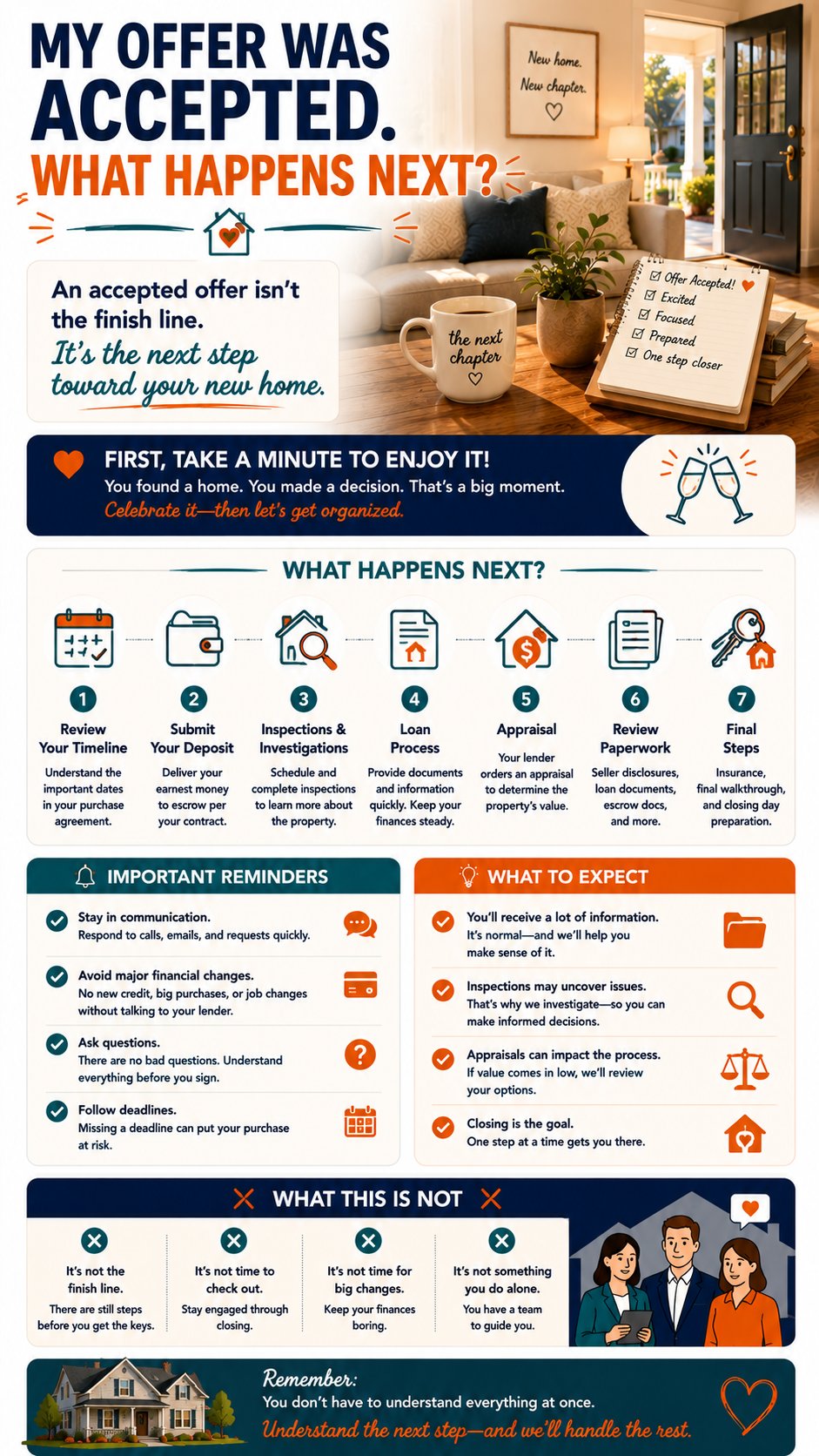
My Offer Was Accepted. What Happens Next?
July 30, 2026

July 30, 2026
You did it.
After getting pre-approved, looking at homes, comparing neighborhoods, and finally writing an offer, you get the call.
"Your offer was accepted."
For about five minutes, you're thrilled.
Then another thought usually shows up.
"Okay...what happens now?"
This is the part of buying a home that first-time buyers often know the least about.
You've spent weeks or months focused on finding the house.
Now you actually have one under contract.
And suddenly there are inspections.
Loan documents.
An appraisal.
Deadlines.
Disclosures.
Insurance.
Escrow.
A final walkthrough.
It can feel like everything starts happening at once.
Here's the thing.
An accepted offer isn't the finish line. It's the point where the home-buying process shifts from finding the house to making sure you're prepared to close on it.
You don't have to understand everything at once.
You just need to know what happens next.
Amber is a real estate agent in Paso Robles, CA with 13 years of experience helping clients throughout San Luis Obispo County. Her approach is clear and practical, with consistent communication from start to finish.
Getting your offer accepted is exciting. It's also when a completely new part of the buying process begins.
First, Take a Minute to Enjoy It
Seriously.
You found a home.
You made a decision.
You wrote an offer.
The seller said yes.
That's worth being excited about.
First-time buyers sometimes move so quickly into worrying about the next step that they forget this is a pretty big moment.
Enjoy it.
Then we'll get organized.
Because once the offer is accepted, there are dates and responsibilities that need your attention.
The Biggest Misconception
Some buyers believe:
"My offer was accepted, so the house is basically mine now."
Not quite.
An accepted offer generally means you and the seller have entered into a contract, subject to the terms and contingencies in that agreement.
There are still important things that need to happen before closing.
Your financing needs to continue moving forward.
You'll have an opportunity to investigate the property based on your contract.
The lender may require an appraisal.
You'll review documents and disclosures.
And you'll continue working toward satisfying the requirements of the purchase agreement and your loan.
That's why the period after acceptance matters so much.
Your Timeline Suddenly Matters
Before your offer was accepted, your schedule was fairly flexible.
You could tour homes when it worked for you.
Think overnight.
Look again next weekend.
Once you're under contract, that changes.
Your purchase agreement contains deadlines.
Those dates can relate to things like:
The exact timeline depends on your contract and situation.
This is where communication becomes especially important.
You shouldn't have to memorize every date yourself.
But you should know what's coming next and what your team needs from you.
Your Deposit Is Usually One of the First Steps
After your offer is accepted, one of the early items is typically getting your initial deposit to escrow according to the terms of your contract.
First-time buyers sometimes confuse this with their entire down payment.
They're not necessarily the same thing.
Your deposit is part of the transaction and is handled according to the purchase agreement.
Your escrow and lending team can explain exactly how the funds need to be delivered and when.
And this is important.
Always verify wiring or transfer instructions through trusted contact information before sending money.
If something about payment instructions seems unusual, stop and confirm before doing anything.
Then Come the Inspections and Investigations
This is when you start learning more about the property itself.
Depending on the home and your purchase agreement, you may have different inspections or investigations.
The purpose isn't to find a perfect house.
You won't.
The purpose is to better understand the property you're buying.
That's an important distinction.
An inspection report can contain a lot of information, especially for an older home.
Don't panic just because the report is long.
We'll talk much more about that in the next few articles.
The inspection period is about learning more about the property so you can make informed decisions about what you're buying.
Your Loan Keeps Moving Too
Getting pre-approved was the beginning of the financing process.
It wasn't the end.
Once you have an accepted offer, your lender now has an actual property connected to your loan.
You'll likely be asked for additional documents or updated information.
Respond quickly.
This is not the time to disappear for three days because the lender asked for another bank statement.
It also isn't the time to make major financial changes without talking with your lender.
Avoid opening new credit accounts.
Don't finance furniture.
Don't buy a new car because you suddenly have a garage.
And if you're considering changing jobs or moving money around, talk with your lender first.
Keep things boring financially until the home closes.
Boring is good.
The Appraisal Is Different From the Inspection
First-time buyers sometimes mix these up.
They're different.
A home inspection is primarily about helping you understand the property's condition.
An appraisal is generally ordered as part of the lender's process to develop an opinion of the property's value for the loan.
Those serve different purposes.
One doesn't replace the other.
And depending on your financing and contract, what happens with the appraisal can affect the next steps in the transaction.
We'll cover appraisal questions separately because they deserve their own conversation.
You'll Receive a Lot of Paperwork
This surprises buyers.
There can be a lot to review.
Seller disclosures.
Inspection reports.
Escrow documents.
Loan documents.
Insurance information.
Title-related documents.
And depending on the property, there may be additional information specific to that home or location.
Don't assume you're supposed to understand everything the first time you read it.
Ask questions.
That's part of the process.
I'd much rather have a buyer call me and say:
"Amber, what does this mean?"
than sign something they don't understand because they were embarrassed to ask.
What I'm Seeing Right Now
After 13 years in real estate on the Central Coast, I've noticed that buyers often expect the stressful part to end once their offer is accepted.
Sometimes the opposite happens.
The search is over, but now there are real deadlines and real decisions.
That's why communication matters so much during this part of the purchase.
Whether you're buying in Paso Robles, Templeton, Atascadero, or elsewhere in San Luis Obispo County, you shouldn't be waking up wondering:
"Am I supposed to be doing something today?"
You should know what's happening.
What's next.
What needs your attention.
And what your agent, lender, escrow team, and other professionals are handling.
That's what a well-managed transaction should feel like.
Not zero questions.
A clear plan.
A Real-Life Example
I worked with first-time buyers who were incredibly focused during their home search.
They got pre-approved.
They understood their budget.
They asked good questions.
Then we found the home.
We wrote the offer.
And it was accepted.
They were thrilled.
The next morning, I received a message:
"Okay, Amber. What are we supposed to be doing now?"
That's such a common question.
For weeks, their job had been simple.
Find the right house.
Now suddenly they were hearing about escrow, inspections, deposits, disclosures, appraisal, insurance, and loan documents.
It felt like the entire process had changed overnight.
So we broke it down.
What needed to happen today?
What would happen later that week?
What was I handling?
What was the lender handling?
What did they actually need to do?
Once they could see the process in smaller pieces, everything felt much more manageable.
That's something I've learned after 13 years in real estate.
Buyers usually aren't overwhelmed because the process is impossible.
They're overwhelmed because they don't know what's coming next.
The Biggest Mistake
The biggest mistake after your offer is accepted is assuming you can finally stop paying attention.
This is actually the time to stay engaged.
Check your email.
Respond to your lender.
Review documents when they're sent to you.
Keep important appointments.
Ask questions when something doesn't make sense.
And pay attention to the deadlines in your purchase agreement.
You don't need to obsess over the transaction.
But you do need to stay connected to it.
What This Process Should Feel Like
The period between offer acceptance and closing can be busy.
It shouldn't feel chaotic.
You should have a general understanding of:
What's happening now.
What's happening next.
What decisions you'll need to make.
Who is responsible for what.
There may still be surprises.
An inspection may uncover something.
The lender may ask for another document.
A question may come up during the appraisal or escrow process.
That's normal.
The goal isn't a transaction where nothing unexpected ever happens.
It's having a plan for dealing with things when they do.
How This Connects to the Bigger Picture
We've spent the last several articles helping first-time buyers get to this exact moment.
You figured out whether you're ready.
You learned how to avoid common mistakes.
You worked through the emotions of making an offer.
You learned how to choose the right neighborhood and the right home.
Then you wrote the offer.
And the seller accepted it.
Now the focus changes.
You're no longer trying to find a home.
You're working toward owning this one.
Related: How Do I Know When I've Found "The One?"
Once your offer is accepted, you don't need to understand the entire transaction at once. You need to understand the next step and stay connected to your team.
Steps: What Happens After Your Offer Is Accepted?
Step 1: Review the Timeline
Go through the important dates in your purchase agreement with your real estate agent.
Know what's coming first.
Then focus on one deadline at a time.
Step 2: Handle Your Deposit
Follow the instructions provided for delivering your deposit according to your contract.
Be careful with any transfer of funds.
Always independently verify instructions before sending money.
Step 3: Schedule Your Inspections and Investigations
Use the time provided in your agreement to learn more about the property.
Ask questions.
Review the findings.
Understand what you're buying.
Step 4: Stay in Contact With Your Lender
Provide requested documents quickly.
Avoid major financial changes.
Keep your lender informed if anything changes with your employment, finances, or credit.
Step 5: Review the Documents You Receive
Don't ignore paperwork because it looks overwhelming.
Take your time.
Ask questions.
Understand what you're reviewing before moving forward.
Step 6: Prepare for Closing
As the transaction progresses, you'll receive instructions about the remaining steps before closing.
You'll also typically have a final walkthrough before the purchase is completed.
We'll cover those later in this series because each deserves its own conversation.
So... My Offer Was Accepted. What Happens Next?
First, celebrate.
Then get organized.
The next stage of buying a home is about turning an accepted offer into a successful closing.
You'll work through inspections and investigations.
Your lender will continue processing your loan.
There may be an appraisal.
You'll review documents and disclosures.
You'll work with escrow.
And eventually, you'll prepare for the final steps before closing.
You don't have to manage all of those things by yourself.
That's what your team is there for.
Your job is to stay engaged, respond when something needs your attention, and keep asking questions.
One Step at a Time
This is probably the most important thing I can tell first-time buyers during this stage.
Don't wake up every morning thinking about everything that still needs to happen before you get the keys.
Think about what needs to happen next.
Today it may be your deposit.
Tomorrow it may be scheduling an inspection.
Later it may be sending your lender a document.
One step.
Then the next.
That's how you get from an accepted offer to closing day.
The Real Question to Ask
Instead of asking:
"How am I supposed to keep track of all of this?"
Ask:
"What's the next thing I need to do?"
That question makes the process much easier to manage.
Next Steps
If your offer was just accepted on a home in Paso Robles, Templeton, Atascadero, or anywhere in San Luis Obispo County, congratulations.
This is where having clear communication becomes especially important.
My job isn't simply to help you get an offer accepted.
It's to help you understand what happens from that moment all the way through closing.
We'll take it one step at a time.
From start to finish.
FAQ
What happens immediately after my offer is accepted?
You'll want to review the important dates in your purchase agreement and follow the next steps required by your contract. Early items may include your deposit, inspections or investigations, and continued coordination with your lender and escrow.
Is the house officially mine once my offer is accepted?
No. An accepted offer generally puts the home under contract, but there are still contractual, financing, escrow, and closing steps that need to be completed before ownership transfers.
What should I avoid doing after my offer is accepted?
Avoid making significant financial changes without speaking with your lender. That can include opening new credit, financing large purchases, changing employment, or moving substantial amounts of money.
What's the difference between a home inspection and an appraisal?
An inspection helps you learn more about the property's condition. An appraisal is generally part of the lender's process for developing an opinion of the property's value for the loan. They serve different purposes.
How long does it take to close after an offer is accepted?
There isn't one timeline for every purchase. The closing date and other deadlines depend on your purchase agreement, financing, and the specific transaction. Review your contract and timeline with the professionals handling your purchase.
Amber Johnson, Founder
Pillar Real Estate
805.835.3425
[email protected]
1345 Park St. Paso Robles, CA 93446
DRE# 01925434

Amber Johnson | September 21, 2026
How traffic patterns, privacy, parking, lot shape, and buyer preferences can influence marketing and value.

Amber Johnson | September 21, 2026
The price, credits, repairs, timing, and other terms Paso Robles sellers may need to evaluate this season.

Amber Johnson | September 21, 2026
When an open house can support a launch, when private showings may matter more, and how to judge the results.
Amber Johnson | September 20, 2026
How garage organization, storage, access, and visible maintenance can influence a buyer’s overall impression.

Amber Johnson | September 20, 2026
Why seller absence usually gives buyers more freedom to look, talk, and form an honest impression.
Amber Johnson | September 20, 2026
The records that help confirm ownership, payoff information, property history, and a smoother listing process.

Amber Johnson | September 18, 2026

Amber Johnson | September 18, 2026

Amber Johnson | September 18, 2026
How wells, septic systems, acreage, access, and the buyer pool shape a rural-property sale.
You’ve got questions and we can’t wait to answer them.

Amber Johnson, Founder
Pillar Real Estate
805.835.3425
DRE# 01925434
1345 Park Street
Paso Robles, CA 93446