What Is an Earnest Money Deposit?
August 19, 2026

August 19, 2026
One of the first questions buyers ask after their offer is accepted is,
"What happens to my earnest money?"
Or sometimes...
"Am I going to lose it?"
If you've never bought a home before, it's completely understandable to have questions.
The term earnest money deposit sounds more intimidating than it really is.
In reality, it's a normal part of most real estate transactions and an important step in the buying process.
If you're buying a home in Paso Robles, Templeton, Atascadero, San Miguel, or anywhere in San Luis Obispo County, understanding how an earnest money deposit works can help you move through escrow with confidence.
Over the past 13+ years, I've helped buyers and sellers throughout San Luis Obispo County navigate hundreds of real estate transactions. One thing I've learned is that the process becomes much less stressful when you understand what each step is for. My goal is to explain things in plain English so you can make informed decisions from start to finish.
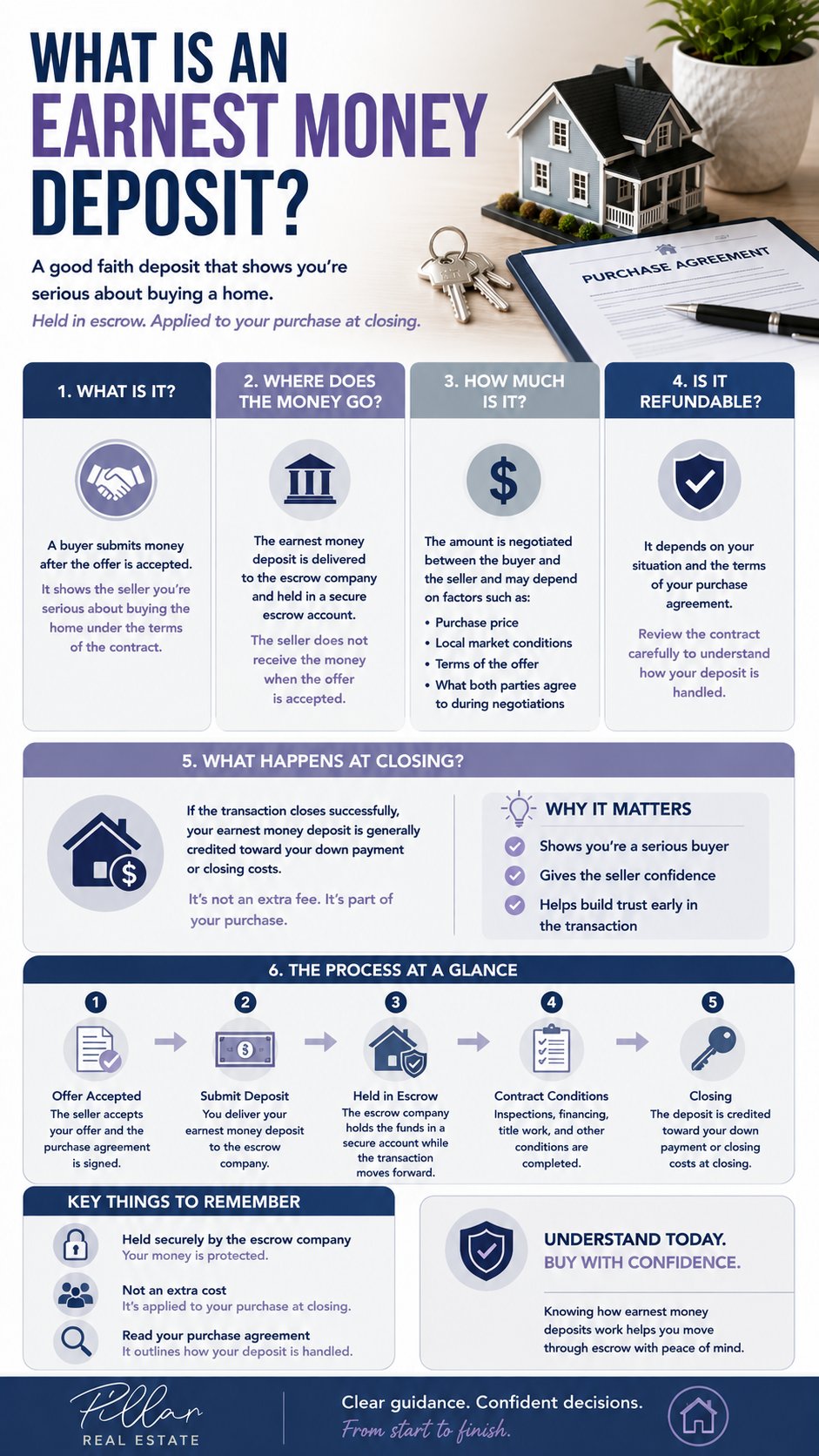
An earnest money deposit isn't an extra fee.
It's a deposit that demonstrates you're serious about buying the home.
What Is an Earnest Money Deposit?
An earnest money deposit is money a buyer submits after a purchase agreement has been accepted.
Think of it as a good faith deposit.
It shows the seller that you're committed to moving forward with the purchase according to the terms of the contract.
The deposit doesn't increase the purchase price.
Instead, it's typically applied toward your down payment or closing costs when the transaction closes.
Where Does the Money Go?
Many buyers assume the seller receives the money immediately.
That's not how it works.
In most transactions, the earnest money deposit is delivered to the escrow company, where it's held in a secure escrow account while the transaction moves forward.
The escrow company doesn't give the money to the seller just because the offer has been accepted.
Instead, the funds are held according to the terms of the purchase agreement until closing or until another outcome is determined under the contract.
How Much Is an Earnest Money Deposit?
There's no single amount that applies to every transaction.
The amount is negotiated between the buyer and the seller and may depend on factors such as:
That's why it's important to discuss your strategy with your real estate agent before submitting an offer.
Is the Earnest Money Deposit Refundable?
This is probably the question I hear most often.
The answer is...
It depends on your situation and the terms of your purchase agreement.
Purchase agreements include important timelines, contingencies, and conditions that affect what happens to the earnest money deposit.
If a transaction doesn't close, the outcome depends on the specific terms of the contract and the reason the transaction ended.
That's why understanding your purchase agreement is so important before you sign it.
What Happens at Closing?
If everything moves forward successfully, the earnest money deposit is generally credited toward the amount you need to bring to closing.
It doesn't disappear.
And it isn't an additional expense.
It's simply one part of the overall financial picture of buying your home.
Why Is the Earnest Money Deposit Important?
For buyers, it demonstrates a serious commitment to purchasing the property.
For sellers, it provides confidence that the buyer intends to move forward according to the terms of the agreement.
For both parties, it helps establish trust early in the transaction.
What I'm Seeing Right Now
After helping buyers throughout Paso Robles, Templeton, Atascadero, San Miguel, and San Luis Obispo County for more than 13 years, I've found that many first-time buyers worry about earnest money because they don't know where it goes or how it's protected.
Once we walk through the process together, that concern usually disappears.
Understanding who holds the deposit, how it's handled, and what the purchase agreement says about it gives buyers much more confidence.
Like many parts of real estate, the uncertainty is often more stressful than the process itself.
When you understand what's happening, it's much easier to focus on the excitement of buying your new home.
From start to finish.
A Real-Life Example
I was working with first-time buyers who had just gotten their offer accepted.
Everything was exciting until I told them the next step was submitting their earnest money deposit.
One of them immediately asked,
"What if something goes wrong? Do we lose our money?"
It's a question I hear often.
We sat down and reviewed the purchase agreement together.
I explained where the earnest money would be held, how it would be applied if the transaction closed, and how the contract outlines what happens if the sale doesn't move forward.
By the end of our conversation, they weren't worried anymore.
They understood that the earnest money deposit wasn't simply handed over to the seller.
It was being handled according to the terms of their purchase agreement.
That understanding gave them the confidence to keep moving forward.
The Biggest Mistake
The biggest mistake buyers make is thinking the earnest money deposit is an extra cost.
It isn't.
If the transaction closes successfully, it's generally applied toward your down payment or closing costs.
Another common mistake is assuming the earnest money deposit is automatically refundable or automatically forfeited.
Neither is true.
What happens to the deposit depends on the terms of your purchase agreement and the circumstances surrounding the transaction.
That's why it's important to understand the contract before you sign it.
What This Process Should Feel Like
Submitting your earnest money deposit shouldn't feel risky.
It should feel like another step toward becoming a homeowner.
By the time you deliver your deposit, you should understand:
Where it's being held.
Why it's required.
How it's protected.
And what happens to it throughout the transaction.
When you understand those things, the process becomes much less intimidating.
How This Connects to the Bigger Picture
In the last article, we talked about what an escrow company does and how it helps coordinate your real estate transaction.
One of the escrow company's first responsibilities is receiving and holding the earnest money deposit according to the terms of the purchase agreement.
Understanding both topics makes the beginning of escrow much easier to follow.
Next, we'll answer another question nearly every buyer asks:
What are closing costs, and what should I expect to pay as a buyer?
Steps: Understanding the Earnest Money Deposit
Step 1: Your Offer Is Accepted
Once the seller accepts your offer, the purchase agreement outlines when your earnest money deposit is due and where it should be delivered.
Step 2: Submit the Deposit
If you're buying a home in Paso Robles, Templeton, Atascadero, San Miguel, or San Luis Obispo County, your earnest money deposit is typically delivered to the escrow company, where it's held in a secure escrow account according to the purchase agreement.
Step 3: Continue Through Escrow
While inspections, financing, title work, and other parts of the transaction move forward, your earnest money deposit remains in escrow as outlined in the contract.
Step 4: Understand Your Purchase Agreement
Your purchase agreement explains how the earnest money deposit is handled if the transaction closes or if it ends before closing.
Reviewing those terms early helps eliminate surprises later.
Step 5: Receive Credit at Closing
If everything moves forward successfully, your earnest money deposit is generally credited toward your down payment or closing costs.
It's part of your purchase, not an additional expense.
So... What Is an Earnest Money Deposit?
An earnest money deposit is a good faith deposit that shows you're serious about purchasing the home.
It's held by the escrow company according to the purchase agreement and is typically credited toward your purchase at closing.
Understanding how it works helps buyers move through escrow with confidence.
The Best Transactions Begin With Clear Expectations
Over the past 13+ years, I've found that buyers feel much more confident when they understand what's happening with their money throughout the transaction.
The earnest money deposit isn't something to fear.
It's simply one part of a well-structured process that's designed to protect both the buyer and the seller.
When you understand how it works, you can focus on what really matters... preparing for your new home.
From start to finish.
The Real Question to Ask
Instead of asking:
"Will I lose my earnest money?"
Ask:
"What does my purchase agreement say about how my earnest money deposit is handled?"
That's the question that gives you the information you need to move forward with confidence.
Next Steps
If you're planning to buy a home in Paso Robles, Templeton, Atascadero, San Miguel, or San Luis Obispo County, understanding your purchase agreement before you write an offer can make the entire process much less stressful.
Learn more about how I help buyers understand every step of the home buying process by visiting:
👉 https://pillarrealestate.com/buying
Whether you're buying your first home or your fifth, my goal is to help you understand the process so you can make informed decisions with confidence.
From start to finish.
FAQ
What is an earnest money deposit?
An earnest money deposit is a good faith deposit that shows a buyer is serious about purchasing a home. It's typically submitted after the purchase agreement is accepted and is held by the escrow company according to the terms of the contract.
Who holds the earnest money deposit?
In most real estate transactions, the escrow company holds the earnest money deposit in a secure escrow account until closing or until it's distributed according to the purchase agreement.
Is an earnest money deposit part of my down payment?
If the transaction closes successfully, the earnest money deposit is generally credited toward your down payment or closing costs. It isn't an additional purchase expense.
Is the earnest money deposit refundable?
It depends on the terms of the purchase agreement and the circumstances surrounding the transaction. Your contract outlines how the earnest money deposit is handled if the sale does not close.
When do I pay the earnest money deposit?
The purchase agreement specifies when the deposit is due after your offer is accepted. Be sure to review those deadlines carefully with your real estate professional.
Why do sellers ask for an earnest money deposit?
The earnest money deposit demonstrates that the buyer intends to move forward with the purchase according to the terms of the purchase agreement, giving the seller confidence that the transaction is progressing in good faith.
Amber Johnson, Founder
Pillar Real Estate
805.835.3425
[email protected]
1345 Park St. Paso Robles, CA 93446
DRE# 01925434

Amber Johnson | September 21, 2026
How traffic patterns, privacy, parking, lot shape, and buyer preferences can influence marketing and value.
Amber Johnson | September 21, 2026
The price, credits, repairs, timing, and other terms Paso Robles sellers may need to evaluate this season.
Amber Johnson | September 21, 2026
When an open house can support a launch, when private showings may matter more, and how to judge the results.
Amber Johnson | September 20, 2026
How garage organization, storage, access, and visible maintenance can influence a buyer’s overall impression.
Amber Johnson | September 20, 2026
Why seller absence usually gives buyers more freedom to look, talk, and form an honest impression.
Amber Johnson | September 20, 2026
The records that help confirm ownership, payoff information, property history, and a smoother listing process.

Amber Johnson | September 18, 2026

Amber Johnson | September 18, 2026

Amber Johnson | September 18, 2026
How wells, septic systems, acreage, access, and the buyer pool shape a rural-property sale.
You’ve got questions and we can’t wait to answer them.

Amber Johnson, Founder
Pillar Real Estate
805.835.3425
DRE# 01925434
1345 Park Street
Paso Robles, CA 93446