Should Sellers Worry About January’s Market Report?
February 18, 2026

February 18, 2026
If you’ve seen headlines saying “home sales fell sharply in January,” it might have made you pause especially if you’re thinking about selling.
But context matters.
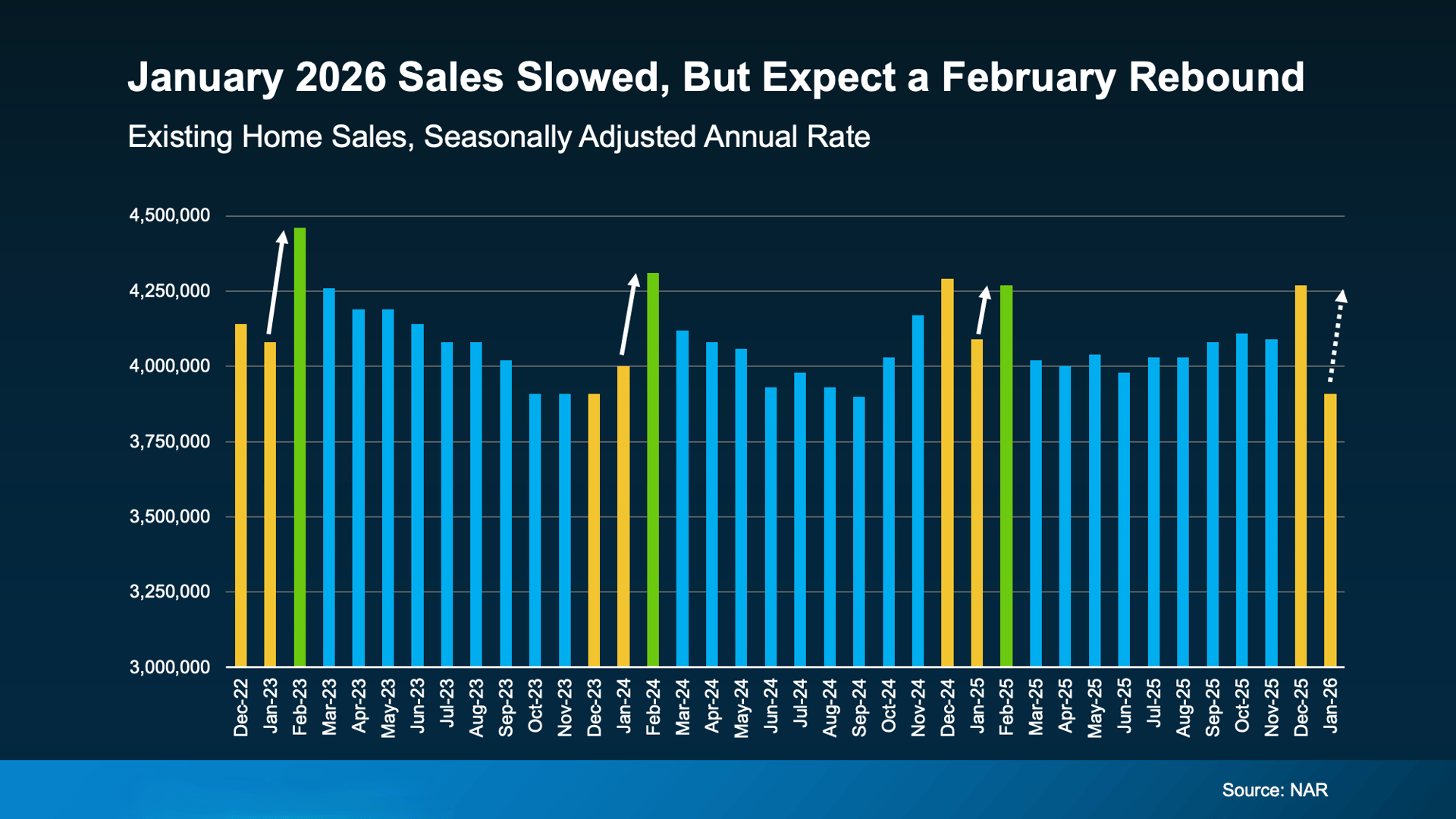
Yes, home sales declined in January. But that has far more to do with seasonality and winter weather than a sudden drop in buyer demand.
Let’s break it down.
According to the National Association of Realtors (NAR), existing home sales fell about 8.4% compared to the previous month.
On its own, that sounds concerning.
But historically, January is one of the slowest months of the year for home sales. In fact, sales have dipped in January in most of the past several years. It’s a seasonal pattern, not a warning sign.
And while this year’s dip was a bit steeper than average, there’s a clear reason for that too.
Realtor.com pointed to Winter Storm Fern, which brought snow and ice to 40 states. When large portions of the country are dealing with severe weather, real estate activity naturally slows down.
Inspections get postponed. Appraisals get delayed. Final walk-throughs are rescheduled. Closings slide into the next month.
It’s important to remember: existing home sales measure closed transactions, not signed contracts. So if weather pushes a closing back a few weeks, it shows up as a dip even though the deal is still moving forward.
In many cases, those sales aren’t lost. They’re simply postponed.
History gives us a clear pattern.
After January’s typical slowdown, activity tends to rebound in February as the spring market begins to ramp up. Buyers re-engage. Listings increase. Momentum builds.
And this year, several broader trends still support a healthier market:
Affordability has improved for seven consecutive months.
Mortgage rates are lower than they were a year ago.
Inventory has increased, giving buyers more options and restoring negotiating power in many markets.
Those aren’t signs of a market losing steam. They’re signs of stabilization.
One weather-impacted month doesn’t define the year.
Real estate moves in cycles, and January has always been a transitional period between the holidays and the spring market. When weather disruptions are layered on top of normal seasonality, the numbers can look dramatic even when underlying demand remains steady.
If you’re planning to sell, what matters more than one monthly report is:
Buyer activity heading into spring
Local inventory levels
Pricing strategy in your specific market
That’s where real opportunity lies.
Don’t confuse a seasonal, weather-impacted slowdown with a market decline.
January’s dip is far more about timing than trouble. As temperatures warm up, activity typically does too.
If you’re hearing conflicting headlines and want clarity about what’s happening in your local market, connect with a trusted real estate professional. A little context goes a long way.
Amber Johnson, Founder
Pillar Real Estate
805.835.3425
[email protected]
1345 Park St. Paso Robles, CA 93446
DRE# 01925434

Amber Johnson | August 21, 2026

Amber Johnson | August 21, 2026

Amber Johnson | August 21, 2026

Amber Johnson | August 21, 2026

Amber Johnson | August 21, 2026

Amber Johnson | August 21, 2026

Amber Johnson | August 21, 2026

Amber Johnson | August 20, 2026

Amber Johnson | August 20, 2026
You’ve got questions and we can’t wait to answer them.

Amber Johnson, Founder
Pillar Real Estate
805.835.3425
DRE# 01925434
1345 Park Street
Paso Robles, CA 93446